> ## Documentation Index
> Fetch the complete documentation index at: https://reactionrepo.com/llms.txt
> Use this file to discover all available pages before exploring further.

# Arrow-Pushing Guide

> Quick Guide to Arrow-Pushing and Key Reactions

## Goals

hi

## Types of Arrows in Mechanisms

<div className="text-center">
  <div>
    <img className="block dark:hidden" src="https://mintcdn.com/reactionrepo-bd9a1c17/AqE5enEskAdOSf_C/images/1e%20vs%202elight.png?fit=max&auto=format&n=AqE5enEskAdOSf_C&q=85&s=6b3a04ec3e35c6601f950427ba781193" alt="Hero Light" title="" width="768" height="361" data-path="images/1e vs 2elight.png" />

    <img className="hidden dark:block" src="https://mintcdn.com/reactionrepo-bd9a1c17/AqE5enEskAdOSf_C/images/1e%20vs%202edark.png?fit=max&auto=format&n=AqE5enEskAdOSf_C&q=85&s=c0e6414bf34ba570c0bc537e264a751e" alt="Hero Dark" title="" width="768" height="361" data-path="images/1e vs 2edark.png" />
  </div>

  <p className="mt-2 text-sm font-bold text-gray-600 dark:text-gray-400">
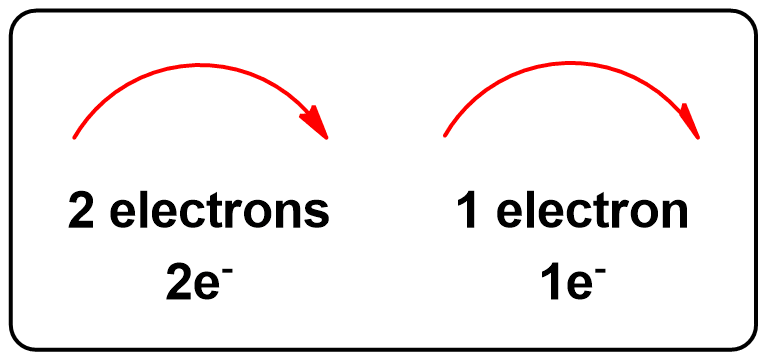
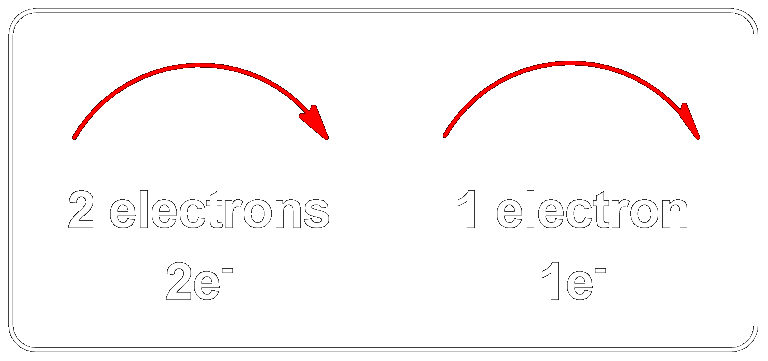
    The Two Types of Arrows used in Mechanisms.
  </p>

  <p className="mt-2 text-sm text-gray-600 dark:text-gray-400">
    Representation of electron movement: Representation of electron movement: **two-electron (1 bond) processes (Full-arrow →) vs. one-electron (half bond) processes (Half-arrow ↷)**.
  </p>
</div>

In organic and inorganic mechanisms, arrows are used to show **electron movement**.

### Full Arrows (→)

A **full curved arrow** represents the movement of **two electrons**, usually in **bond formation or breaking**. This applies to:

* Nucleophilic attacks
* Resonance structures
* Electrophilic and nucleophilic reactions
  * Nucleophiles **attack electrophiles** by donating an electron pair to form a new bond.
  * Electrophiles **receive the  nucleophillic attack** to accept an electron pair to form a new bond.

<Note> Nucleophiles donate electron pairs (electron-rich) vs. Electrophiles accept electron pairs (electron-poor).</Note>

### Half Arrows (↷)

A **half-arrow** represents the movement of **one electron**, commonly seen in:

* Radical reactions
* Homolytic bond cleavage
* Radical propagation steps

<Note> There will be lots of examples in the entries of Reaction Repo of all reactions mentioned </Note>

## Applications of the Arrows

### Bond Formation

#### Full Arrow

#### Half Arrow

### Forming Resonance Structures

<div className="text-center">
  <div>
    <img className="block dark:hidden" src="https://mintcdn.com/reactionrepo-bd9a1c17/FPrB1cWcGMz1Cyel/reactions/swern-oxidation/step0light.png?fit=max&auto=format&n=FPrB1cWcGMz1Cyel&q=85&s=228850e61b13077882df90dbce5bb273" alt="Hero Light" title="" width="756" height="290" data-path="reactions/swern-oxidation/step0light.png" />

    <img className="hidden dark:block" src="https://mintcdn.com/reactionrepo-bd9a1c17/FPrB1cWcGMz1Cyel/reactions/swern-oxidation/step0dark.png?fit=max&auto=format&n=FPrB1cWcGMz1Cyel&q=85&s=7b4ae1a872d39f8e8f0b3e8cb0dd1d7d" alt="Hero Dark" title="" width="756" height="290" data-path="reactions/swern-oxidation/step0dark.png" />
  </div>

  <p className="mt-2 text-sm font-bold text-gray-600 dark:text-gray-400">
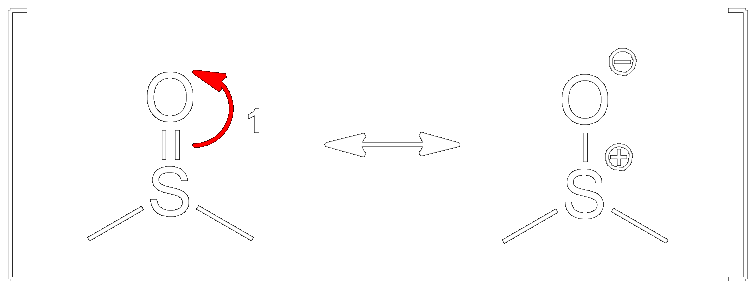
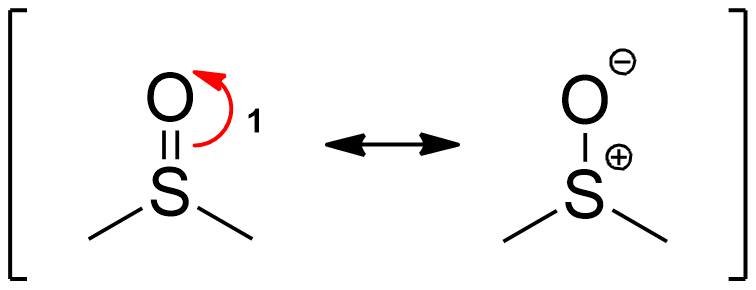
    Resonance forms of DMSO.
  </p>

  <p className="mt-2 text-sm text-gray-600 dark:text-gray-400">
    DMSO is capable of undergoing resonance. The first step (1) towards the [Swern Oxidation](https://reactionrepo.mintlify.app/reactions/swern-oxidation/oxidation-with-oxalyl-chloride#oxidation-with-oxalyl-chloride)
  </p>
</div>

DMSO undergoes resonance, which is represented using a full arrow, indicating the movement of two electrons (one bond). This differs from one-electron processes (shown by half-arrows). The electron pair from the S=O double bond shifts toward oxygen, converting it into a single bond. Since oxygen gains an extra lone pair, it takes on a negative formal charge, while sulfur loses electron density, resulting in a positive charge.