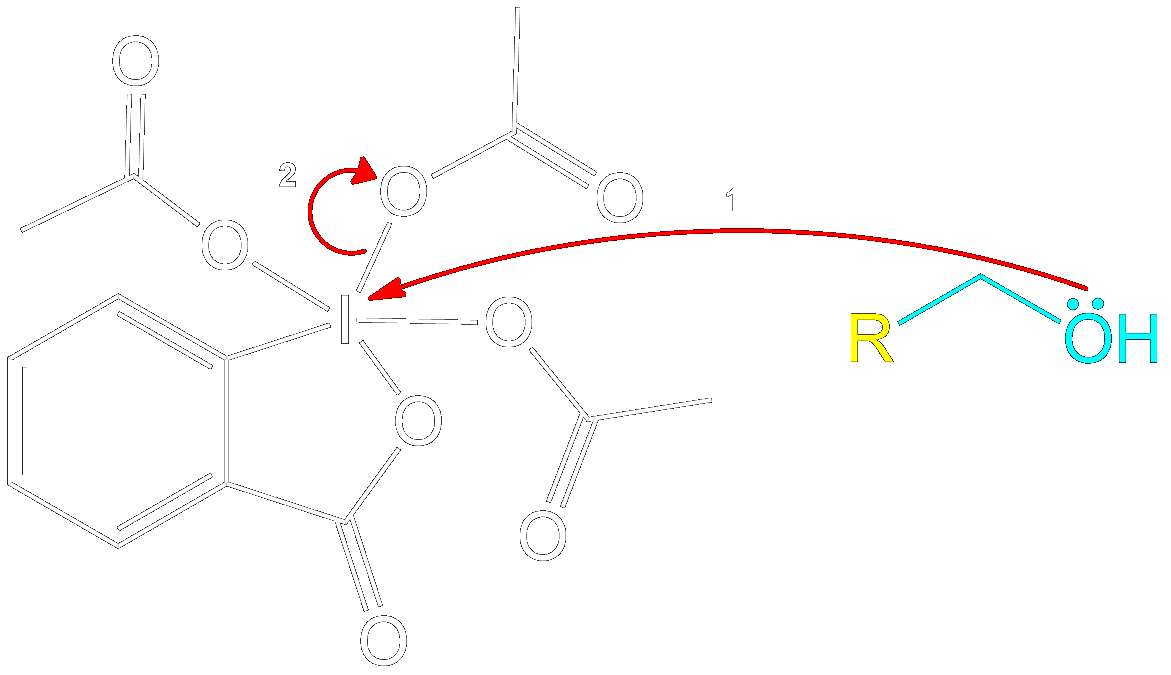
> ## Documentation Index
> Fetch the complete documentation index at: https://reactionrepo.com/llms.txt
> Use this file to discover all available pages before exploring further.

# Oxidation without Water

> Mild Oxidation Method without Water

<a href="https://doi.org/10.1021/ja8071918" target="_blank" rel="noopener noreferrer">
  <img noZoom className="block dark:hidden -mt-0" src="https://mintcdn.com/reactionrepo-bd9a1c17/AqE5enEskAdOSf_C/images/DMPOverviewLightFix.png?fit=max&auto=format&n=AqE5enEskAdOSf_C&q=85&s=4da0a5c090ba31b932a1dd733e3d4780" alt="Hero Light" width="1363" height="740" data-path="images/DMPOverviewLightFix.png" />

  <img noZoom className="hidden dark:block -mt-0" src="https://mintcdn.com/reactionrepo-bd9a1c17/AqE5enEskAdOSf_C/images/DMPOverviewDarkFix.png?fit=max&auto=format&n=AqE5enEskAdOSf_C&q=85&s=72036ba39afdc3bca274ca4ab5b974ca" alt="Hero Dark" width="1363" height="741" data-path="images/DMPOverviewDarkFix.png" />
</a>

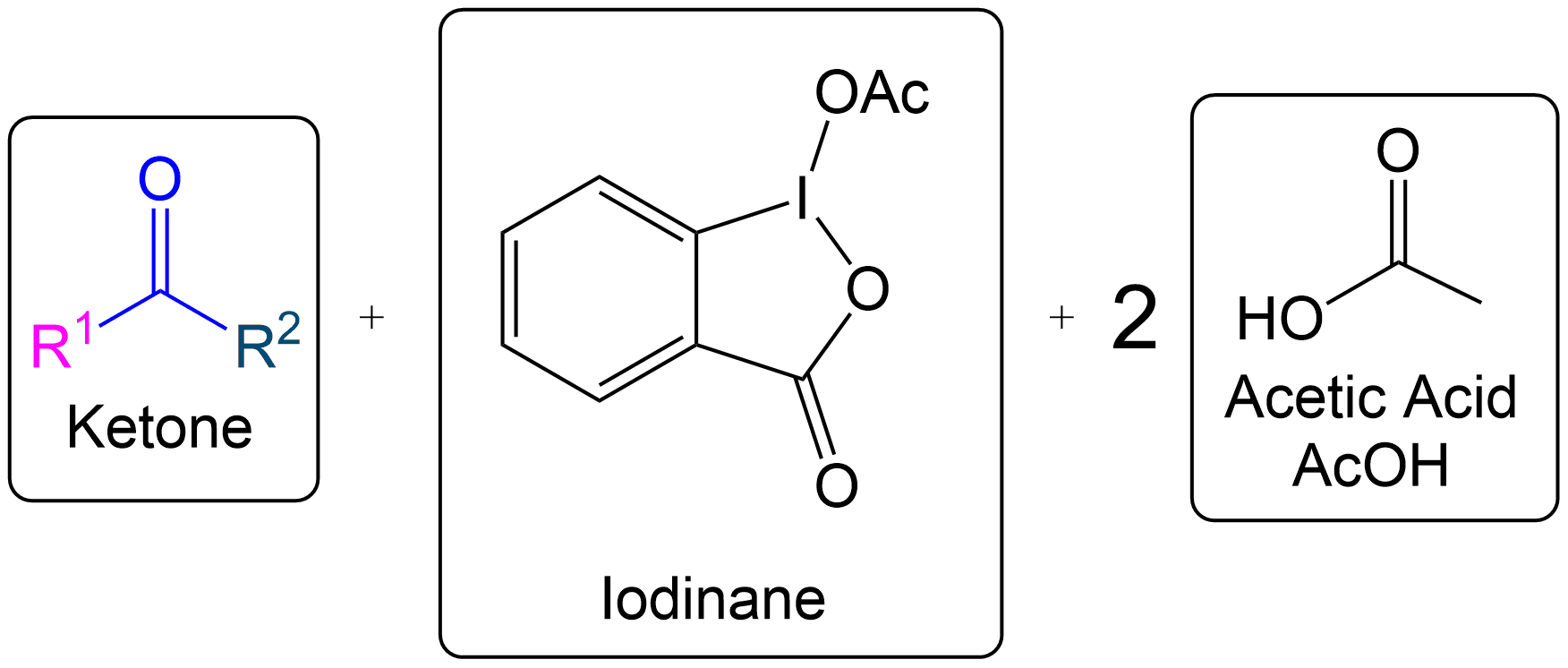
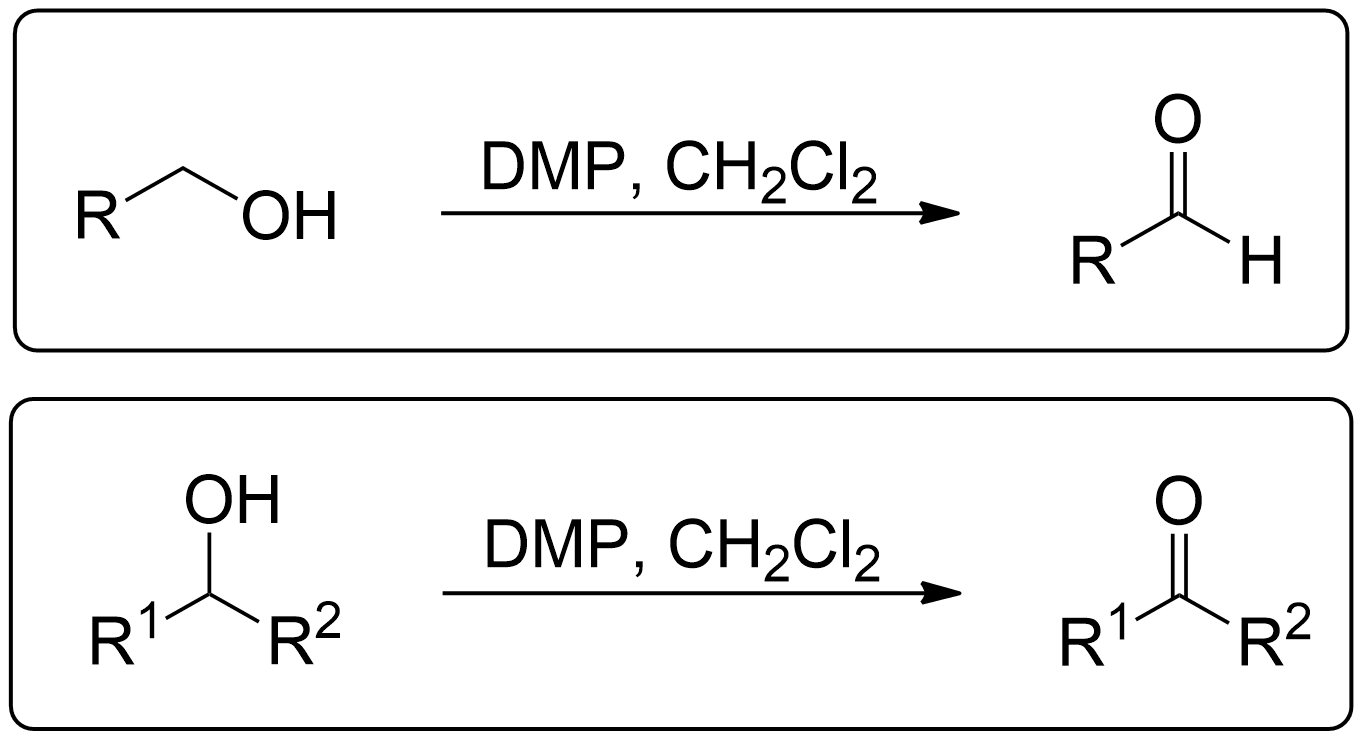
The Dess-Martin oxidation is a method used to oxidize primary alcohols to aldehydes and secondary alcohols to ketones using the Dess-Martin periodinane (DMP). <sup>**1**</sup>

## Finding the Product for a 1° Alcohol

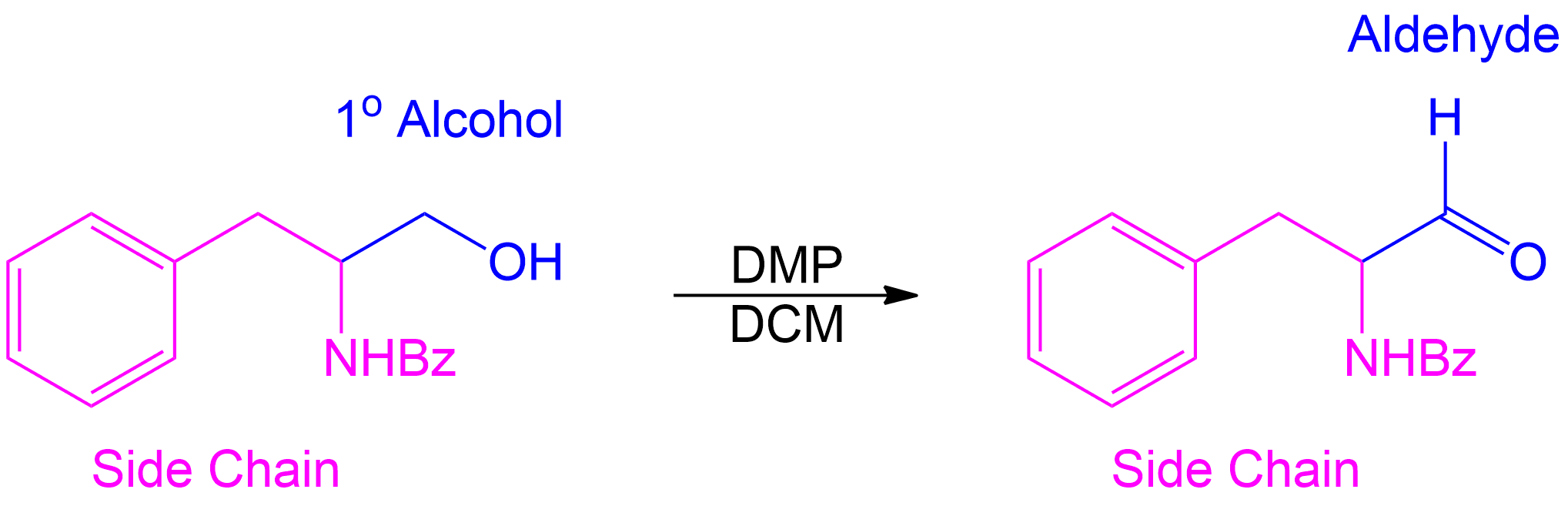
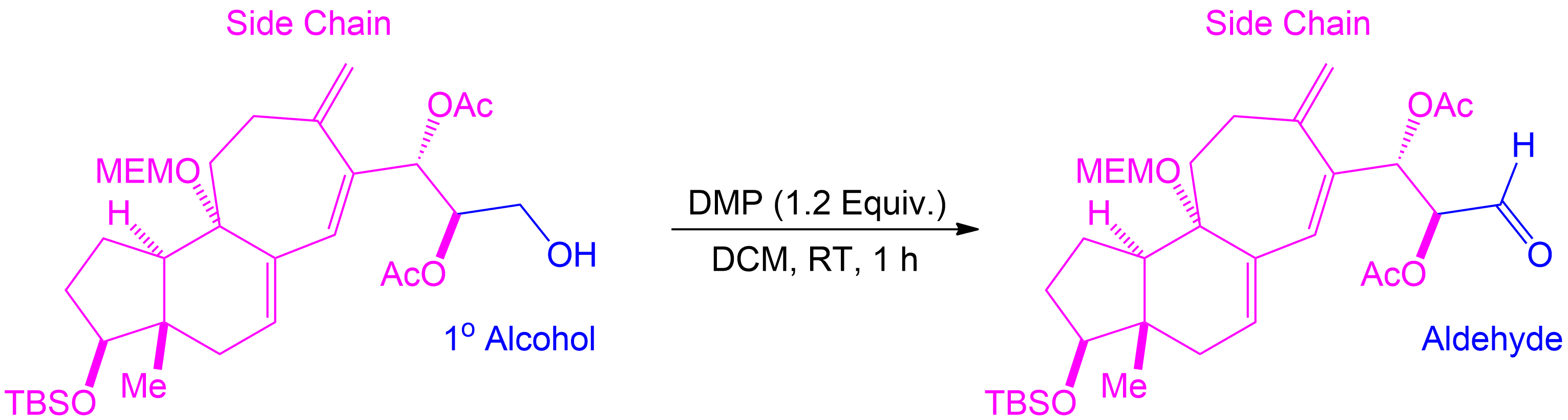
This section is a brief overview on how to find the product for a 1° Alcohol (Primary) using a example from a real scientific research paper.
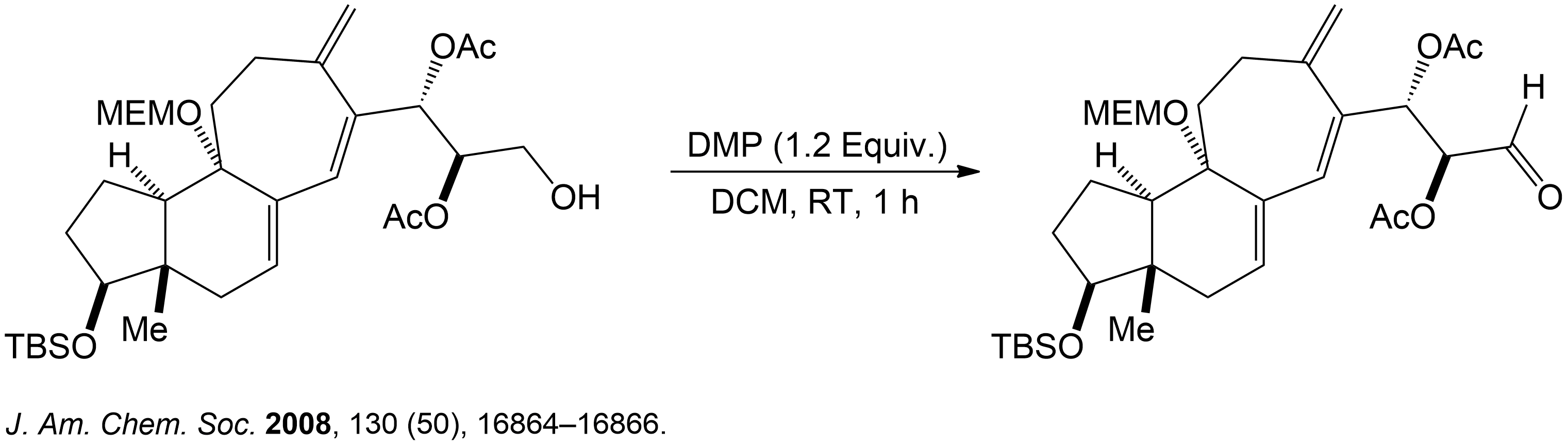
<div className="text-center">
  <div>
    <img className="block dark:hidden" src="https://mintcdn.com/reactionrepo-bd9a1c17/AqE5enEskAdOSf_C/images/DMPPrimaryExampleQ1Light.png?fit=max&auto=format&n=AqE5enEskAdOSf_C&q=85&s=67165b3f9a5988032675f88a60167b73" alt="Hero Light" title="DMP Oxidation (Light Mode)" width="3042" height="866" data-path="images/DMPPrimaryExampleQ1Light.png" />

    <img className="hidden dark:block" src="https://mintcdn.com/reactionrepo-bd9a1c17/AqE5enEskAdOSf_C/images/DMPPrimaryExampleQ1Dark.png?fit=max&auto=format&n=AqE5enEskAdOSf_C&q=85&s=127bc7da4caf68d6e4a258bab0c62e08" alt="Hero Dark" title="DMP Oxidation (Dark Mode)" width="3042" height="866" data-path="images/DMPPrimaryExampleQ1Dark.png" />
  </div>

  <p className="mt-2 text-sm font-bold text-gray-600 dark:text-gray-400">
    Propose a Mechanism.
  </p>
</div>

<AccordionGroup>
  <Accordion title="Where did this Reaction come from?">
    <div className="text-center">
      <div>
        <a href="https://pubs.acs.org/doi/10.1021/ja8071918" target="_blank" rel="noopener noreferrer">
          <img noZoom className="block dark:hidden" src="https://mintcdn.com/reactionrepo-bd9a1c17/AqE5enEskAdOSf_C/images/DMPCortistatin1LBox.png?fit=max&auto=format&n=AqE5enEskAdOSf_C&q=85&s=81b9d7369891e13b171e6c4b953008ae" alt="Hero Light" title="" width="3070" height="869" data-path="images/DMPCortistatin1LBox.png" />

          <img noZoom className="hidden dark:block" src="https://mintcdn.com/reactionrepo-bd9a1c17/AqE5enEskAdOSf_C/images/DMPCortistatin1DBox.png?fit=max&auto=format&n=AqE5enEskAdOSf_C&q=85&s=e21d847401e9a306a33f1da6768173f3" alt="Hero Dark" title="" width="3070" height="877" data-path="images/DMPCortistatin1DBox.png" />
        </a>
      </div>

      <p className="mt-2 text-sm font-bold text-gray-600 dark:text-gray-400">
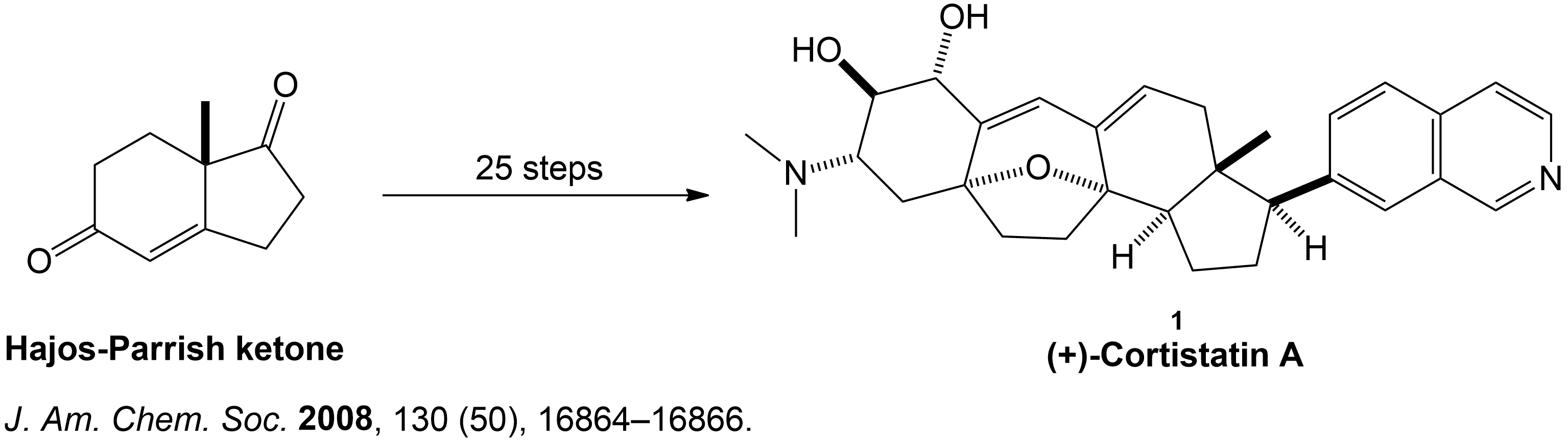
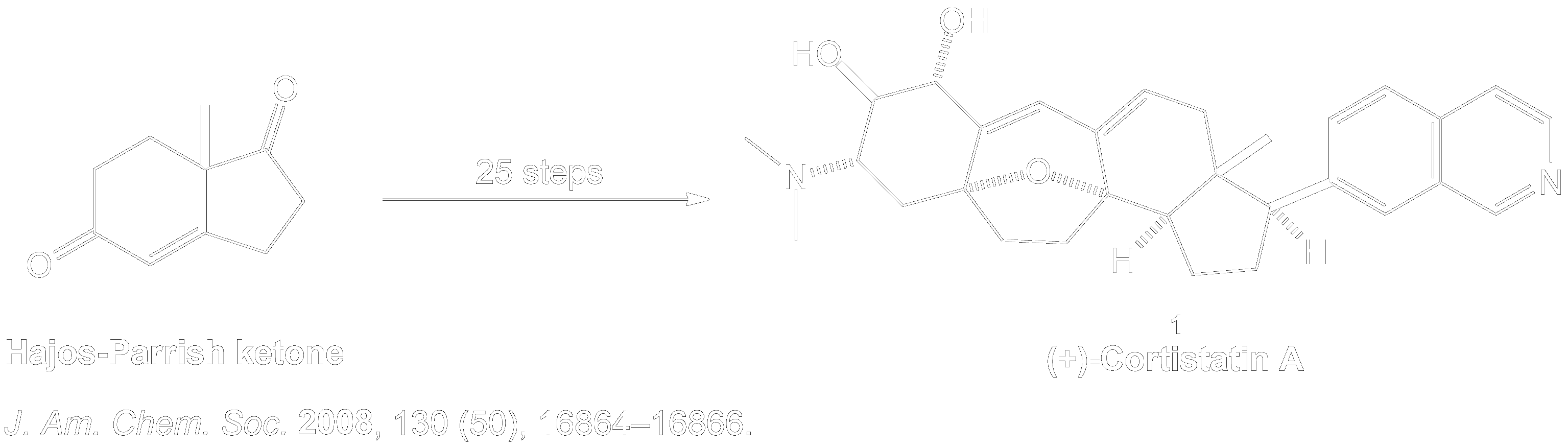
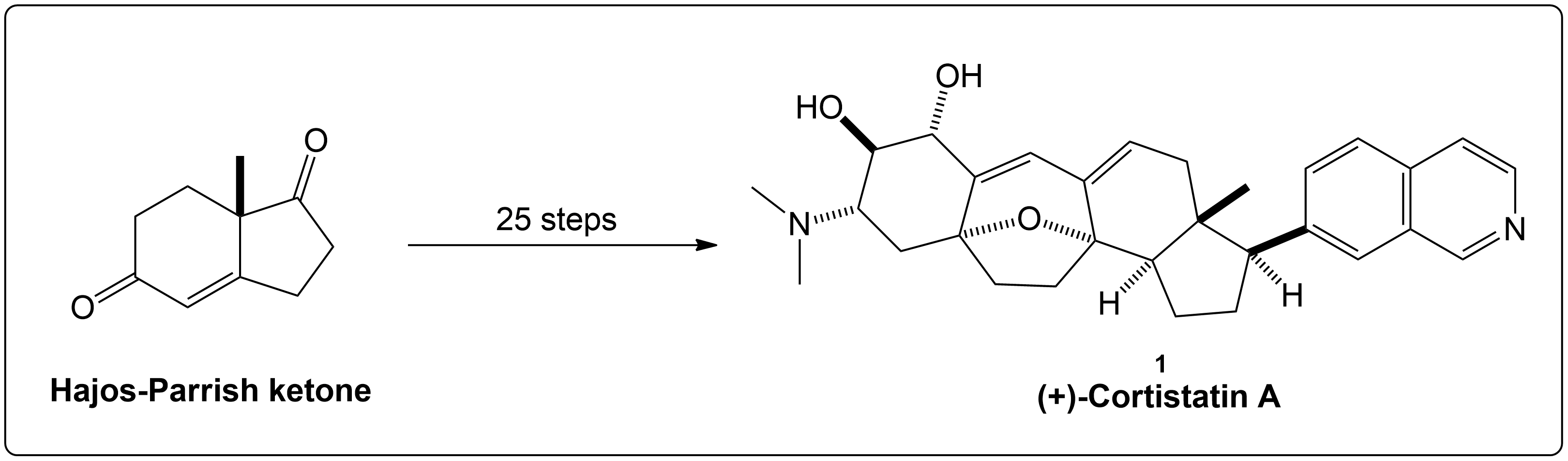
        Condensed Synthesis Overview of (+)-Cortistatin A from Hajos-Parrish Ketone.
      </p>

      <p className="mt-2 text-sm text-gray-600 dark:text-gray-400">
        The overall synthesis of (+)-Cortistatin A started with an enantiomerically pure Hajos-Parrish ketone undergoing key reactions such as diastereoselective hydrogenation, Rubottom oxidation, the Dess-Martin oxidation and other types of reactions to eventually form the target compound (+)-Cortistatin A. This occurs over a 26 step synthesis pathway.
      </p>
    </div>

    For simplicity, this image summarizes the start and end products of the synthesis in the original paper by [Lee et al. (2008)](https://pubs.acs.org/doi/10.1021/ja8071918), highlighting the step count and reaction materials. The full pathway is not shown to maintain clarity and focus on building towards when Dess-Martin oxidation is used.
  </Accordion>

  <Accordion title="How is Dess-Martin Oxidation used?">
    <div className="text-center">
      <div>
        <a href="https://pubs.acs.org/doi/10.1021/ja8071918" target="_blank" rel="noopener noreferrer">
          <img noZoom className="block dark:hidden" src="https://mintcdn.com/reactionrepo-bd9a1c17/AqE5enEskAdOSf_C/images/CortistatinOxidationL.png?fit=max&auto=format&n=AqE5enEskAdOSf_C&q=85&s=69a652e9222083f899aedcf102df1131" alt="Hero Light" title="" width="3212" height="975" data-path="images/CortistatinOxidationL.png" />

          <img noZoom className="hidden dark:block" src="https://mintcdn.com/reactionrepo-bd9a1c17/AqE5enEskAdOSf_C/images/CortistatinOxidationD.png?fit=max&auto=format&n=AqE5enEskAdOSf_C&q=85&s=e44df7ebd893a5c86ce120e2ee72d175" alt="Hero Dark" title="" width="3212" height="975" data-path="images/CortistatinOxidationD.png" />
        </a>
      </div>

      <p className="mt-2 text-sm font-bold text-gray-600 dark:text-gray-400">
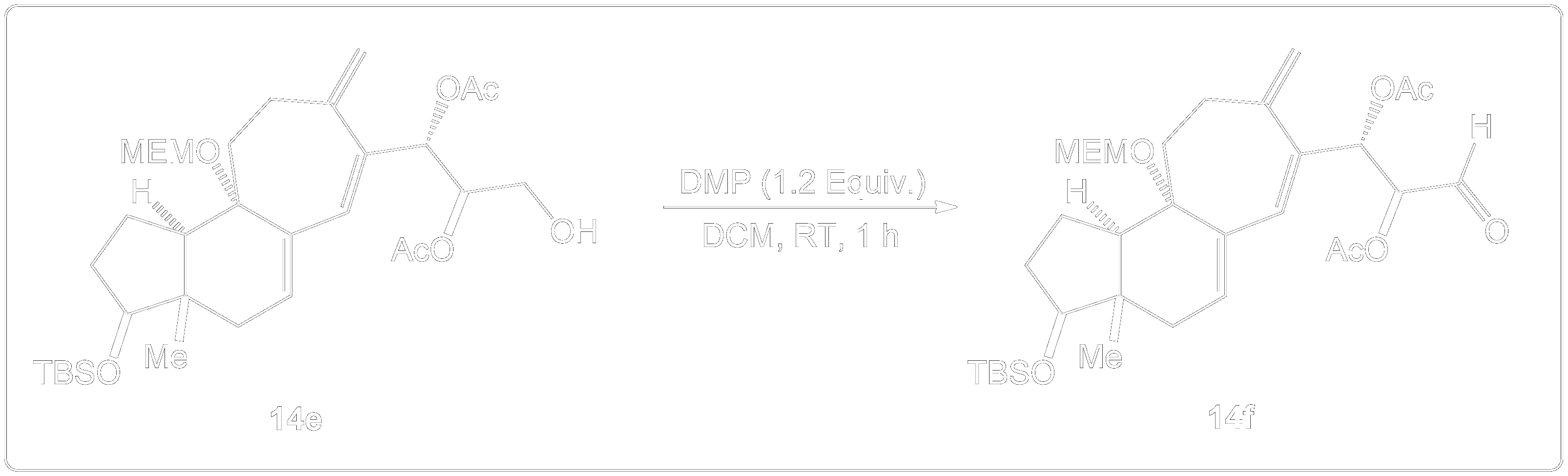
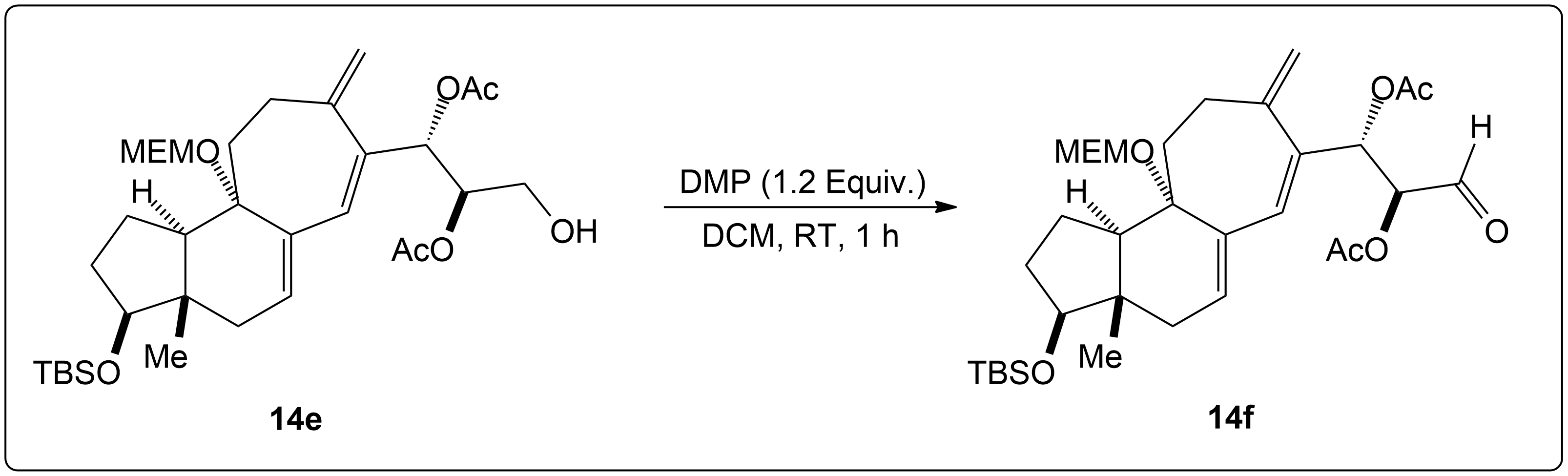
        Dess-Martin Oxidation Usage in Intermediate Formation.
      </p>

      <p className="mt-2 text-sm text-gray-600 dark:text-gray-400">
        This reaction showing the Dess-Martin oxidation of this alcohol intermediate was part of the overall synthesis pathway of the formation of (+)-Cortistatin A. (+)-Cortistatin A is a potent inhibitor of endothelial cell proliferation. This compound was synthesized through the conversion of an enantiomerically pure Hajos-Parrish ketone to a known enone and then to a silyloxydiene intermediate. <sup>**2**</sup>
      </p>
    </div>

    A crucial step in this multi-step process, as depicted above, was the oxidation of a primary alcohol intermediate (14e) formed in the overall synthesis pathway. The alcohol intermediate was converted to an aldehyde intermediate using Dess-Martin periodinane (DMP) (1.2 equiv) in dichloromethane (DCM) at room temperature for 1 hour. The resulting aldehyde intermediate (14f) was then further utilized in subsequent steps towards the total synthesis of (+)-Cortistatin A. <sup>**2**</sup>
  </Accordion>
</AccordionGroup>

<Steps>
  <Step title="Identify the Right Reagents">
    <img className="block dark:hidden" src="https://mintcdn.com/reactionrepo-bd9a1c17/AqE5enEskAdOSf_C/images/ReagentsDMP.png?fit=max&auto=format&n=AqE5enEskAdOSf_C&q=85&s=a1a874af7ae39a5c98dc972ded3f21c1" alt="Hero Light" width="1382" height="952" data-path="images/ReagentsDMP.png" />

    <img className="hidden dark:block" src="https://mintcdn.com/reactionrepo-bd9a1c17/AqE5enEskAdOSf_C/images/ReagentsDMPdark.png?fit=max&auto=format&n=AqE5enEskAdOSf_C&q=85&s=e333364608d36b5b5b5888aea4a880c5" alt="Hero Dark" width="1384" height="954" data-path="images/ReagentsDMPdark.png" />

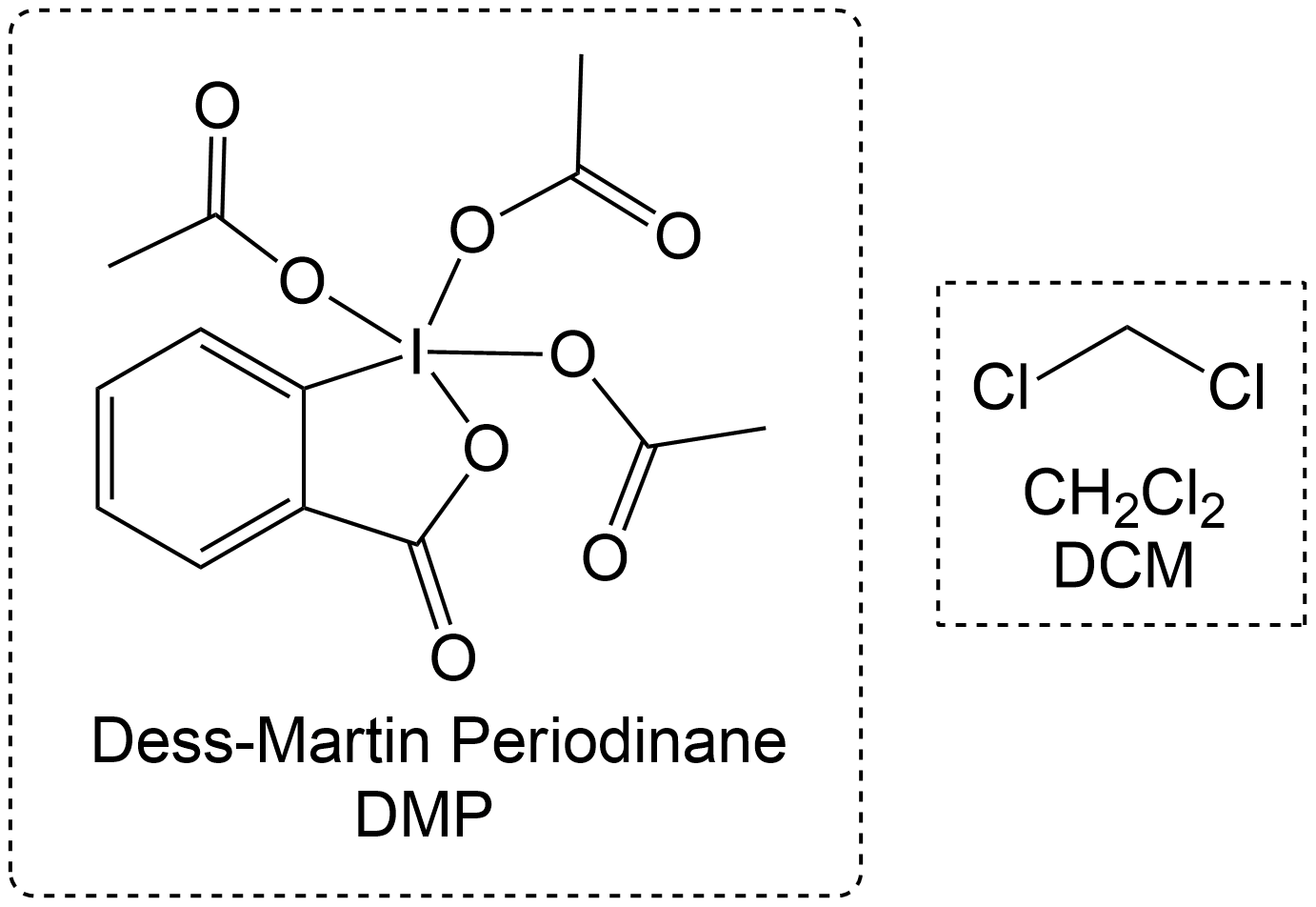
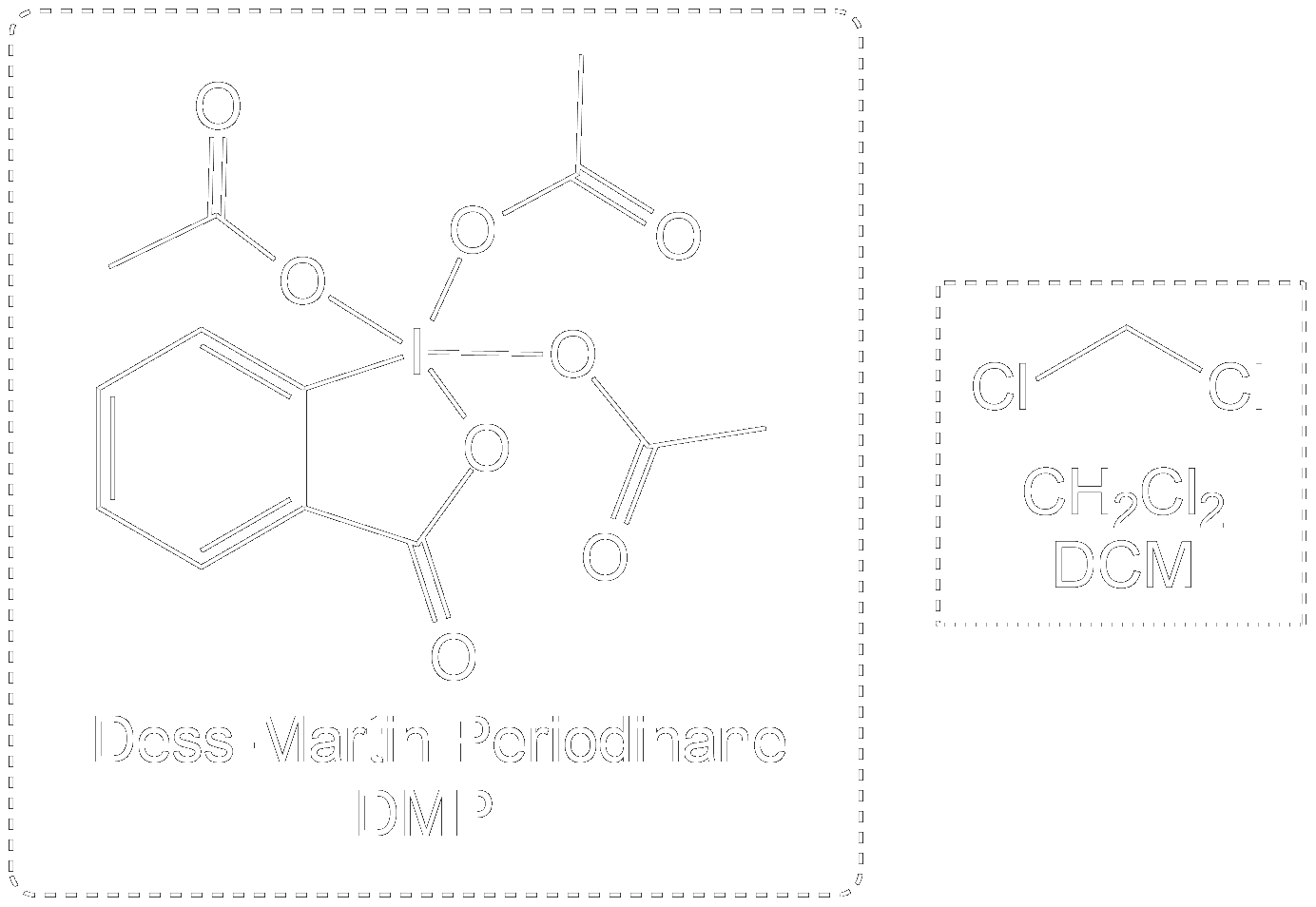
    Often times, Dess Martin Oxidation is always performed with DMP and a solvent. Usually DMP prefers DCM as a solvent it is highly soluble in DCM. This applies to both primary and secondary alcohol oxidations.
    <Note> If you did not read the [**Reagent Variations section**](/reactionrepo/docs/oxidation-reactions/dess-martin-oxidation/#reagent-variations) on the Dess-Martin Oxidation Overview, please check it out. It is highly recommended to review the information as it covers the variations and key characteristics of key Dess-Martin periodinane (DMP). </Note>
  </Step>

  <Step title="Identify the Key Features of the Compound">
    **Alcohol Type**

    <img className="block dark:hidden" src="https://mintcdn.com/reactionrepo-bd9a1c17/AqE5enEskAdOSf_C/images/AlcoholsNewR3Light.png?fit=max&auto=format&n=AqE5enEskAdOSf_C&q=85&s=913acf540038c272446708b204907ee0" alt="Hero Light" width="1221" height="510" data-path="images/AlcoholsNewR3Light.png" />

    <img className="hidden dark:block" src="https://mintcdn.com/reactionrepo-bd9a1c17/AqE5enEskAdOSf_C/images/AlcoholsNewR3Dark.png?fit=max&auto=format&n=AqE5enEskAdOSf_C&q=85&s=3784939b56dea47d0ef01be8e6342cdc" alt="Hero Dark" width="1221" height="503" data-path="images/AlcoholsNewR3Dark.png" />

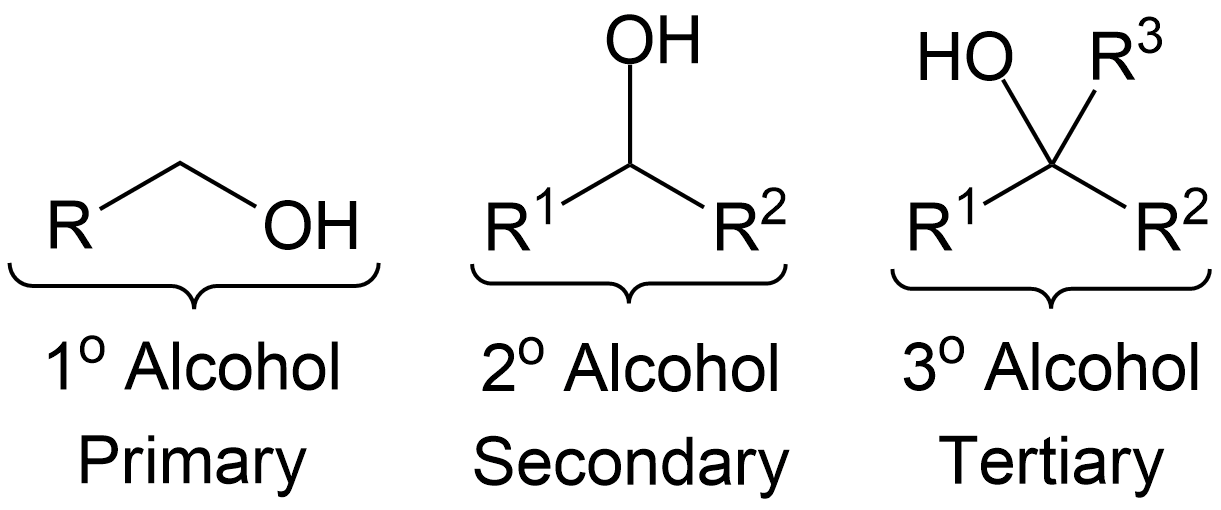
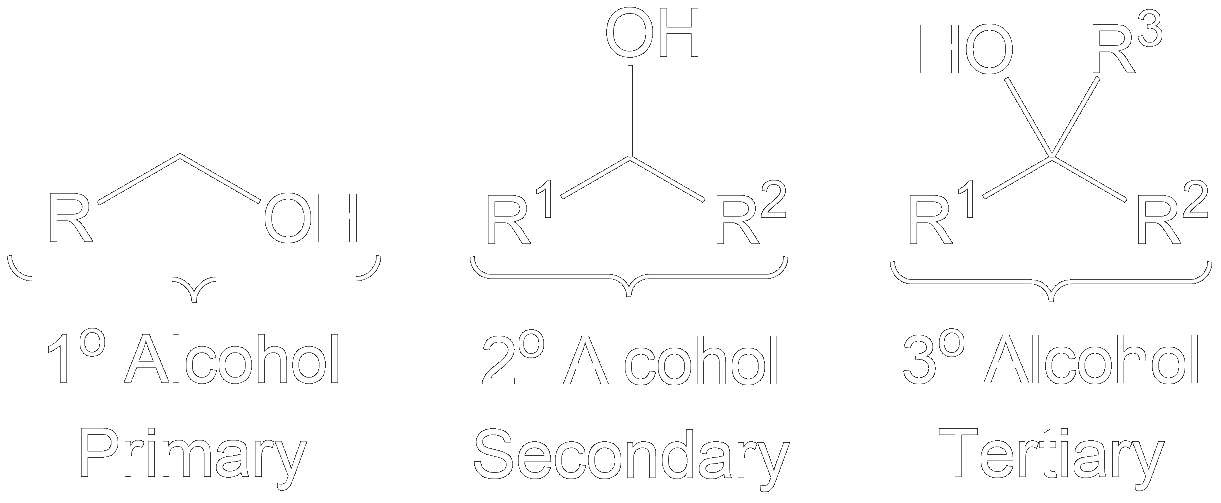
    These are the 3 main types of alcohols:

    * Primary
    * Secondary
    * Tertiary
    <Warning> Tertiary alcohols cannot go through Dess-Martin oxidation. </Warning>

    * Primary alcohols can go through Dess-Martin Oxidation to become an **Aldehyde**.

    By identifying the Alcohol Type, you now know the **product** to expect.
  </Step>

  <Step title="Identifying Side Chains and Alcohol Conversion">
    <div className="text-center">
      <div>
        <img className="block dark:hidden" src="https://mintcdn.com/reactionrepo-bd9a1c17/AqE5enEskAdOSf_C/images/DMPPrimaryExampleQ1LightHighlighted.png?fit=max&auto=format&n=AqE5enEskAdOSf_C&q=85&s=35470ca3fa98c6b8e5fe7157206f86fc" alt="Hero Light" title="" width="3062" height="821" data-path="images/DMPPrimaryExampleQ1LightHighlighted.png" />

        <img className="hidden dark:block" src="https://mintcdn.com/reactionrepo-bd9a1c17/AqE5enEskAdOSf_C/images/DMPPrimaryExampleQ1DarkHighlighted.png?fit=max&auto=format&n=AqE5enEskAdOSf_C&q=85&s=d25cb6d104d476a4392efd2f68b42be6" alt="Hero Dark" title="" width="3062" height="821" data-path="images/DMPPrimaryExampleQ1DarkHighlighted.png" />
      </div>

      <p className="mt-2 text-sm font-bold text-gray-600 dark:text-gray-400">
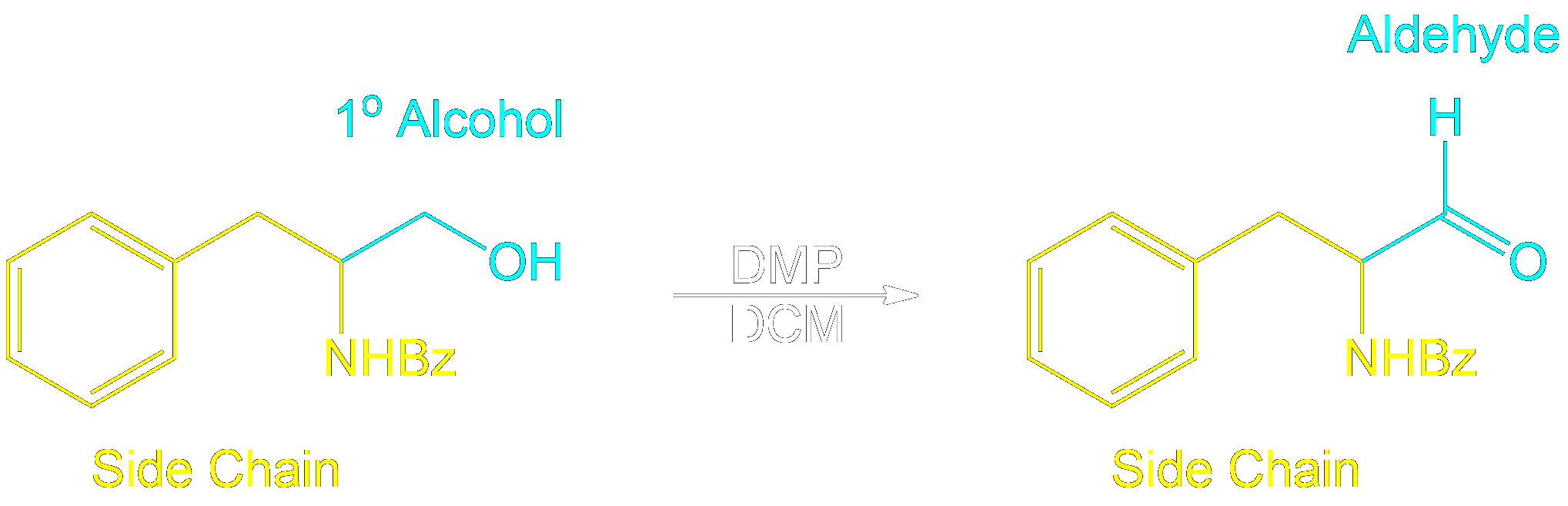
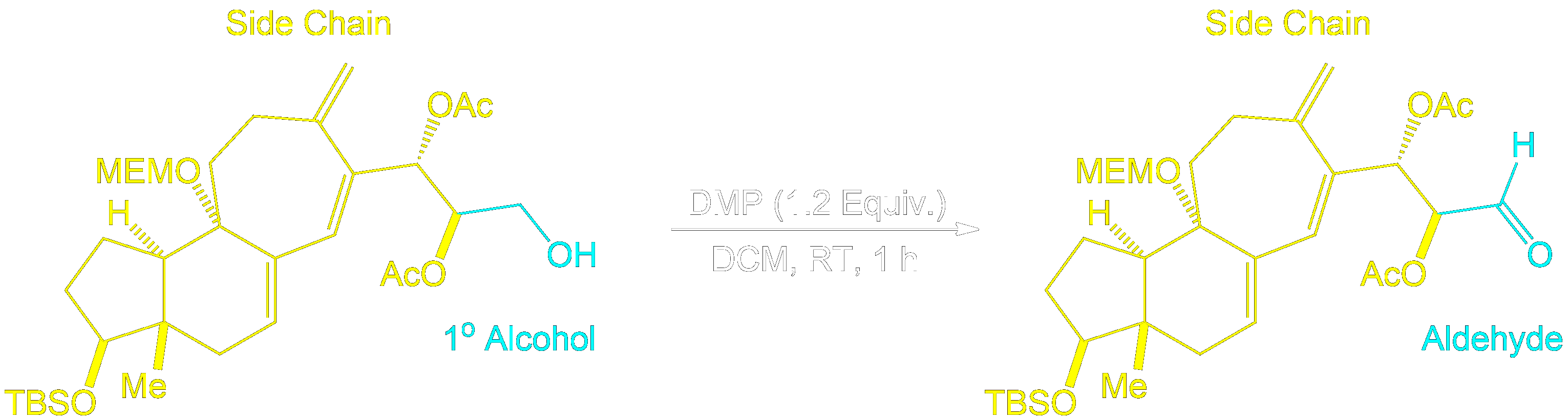
        Tracking Side Chains and Alcohol Conversion.
      </p>

      <p className="mt-2 text-sm text-gray-600 dark:text-gray-400">
        In Dess-Martin oxidation of primary alcohols, the process involves assigning one side chain (R) to understand the reaction better.
      </p>
    </div>

    The colored side chain represents an R group that remains unchanged during the reaction. The alcohol group is selectively oxidized to form an aldehyde. For educational purposes, we conceptually assign the non-alcohol group as R (Side chain) to visualize the changes and reconstruct the molecule post-reaction.

    <Tip>The molecule isn’t taken apart during the reaction, but for understanding the process, we conceptually take it apart to visualize the changes. This allows for easy reconstruction of the molecule after oxidation, emphasizing the selective nature of the reaction for educational purposes.</Tip>

    **Guide to Side Chains**

    1. **Assign the Side Chain (R)**: Identify the non-alcohol part of the molecule and assign it as the placeholder 'R' or side chain.

    2. **Understand Its Role**: This placeholder helps track the unchanged part of the molecule, aiding in visualizing the structure before and after the reaction.

    3. **Focus on the Reaction Center**: The primary alcohol is selectively oxidized to form an aldehyde. The placeholder shows how the structure is altered.

    4. **Reassign the Side Chain**: After the reaction, reattach the placeholder R to the new aldehyde, demonstrating the unchanged nature of the side chain.

    **Disclaimer Warning for Writing Products**

    <div className="text-center">
      <div>
        <img className="block dark:hidden" src="https://mintcdn.com/reactionrepo-bd9a1c17/AqE5enEskAdOSf_C/images/AldehydesWrittenL.png?fit=max&auto=format&n=AqE5enEskAdOSf_C&q=85&s=82f3c0e59a785df7122a10880585805e" alt="Hero Light" title="" width="1319" height="349" data-path="images/AldehydesWrittenL.png" />

        <img className="hidden dark:block" src="https://mintcdn.com/reactionrepo-bd9a1c17/AqE5enEskAdOSf_C/images/AldehydesWrittenD.png?fit=max&auto=format&n=AqE5enEskAdOSf_C&q=85&s=00e11eaa85db40db290be57c7787cb1b" alt="Hero Dark" title="" width="1319" height="349" data-path="images/AldehydesWrittenD.png" />
      </div>

      <p className="mt-2 text-sm font-bold text-gray-600 dark:text-gray-400">
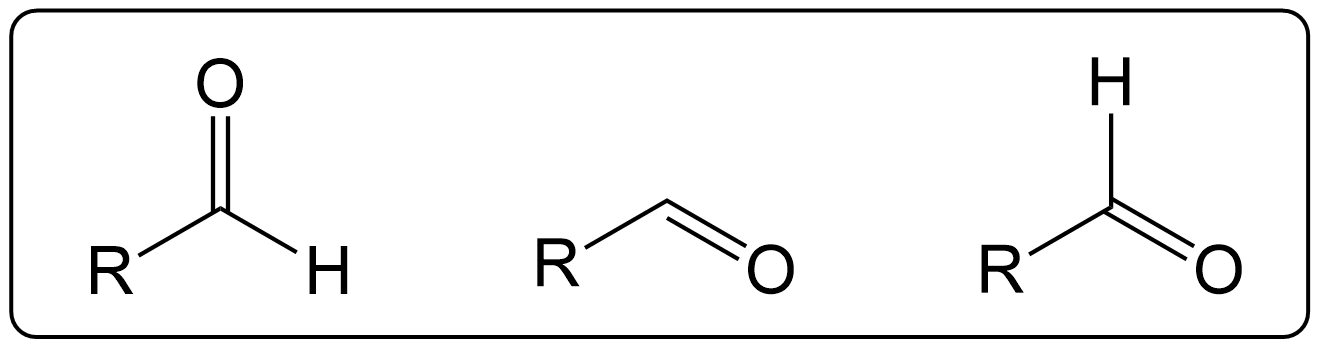
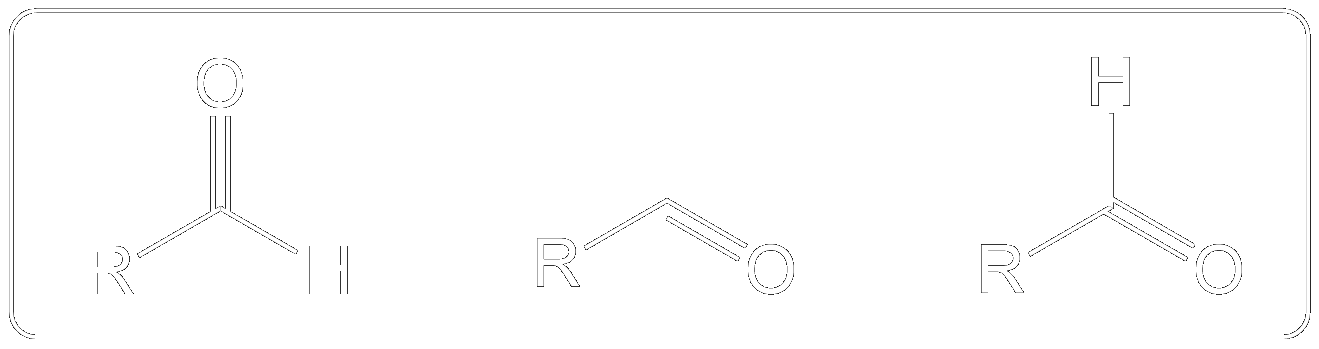
        Variations on how Aldehydes may appear.
      </p>

      <p className="mt-2 text-sm text-gray-600 dark:text-gray-400">
        They may be differently presented in different questions as shown in the image, however they are the same structure.
      </p>
    </div>

    Once you've identified the correct reaction and product, you can now proceed to doing the mechanism.
  </Step>
</Steps>

## Mechanism for 1° Alcohol

This section is a brief overview on how to perform the mechanism for a 1° Alcohol (Primary) using the example from above.

<Steps>
  <Step title="Reactive Intermediate Formation">
    <div className="text-center">
      <div>
        <img className="block dark:hidden" src="https://mintcdn.com/reactionrepo-bd9a1c17/TM754FnBSgoPYglU/images/dmpstep1light.png?fit=max&auto=format&n=TM754FnBSgoPYglU&q=85&s=83ecc4a3d9d593223b29ac964f57d8a7" alt="Hero Light" title="" width="1172" height="675" data-path="images/dmpstep1light.png" />

        <img className="hidden dark:block" src="https://mintcdn.com/reactionrepo-bd9a1c17/AqE5enEskAdOSf_C/images/dmpstep1dark.png?fit=max&auto=format&n=AqE5enEskAdOSf_C&q=85&s=07aa3b6c4474bfe1ca294c64142ceae7" alt="Hero Dark" title="" width="1171" height="675" data-path="images/dmpstep1dark.png" />
      </div>

      <p className="mt-2 text-sm font-bold text-gray-600 dark:text-gray-400">
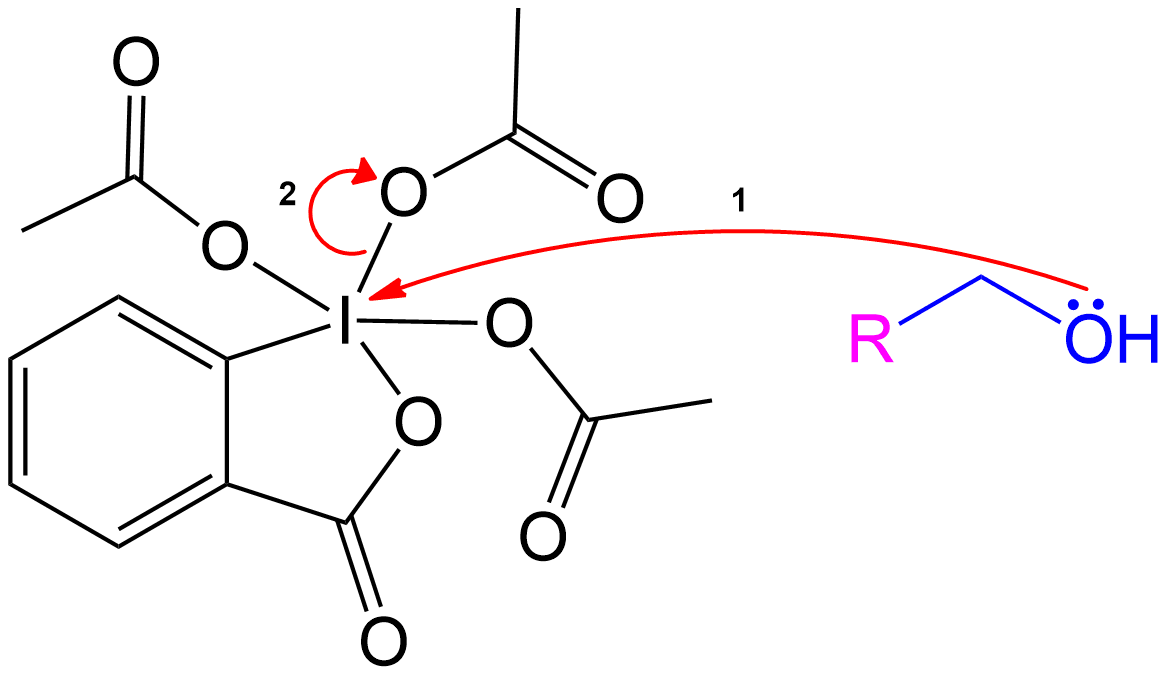
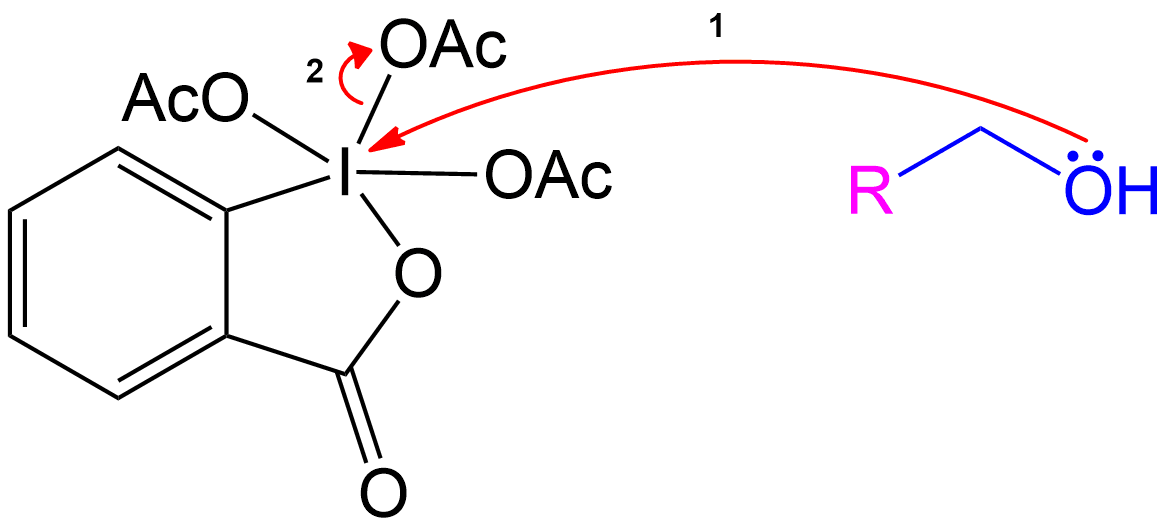
        Formation of Reactive Intermediate.
      </p>

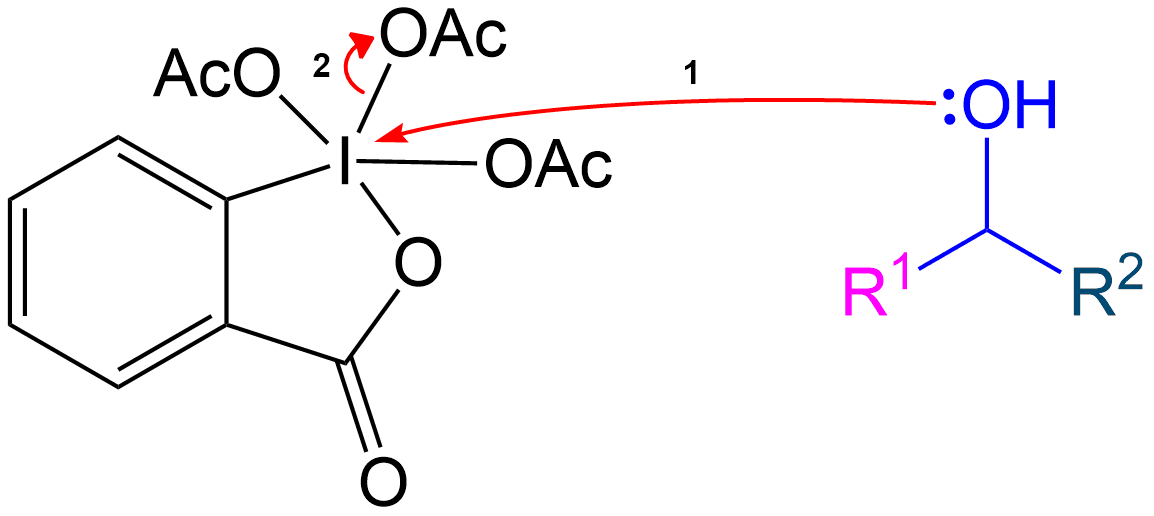
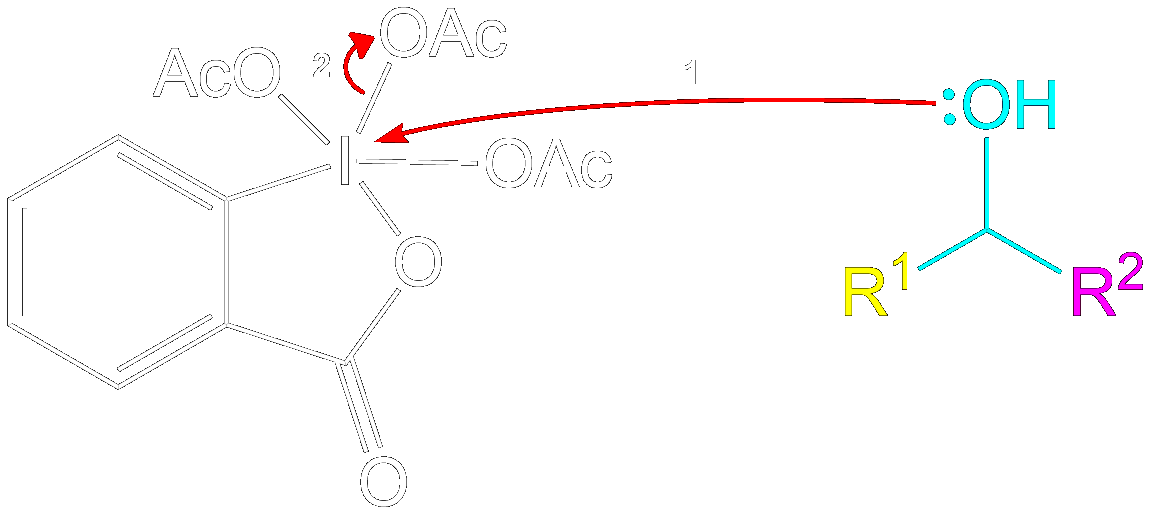
      <p className="mt-2 text-sm text-gray-600 dark:text-gray-400">
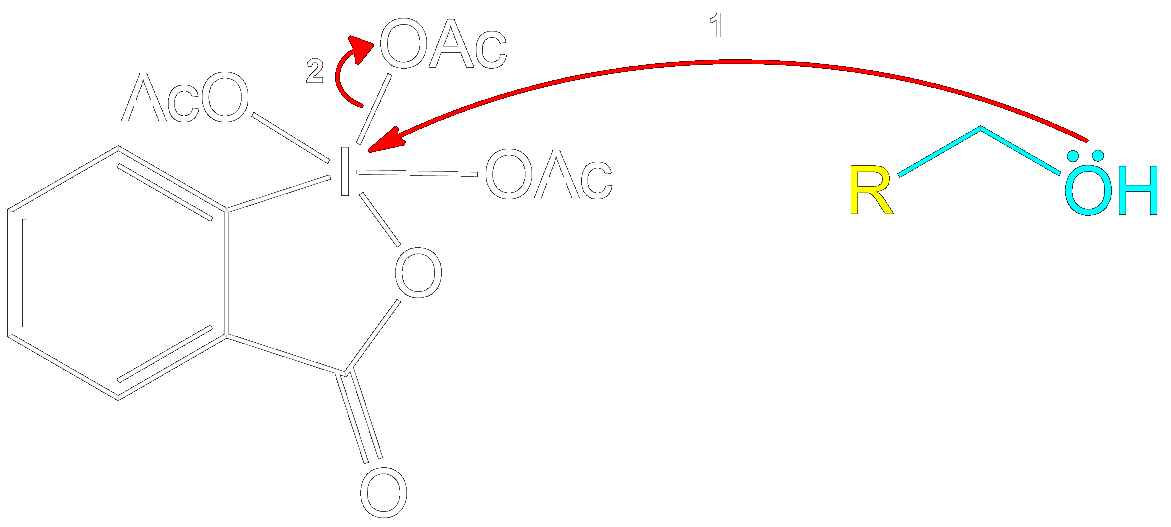
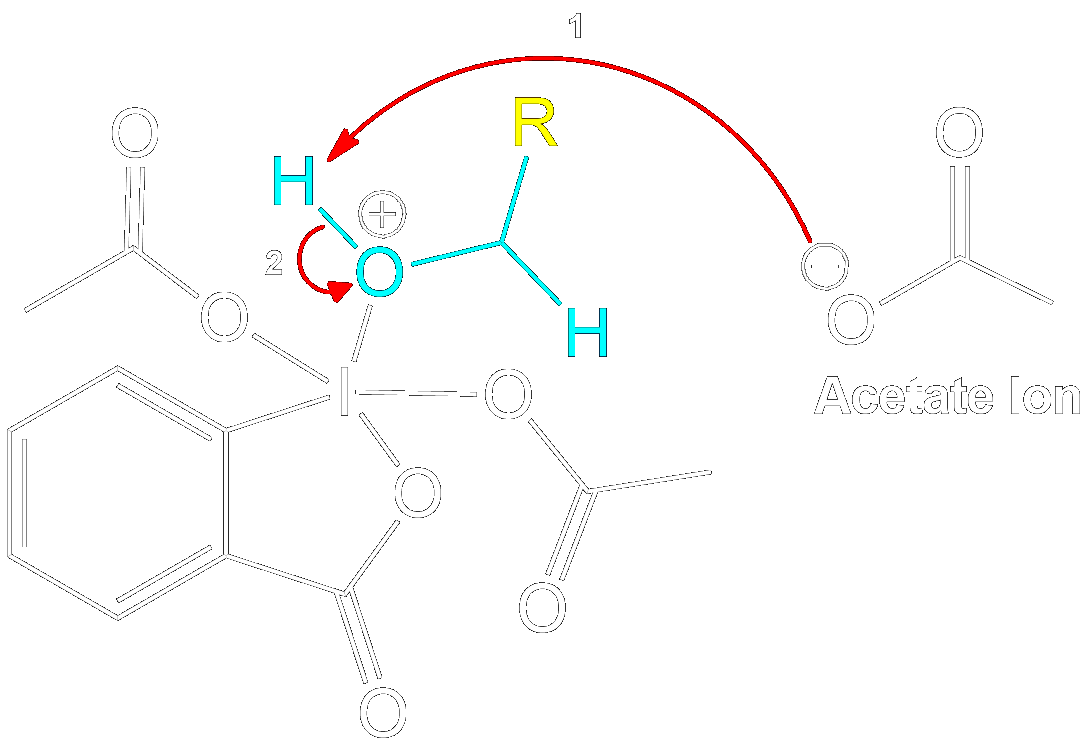
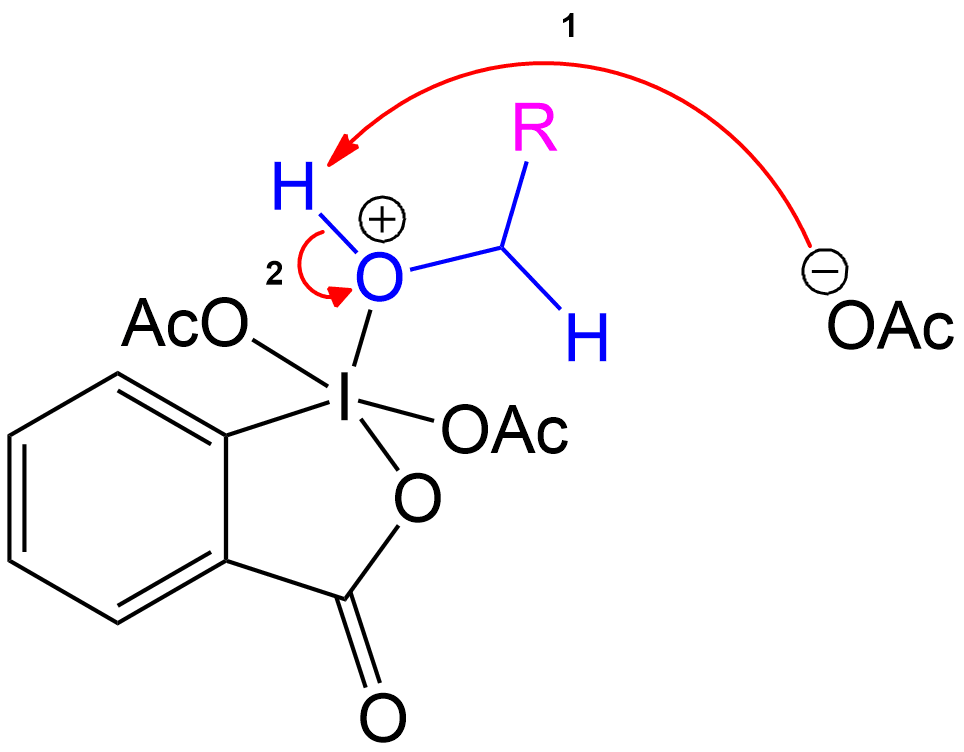
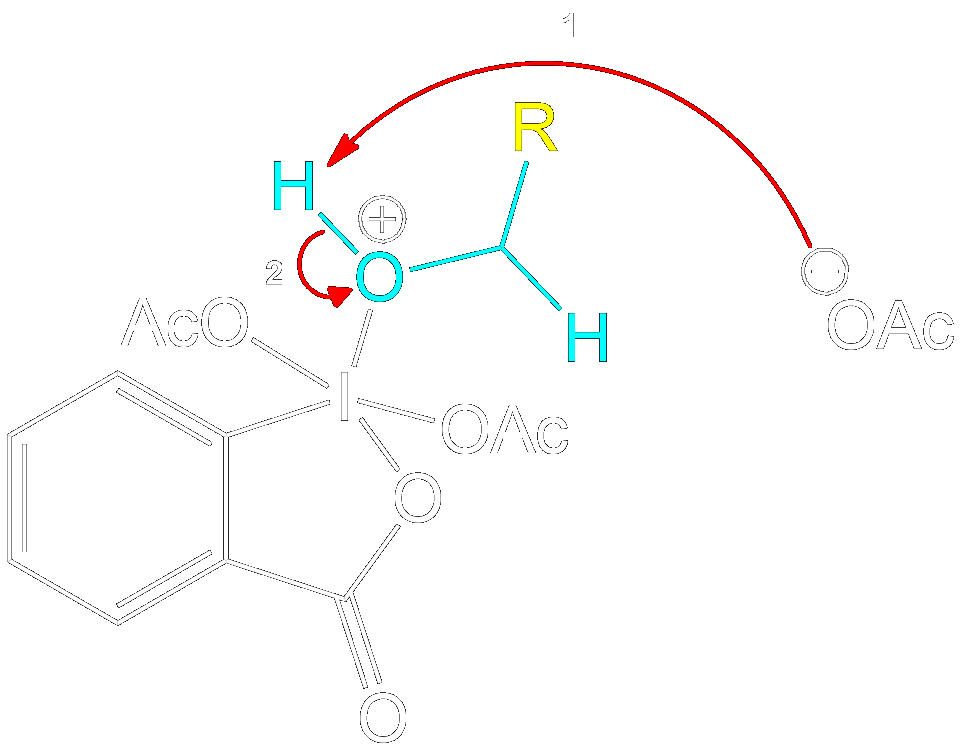
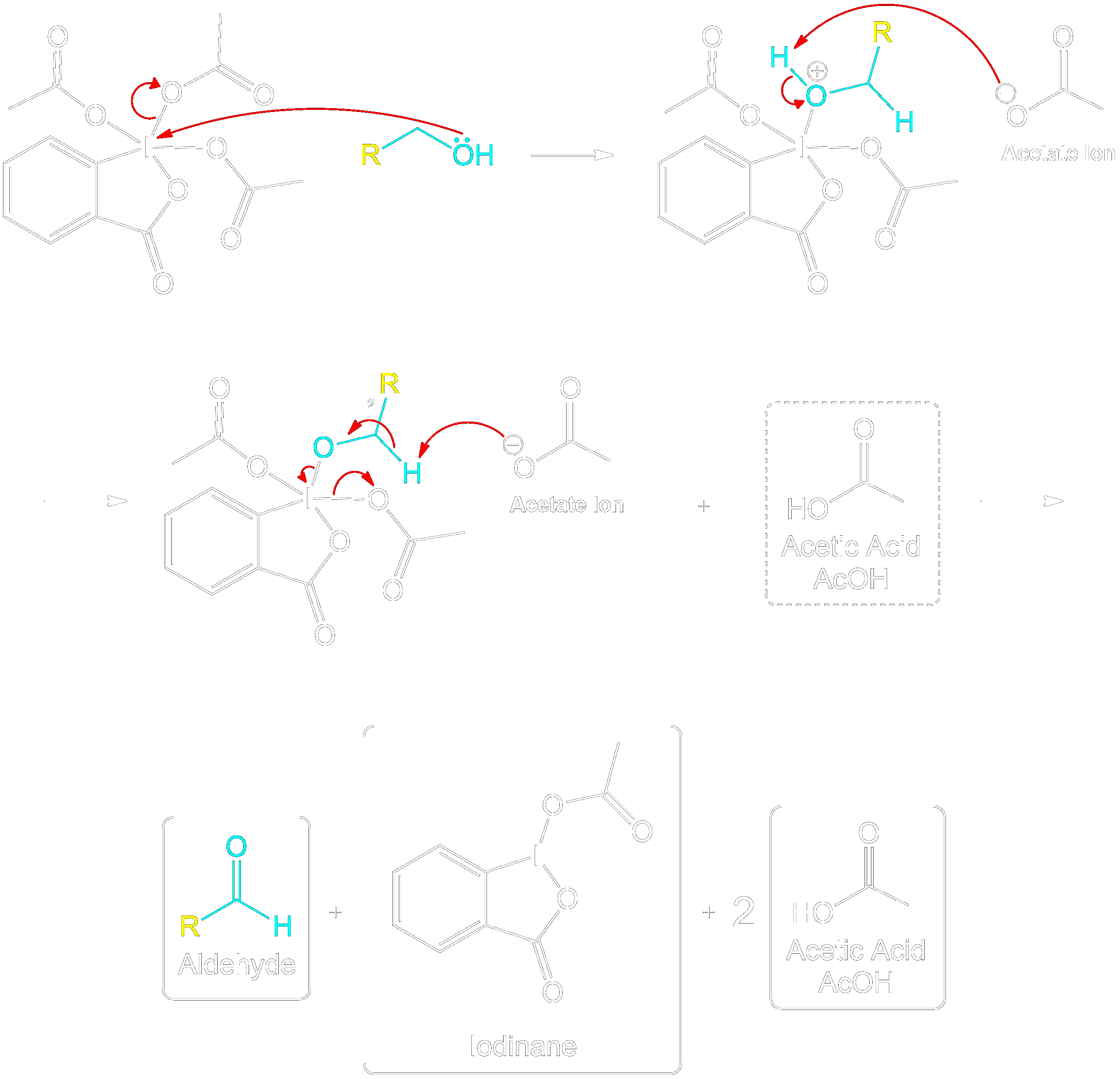
        Alcohol group (-OH) performs a nucleophilic attack on the iodine center of the DMP molecule, forming a complex with the iodine. Acetoxy group is expelled and acts as a good leaving group that leaves with an extra electron pair.
      </p>
    </div>

    This step involves the alcohol group attacking the iodine center of the Dess-Martin Periodinane (DMP), resulting in a complex where the alcohol is temporarily bonded to the iodine. During this reaction, an OAc group is expelled from the compound. The expelled OAc group, initially part of the molecule as an acetoxy group, becomes a negatively charged acetate ion (CH₃COO⁻) once it leaves. This transition occurs because the OAc group acts as a good leaving group, taking an extra electron pair with it, thereby gaining a negative charge and stabilizing as an acetate ion.

    <Accordion title="See the Shortform Version of this Step">
      <img className="block dark:hidden" src="https://mintcdn.com/reactionrepo-bd9a1c17/AqE5enEskAdOSf_C/images/DMPShortformPrimStep1L.png?fit=max&auto=format&n=AqE5enEskAdOSf_C&q=85&s=dcba38b316f785612b9b0c4ad1164206" alt="Hero Light" width="1171" height="527" data-path="images/DMPShortformPrimStep1L.png" />

      <img className="hidden dark:block" src="https://mintcdn.com/reactionrepo-bd9a1c17/AqE5enEskAdOSf_C/images/DMPShortformPrimStep1D.png?fit=max&auto=format&n=AqE5enEskAdOSf_C&q=85&s=940f765a5aa65e3d1988aa44b118a985" alt="Hero Dark" width="1171" height="527" data-path="images/DMPShortformPrimStep1D.png" />
    </Accordion>
  </Step>

  <Step title="Stabilization with Acetate Ion">
    <div className="text-center">
      <div>
        <img className="block dark:hidden" src="https://mintcdn.com/reactionrepo-bd9a1c17/IFWEEywjS-o2nCIa/reactions/dess-martin-oxidation/PrimL2.png?fit=max&auto=format&n=IFWEEywjS-o2nCIa&q=85&s=71a5d2fd733c7c9d953af41aeccf4562" alt="Hero Light" title="" width="1092" height="747" data-path="reactions/dess-martin-oxidation/PrimL2.png" />

        <img className="hidden dark:block" src="https://mintcdn.com/reactionrepo-bd9a1c17/IFWEEywjS-o2nCIa/reactions/dess-martin-oxidation/PrimD2.png?fit=max&auto=format&n=IFWEEywjS-o2nCIa&q=85&s=2da18d21c1d382b2712d2e88eba621ed" alt="Hero Dark" title="" width="1092" height="747" data-path="reactions/dess-martin-oxidation/PrimD2.png" />
      </div>

      <p className="mt-2 text-sm font-bold text-gray-600 dark:text-gray-400">
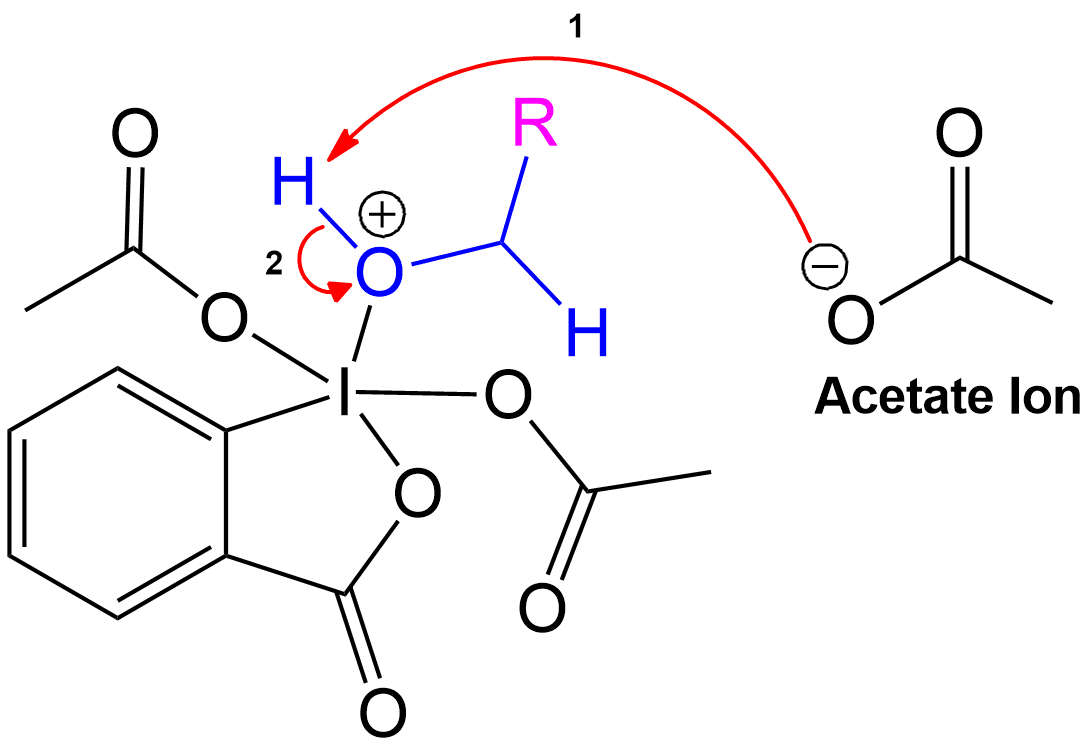
        Charge Stabilization using a Acetate Ion.
      </p>

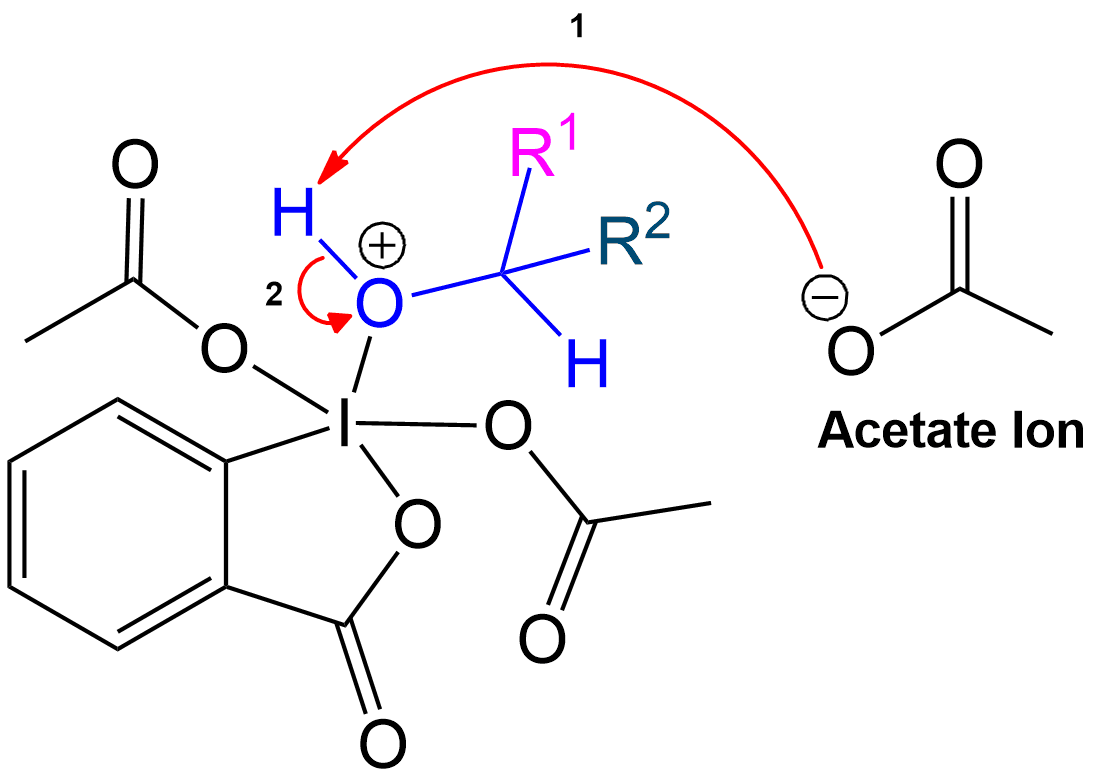
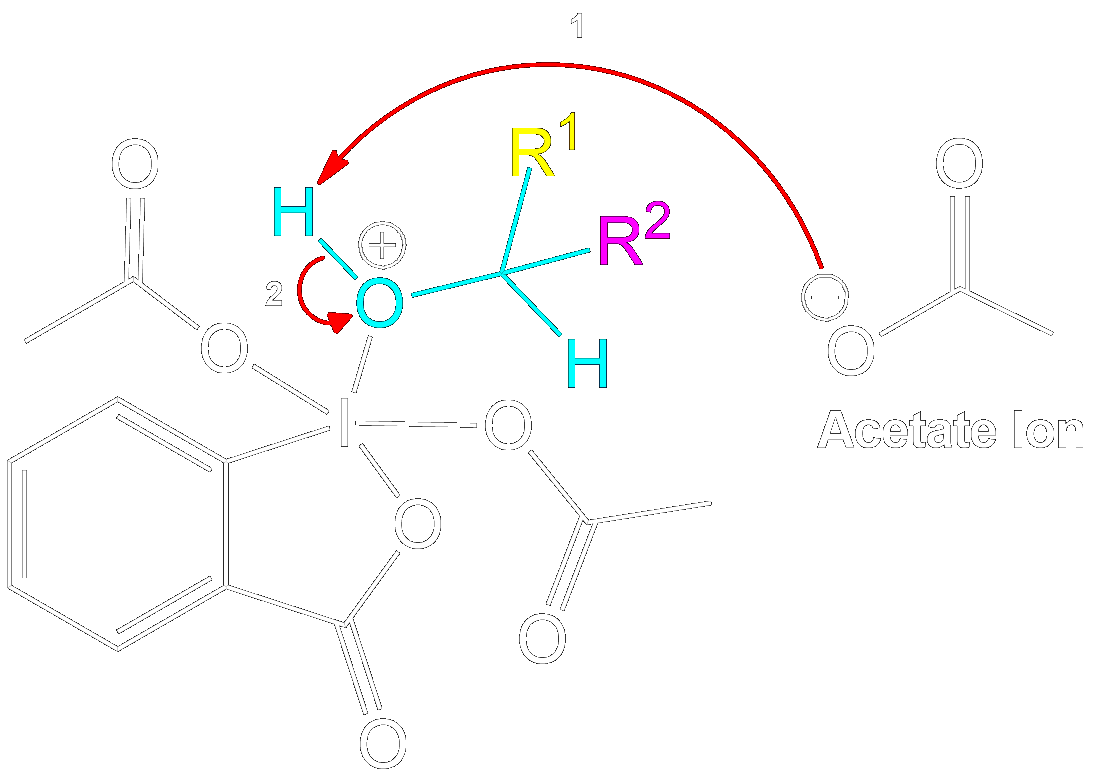
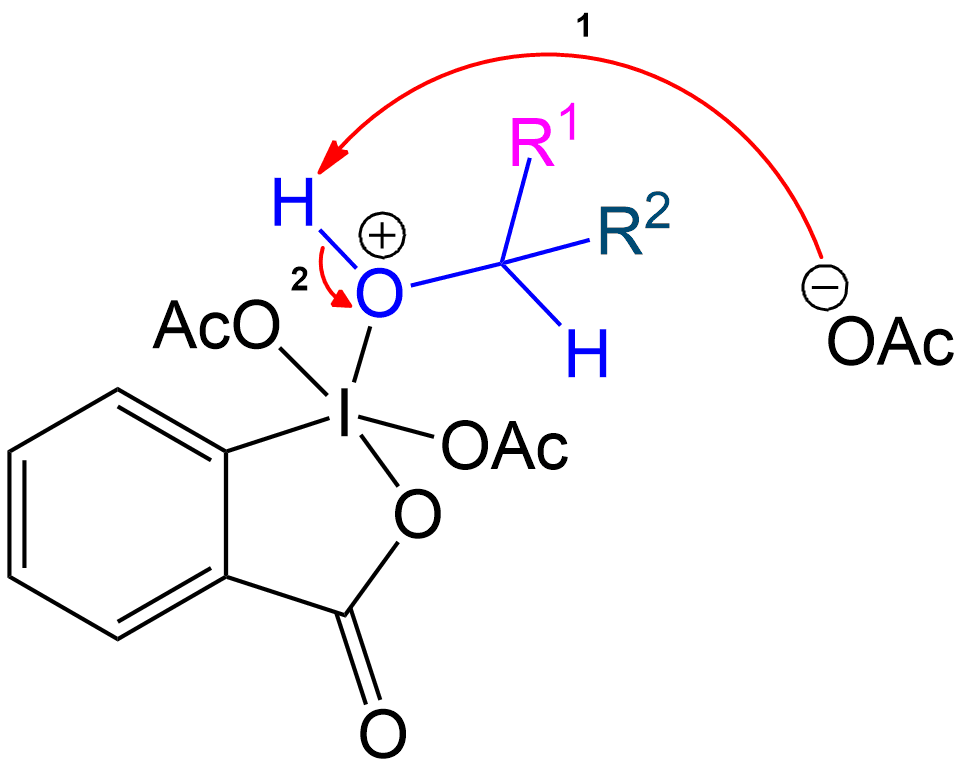
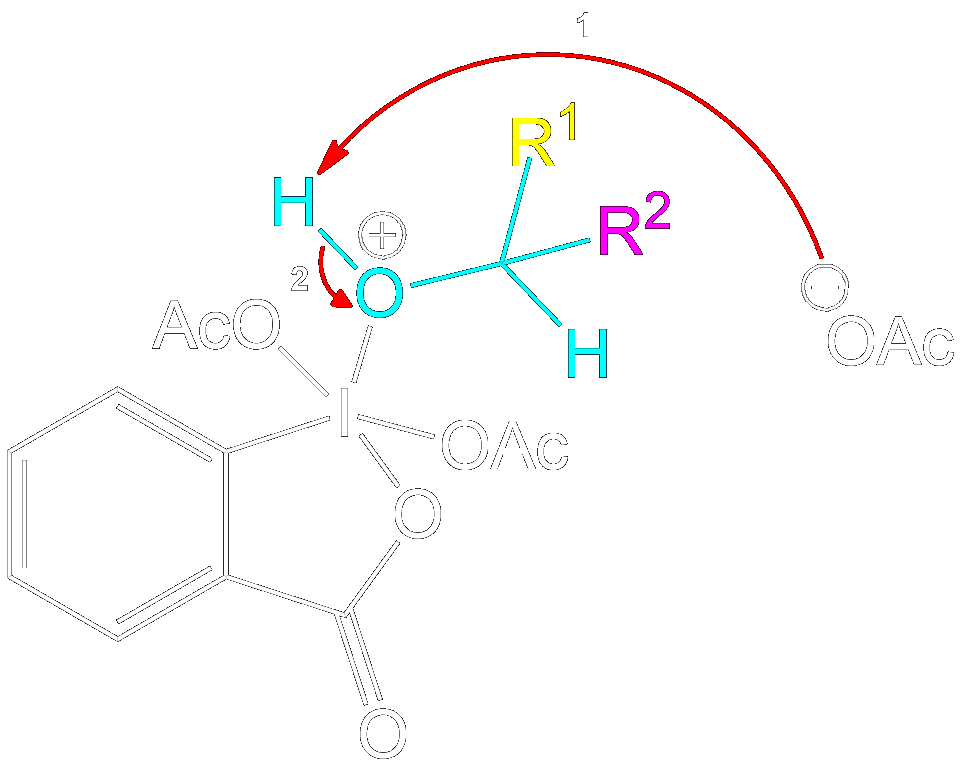
      <p className="mt-2 text-sm text-gray-600 dark:text-gray-400">
        The newly formed intermediate is stabilized by the previously expelled OAc (Acetoxy) group (now an acetate ion).
      </p>
    </div>

    The stabilization of the intermediate occurs when the acetate ion interacts with the intermediate, ensuring the reaction progresses smoothly by stabilizing the charge.

    <Accordion title="See the Shortform Version of this Step">
      <img className="block dark:hidden" src="https://mintcdn.com/reactionrepo-bd9a1c17/IFWEEywjS-o2nCIa/reactions/dess-martin-oxidation/DMPShortformPrimStep2L.png?fit=max&auto=format&n=IFWEEywjS-o2nCIa&q=85&s=dda851971bee5a590d20ca8a1cfa5e4a" alt="Hero Light" width="964" height="752" data-path="reactions/dess-martin-oxidation/DMPShortformPrimStep2L.png" />

      <img className="hidden dark:block" src="https://mintcdn.com/reactionrepo-bd9a1c17/IFWEEywjS-o2nCIa/reactions/dess-martin-oxidation/DMPShortformPrimStep2D.png?fit=max&auto=format&n=IFWEEywjS-o2nCIa&q=85&s=ccc324bd9e49d547aeebdf2330f298ea" alt="Hero Dark" width="964" height="752" data-path="reactions/dess-martin-oxidation/DMPShortformPrimStep2D.png" />
    </Accordion>
  </Step>

  <Step title="Product Formation and Acetic Acid Recovery">
    <div className="text-center">
      <div>
        <img className="block dark:hidden" src="https://mintcdn.com/reactionrepo-bd9a1c17/IFWEEywjS-o2nCIa/reactions/dess-martin-oxidation/PrimL3.png?fit=max&auto=format&n=IFWEEywjS-o2nCIa&q=85&s=8c47e8a8d264a631b22a146e049f8cbd" alt="Hero Light" title="" width="1777" height="656" data-path="reactions/dess-martin-oxidation/PrimL3.png" />

        <img className="hidden dark:block" src="https://mintcdn.com/reactionrepo-bd9a1c17/IFWEEywjS-o2nCIa/reactions/dess-martin-oxidation/PrimD3.png?fit=max&auto=format&n=IFWEEywjS-o2nCIa&q=85&s=c27897fe3fd09f29219233681d2b8e75" alt="Hero Dark" title="" width="1777" height="656" data-path="reactions/dess-martin-oxidation/PrimD3.png" />
      </div>

      <p className="mt-2 text-sm font-bold text-gray-600 dark:text-gray-400">
        Acetic Acid Recovery and Product Formation.
      </p>

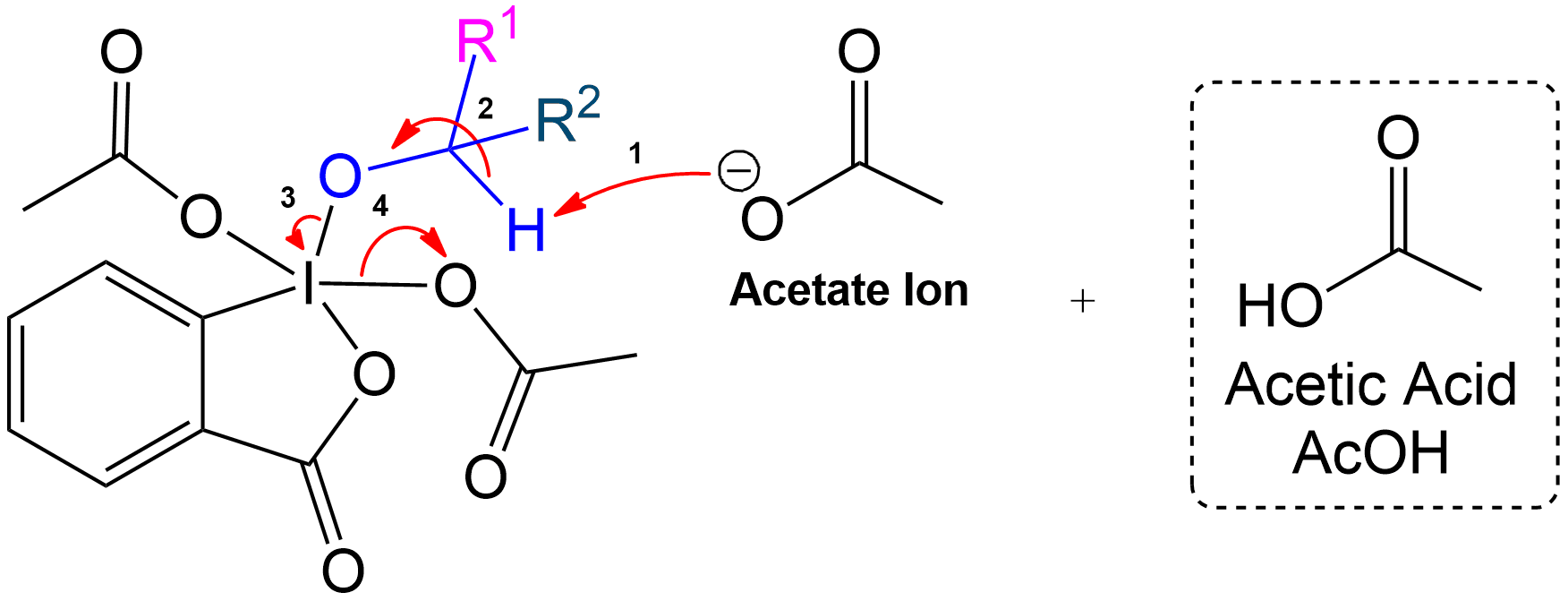
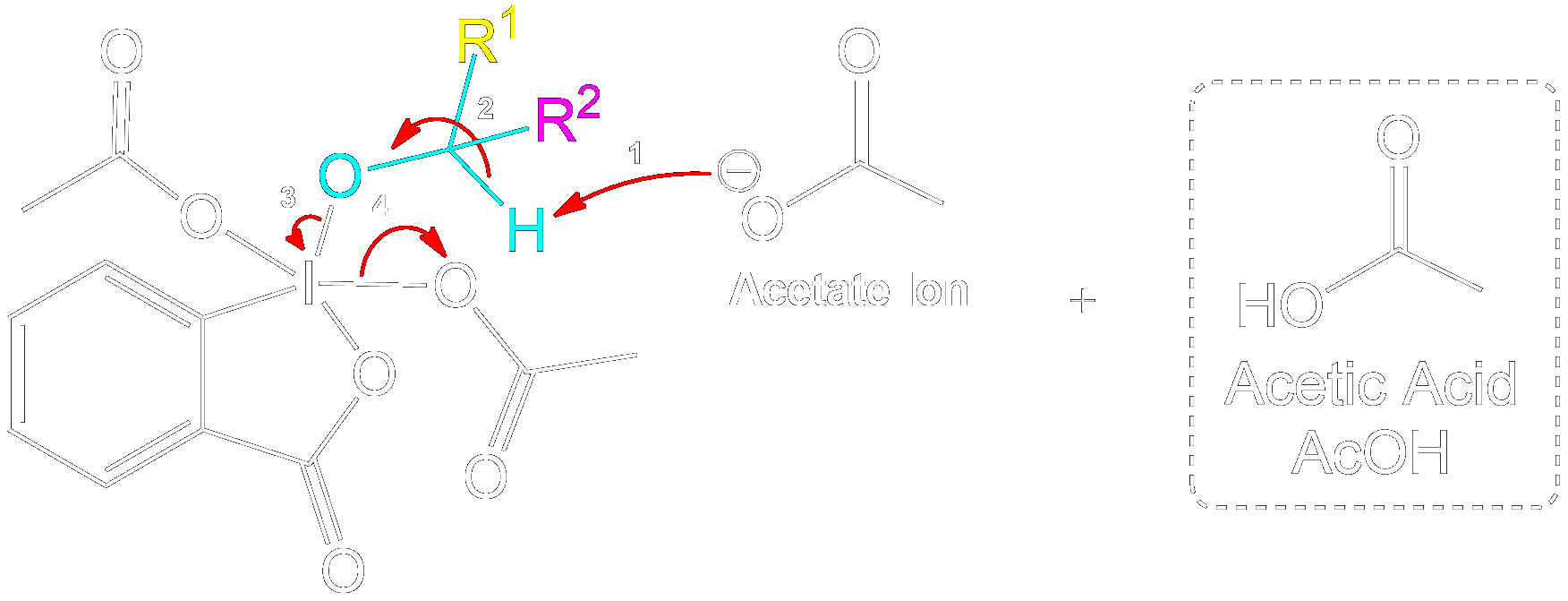
      <p className="mt-2 text-sm text-gray-600 dark:text-gray-400">
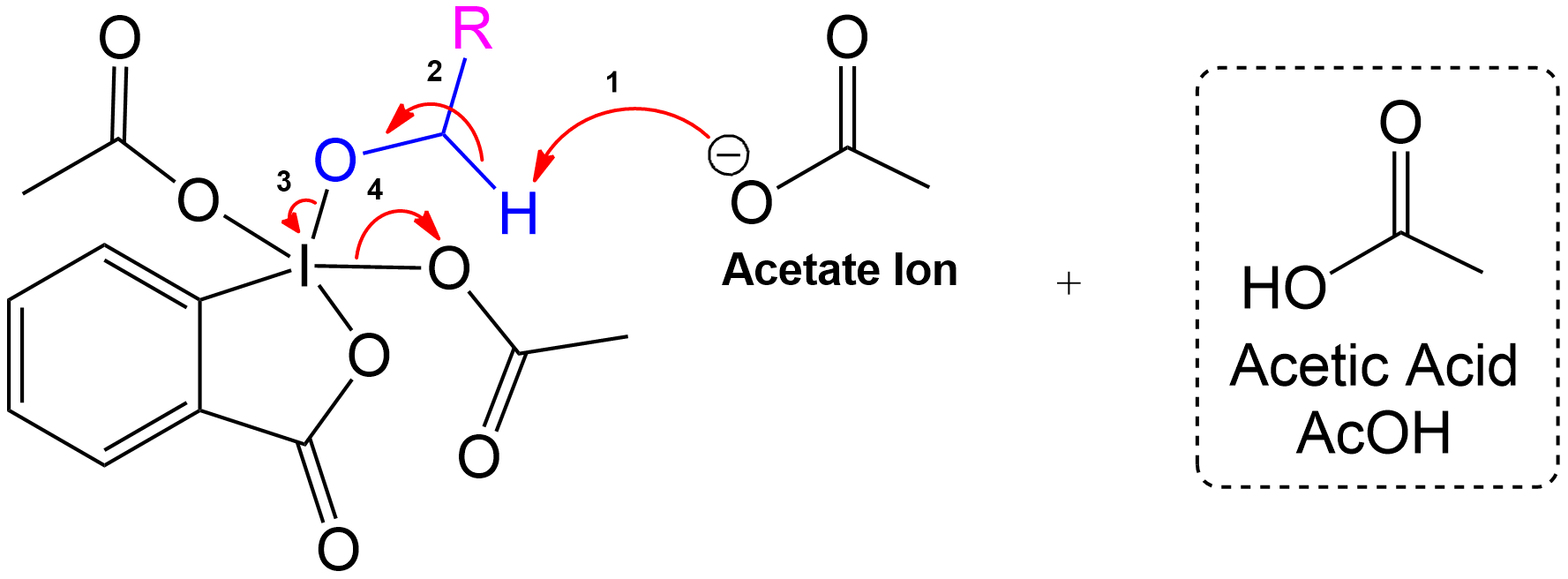
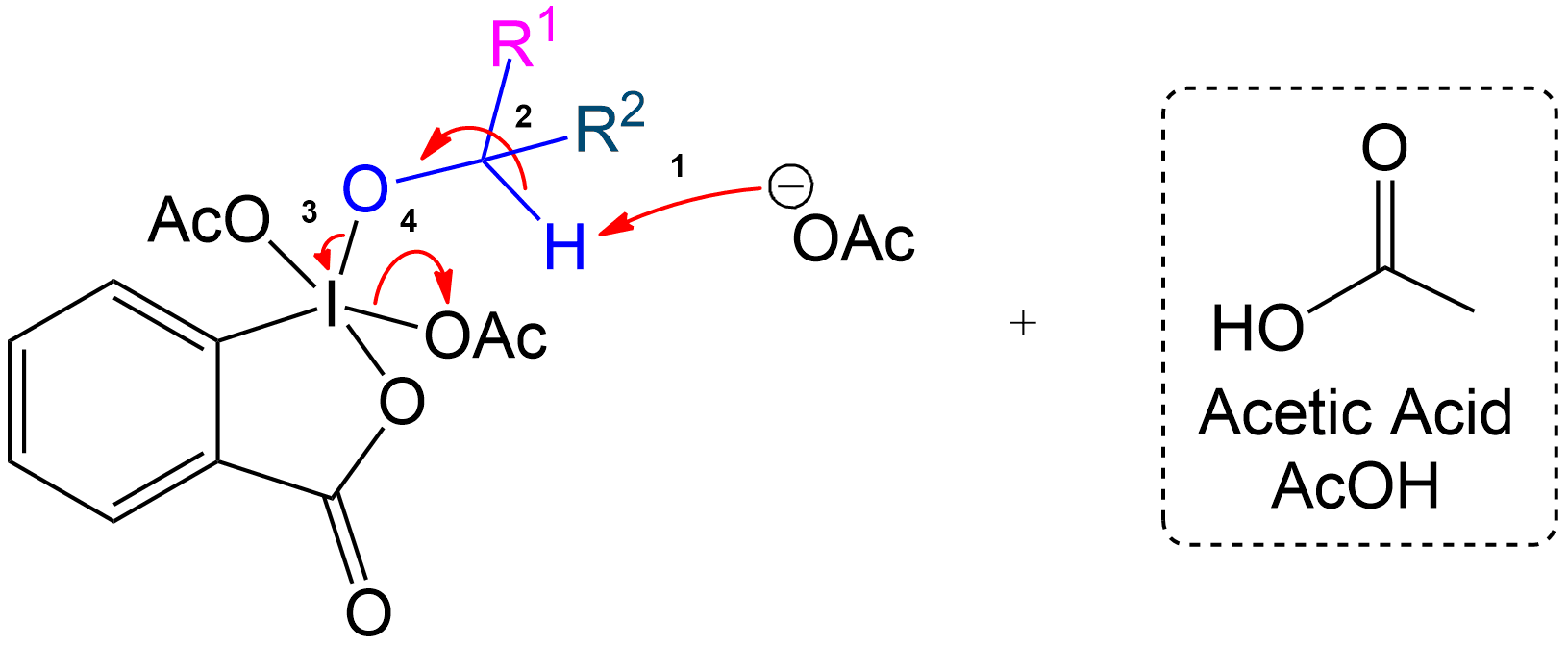
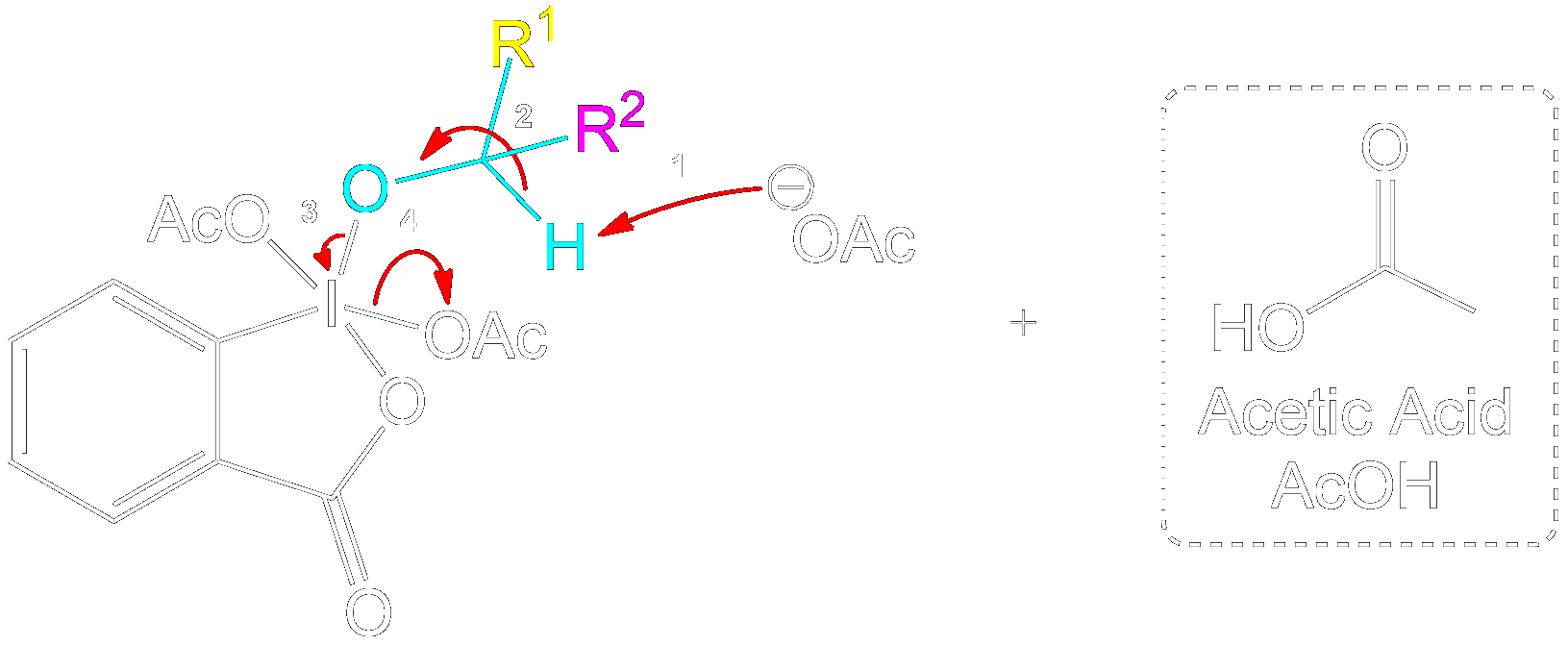
        Acetic acid is recovered, and the intermediate undergoes proton transfer initiated by another acetate ion to form the aldehyde product.
      </p>
    </div>

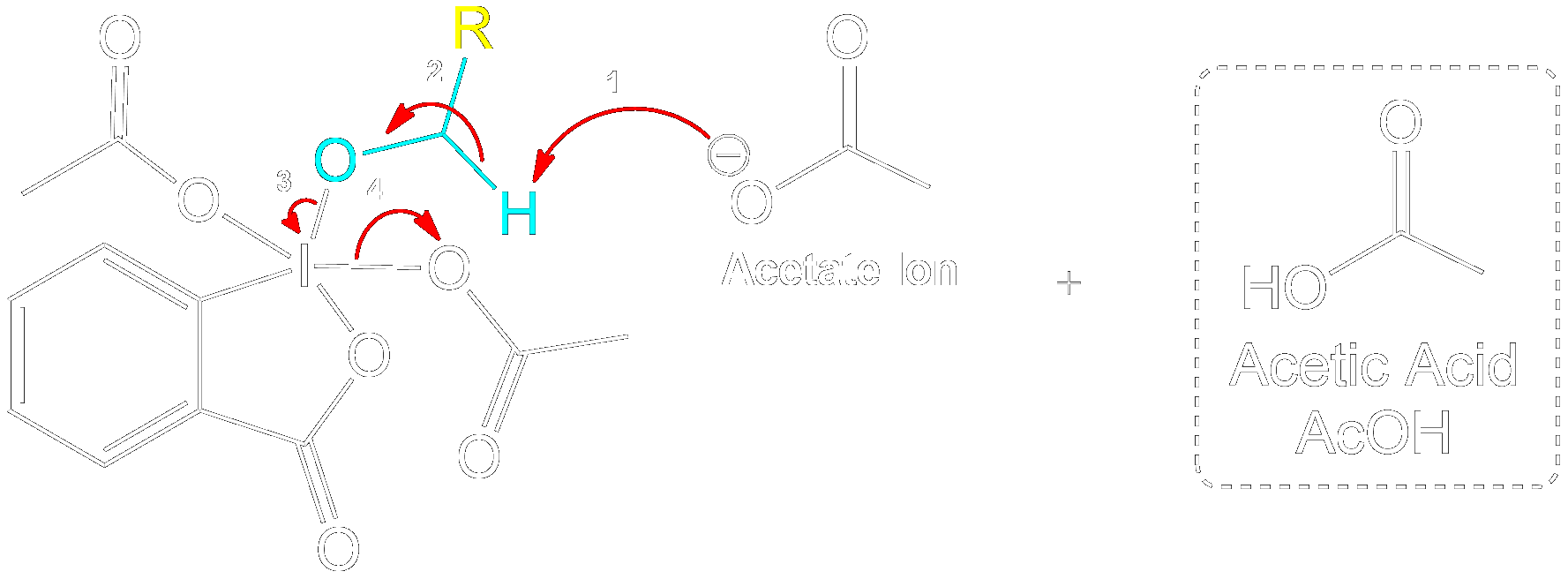
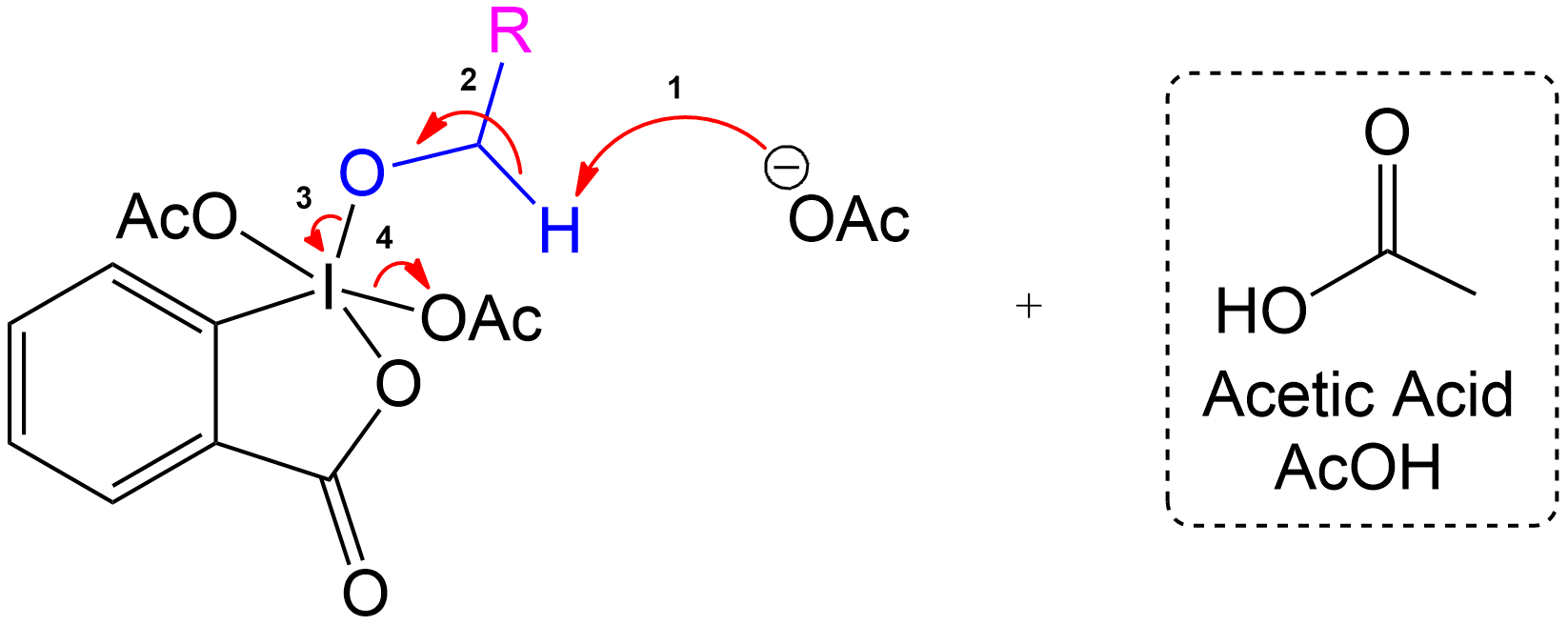
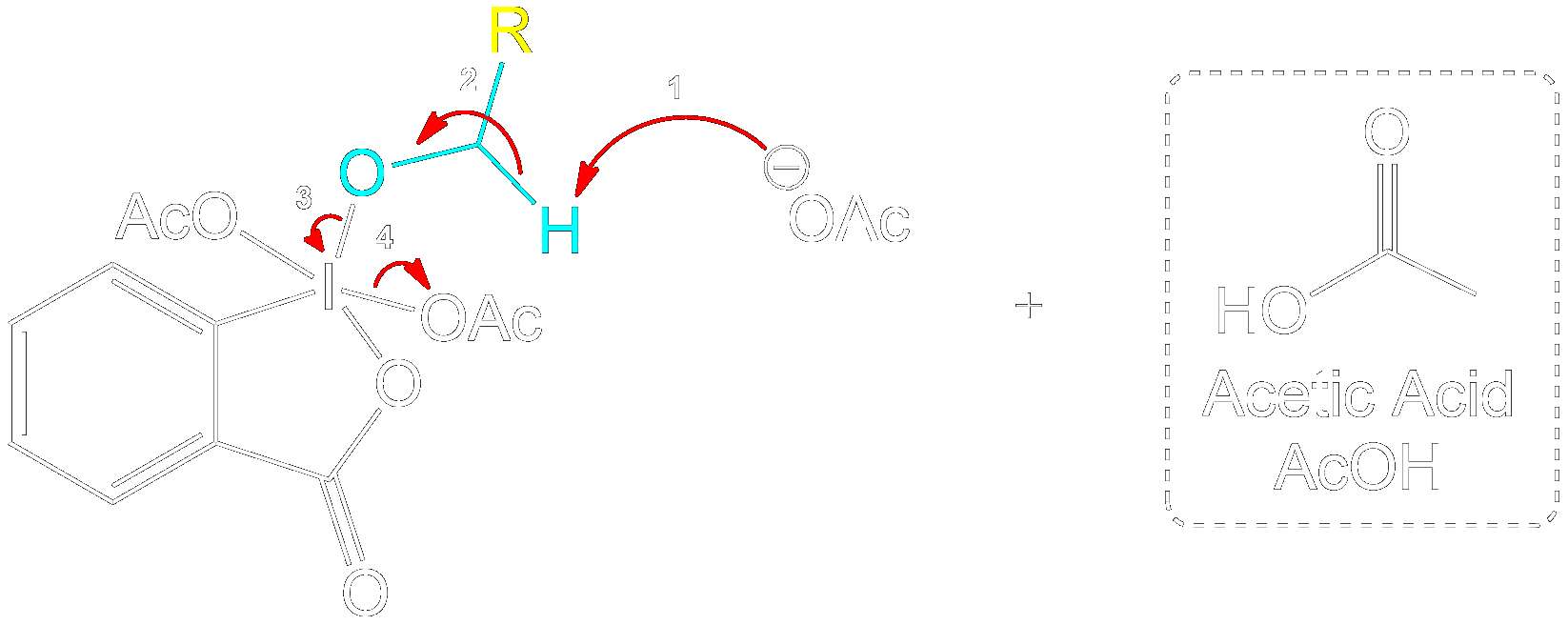
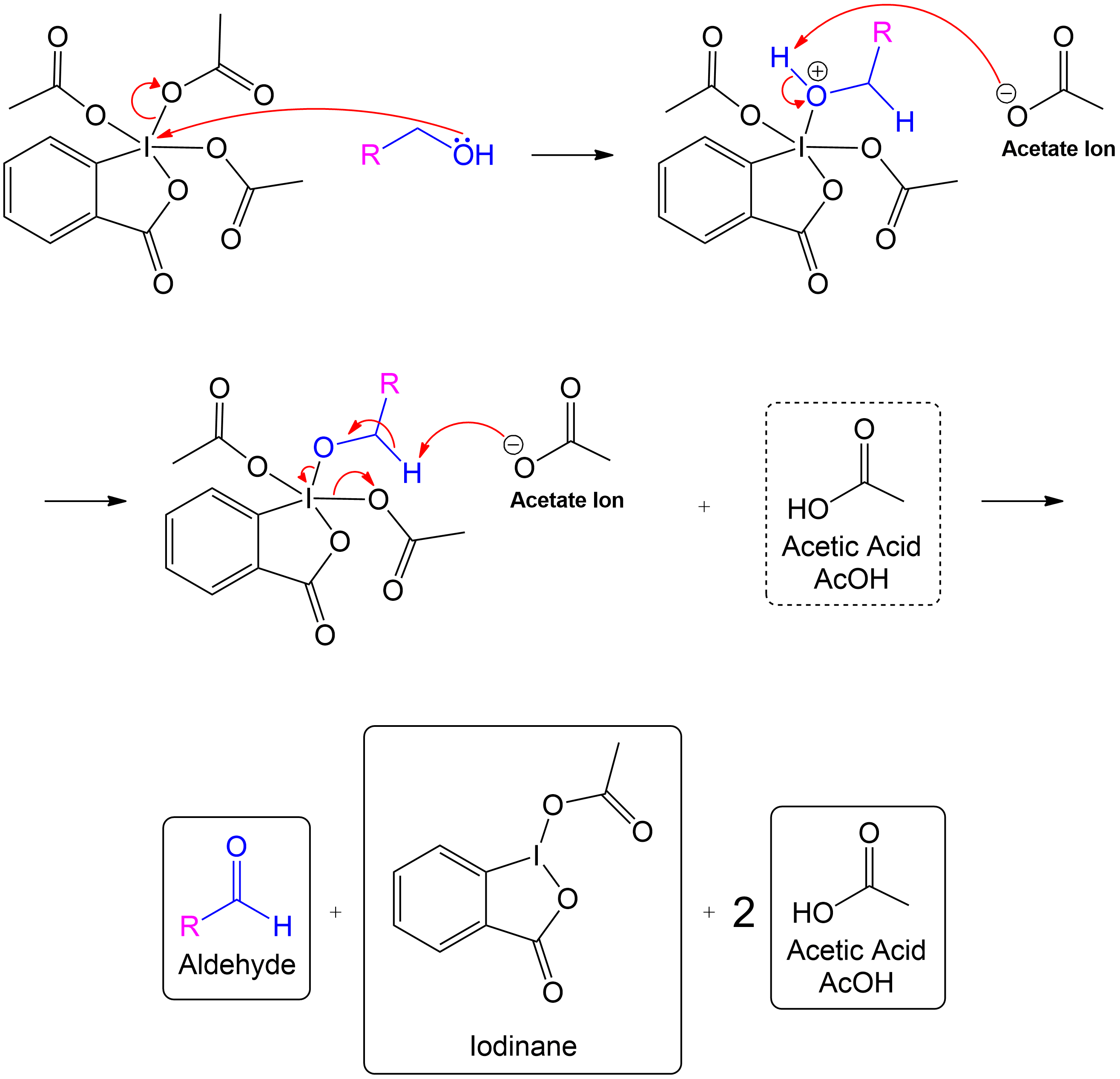
    In the final steps, one mole of acetic acid is recovered. The intermediate then undergoes a proton transfer, initiated by another acetate ion, leading to the formation of the aldehyde product.

    <Accordion title="See the Shortform Version of this Step">
      <img className="block dark:hidden" src="https://mintcdn.com/reactionrepo-bd9a1c17/IFWEEywjS-o2nCIa/reactions/dess-martin-oxidation/DMPShortformPrimStep3L.png?fit=max&auto=format&n=IFWEEywjS-o2nCIa&q=85&s=a04b160618cea923ec7966a622c41a68" alt="Hero Light" width="1646" height="656" data-path="reactions/dess-martin-oxidation/DMPShortformPrimStep3L.png" />

      <img className="hidden dark:block" src="https://mintcdn.com/reactionrepo-bd9a1c17/IFWEEywjS-o2nCIa/reactions/dess-martin-oxidation/DMPShortformPrimStep3D.png?fit=max&auto=format&n=IFWEEywjS-o2nCIa&q=85&s=15837ca5ef3841adf18632764c70c3bd" alt="Hero Dark" width="1646" height="656" data-path="reactions/dess-martin-oxidation/DMPShortformPrimStep3D.png" />
    </Accordion>
  </Step>

  <Step title="Overview of Final Products">
    <div className="text-center">
      <div>
        <img className="block dark:hidden" src="https://mintcdn.com/reactionrepo-bd9a1c17/IFWEEywjS-o2nCIa/reactions/dess-martin-oxidation/DMPProductsLightPrimary.png?fit=max&auto=format&n=IFWEEywjS-o2nCIa&q=85&s=73df5598be5c992674d9ee0be632e975" alt="Hero Light" title="" width="1859" height="840" data-path="reactions/dess-martin-oxidation/DMPProductsLightPrimary.png" />

        <img className="hidden dark:block" src="https://mintcdn.com/reactionrepo-bd9a1c17/IFWEEywjS-o2nCIa/reactions/dess-martin-oxidation/DMPProductsDarkPrimary.png?fit=max&auto=format&n=IFWEEywjS-o2nCIa&q=85&s=ecb6d97e12e7757d73e8fbb54815df81" alt="Hero Dark" title="" width="1859" height="840" data-path="reactions/dess-martin-oxidation/DMPProductsDarkPrimary.png" />
      </div>

      <p className="mt-2 text-sm font-bold text-gray-600 dark:text-gray-400">
        Overall Products recovered post-oxidation.
      </p>

      <p className="mt-2 text-sm text-gray-600 dark:text-gray-400">
        Formation of the aldehyde product and iodinane and acetic acid as by-products.
      </p>
    </div>

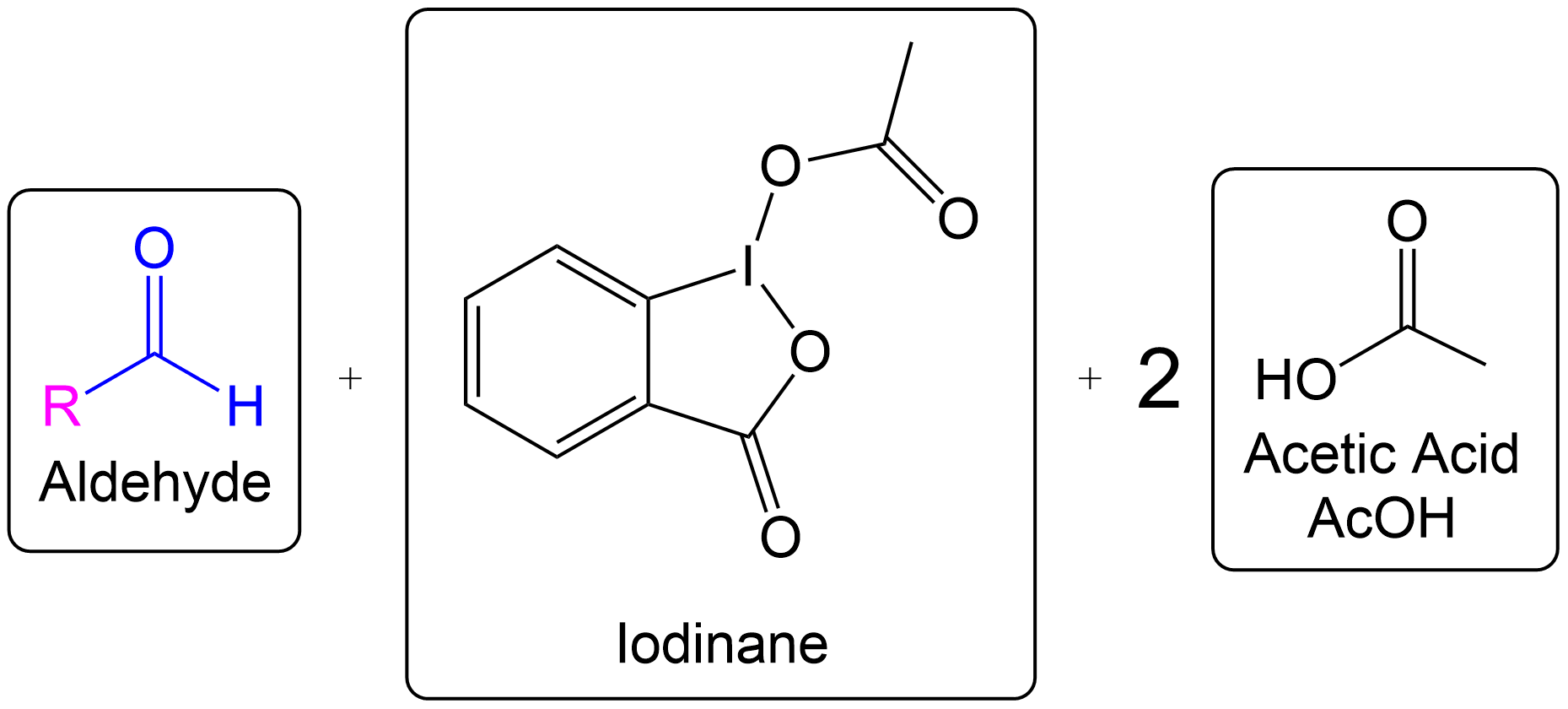
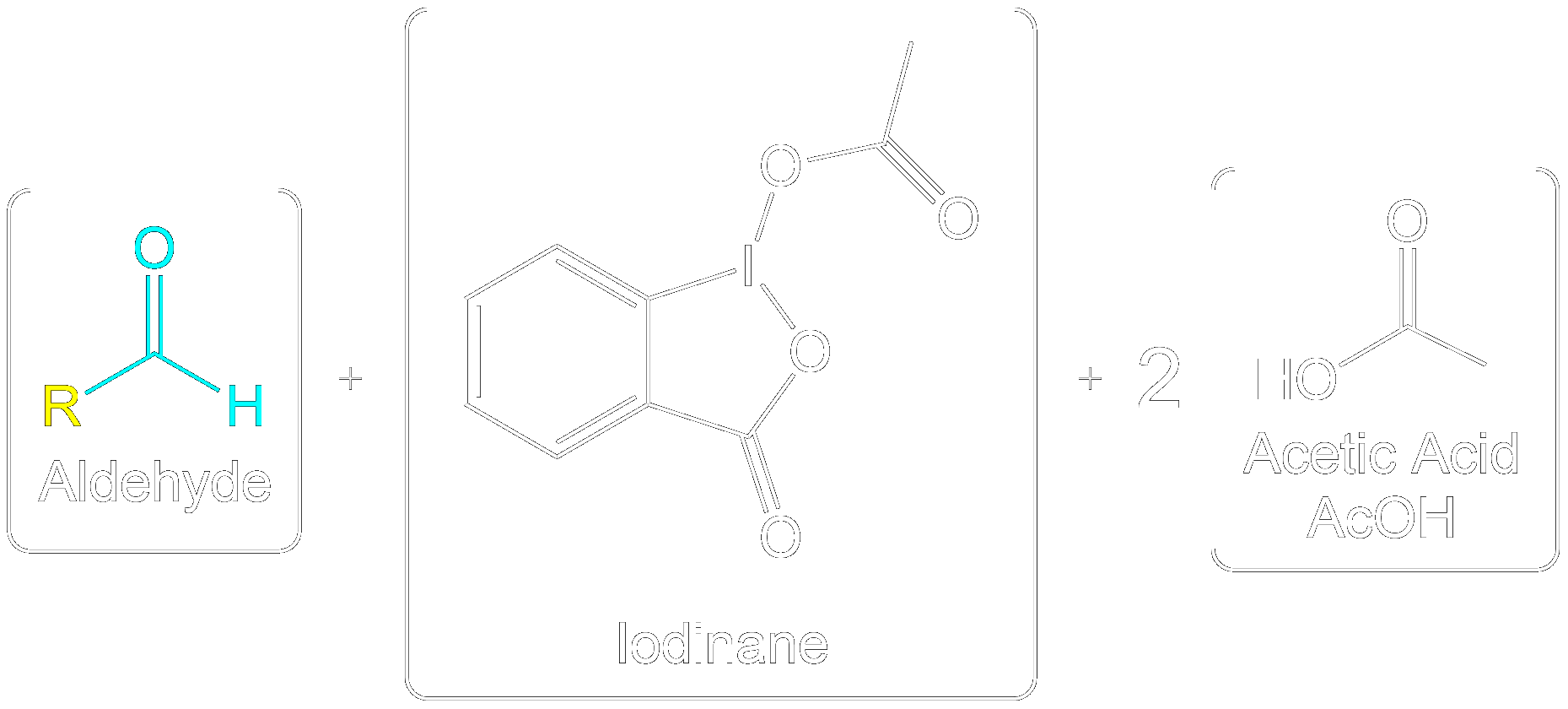
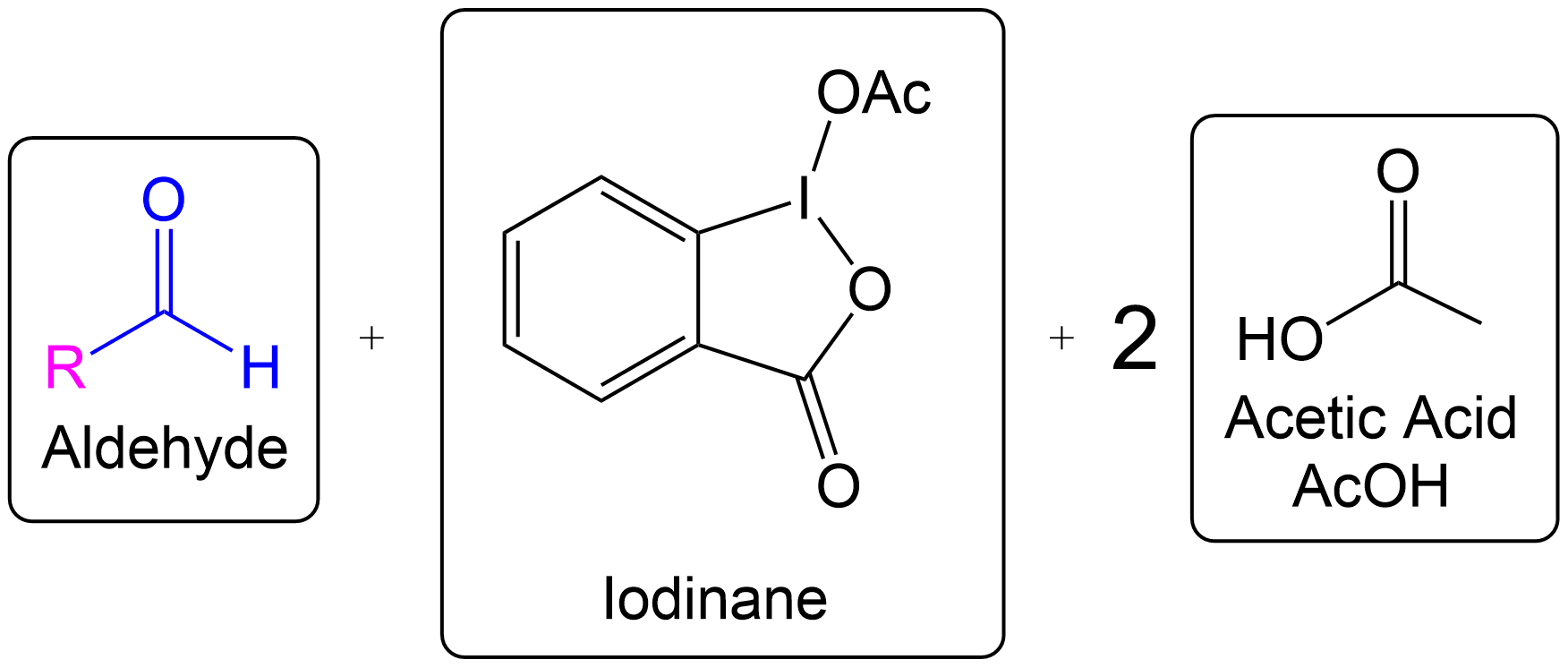
    The overall products of the Dess-Martin oxidation include the aldehyde formed from the primary alcohol, iodinane as a by-product, and the recovery of two moles of acetic acid.

    <Accordion title="See the Shortform Version of the Products">
      <img className="block dark:hidden" src="https://mintcdn.com/reactionrepo-bd9a1c17/IFWEEywjS-o2nCIa/reactions/dess-martin-oxidation/PrimLightProd.png?fit=max&auto=format&n=IFWEEywjS-o2nCIa&q=85&s=31448f7072f01f78e61195e99c6f8285" alt="Hero Light" width="1752" height="746" data-path="reactions/dess-martin-oxidation/PrimLightProd.png" />

      <img className="hidden dark:block" src="https://mintcdn.com/reactionrepo-bd9a1c17/IFWEEywjS-o2nCIa/reactions/dess-martin-oxidation/PrimDarkProd.png?fit=max&auto=format&n=IFWEEywjS-o2nCIa&q=85&s=df7ff8e46365f10c22fa70841f9b903d" alt="Hero Dark" width="1752" height="746" data-path="reactions/dess-martin-oxidation/PrimDarkProd.png" />
    </Accordion>
  </Step>
</Steps>

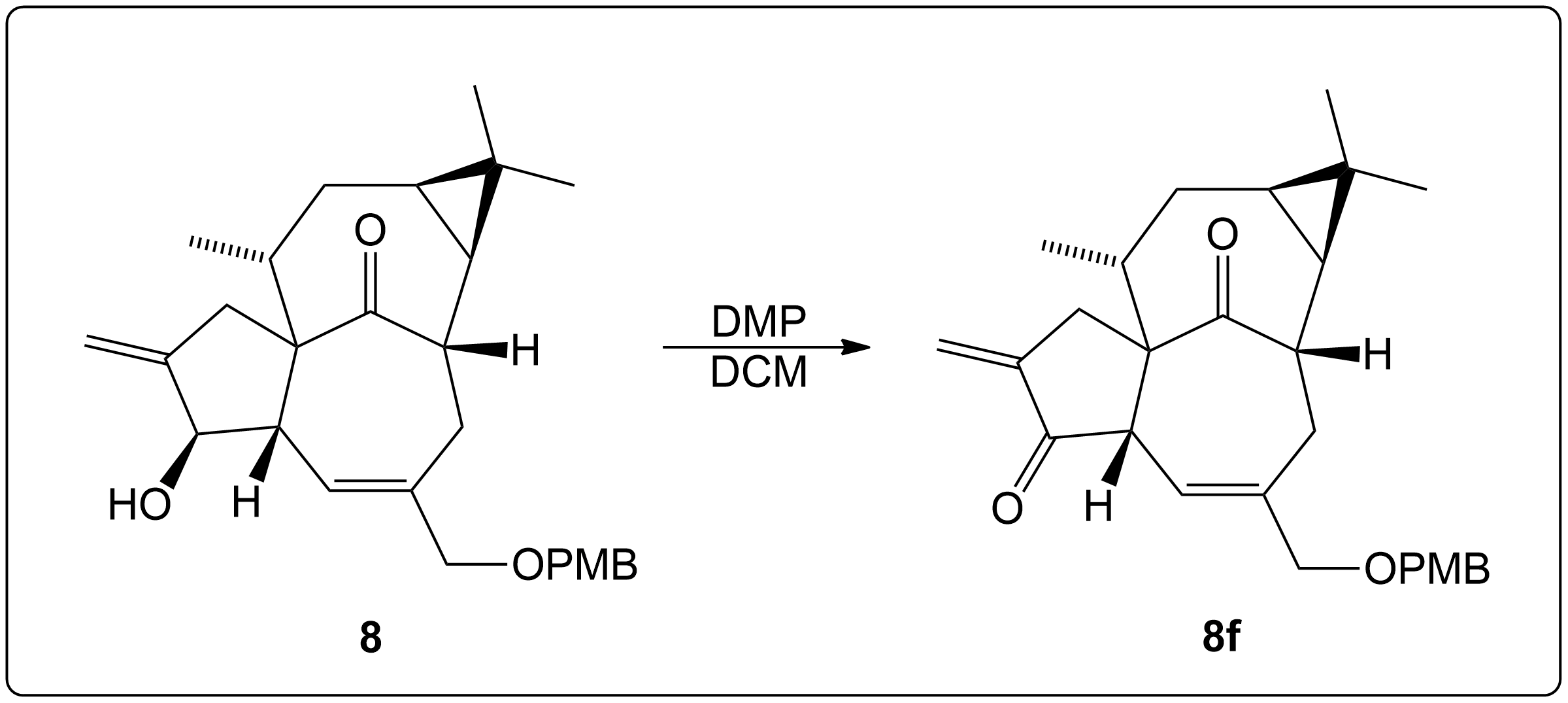
## Finding the Product for a 2° Alcohol

This section is a brief overview on how to find the product for a 2° Alcohol (Secondary) using a example from a real scientific research paper.

<div className="text-center">
  <div>
    <img className="block dark:hidden" src="https://mintcdn.com/reactionrepo-bd9a1c17/IFWEEywjS-o2nCIa/reactions/dess-martin-oxidation/DMPSecondaryQ1Light.png?fit=max&auto=format&n=IFWEEywjS-o2nCIa&q=85&s=f68d497c5eac1a3887b5514cfdbe1286" alt="Hero Light" title="DMP Oxidation (Light Mode)" width="2176" height="983" data-path="reactions/dess-martin-oxidation/DMPSecondaryQ1Light.png" />

    <img className="hidden dark:block" src="https://mintcdn.com/reactionrepo-bd9a1c17/IFWEEywjS-o2nCIa/reactions/dess-martin-oxidation/DMPSecondaryQ1Dark.png?fit=max&auto=format&n=IFWEEywjS-o2nCIa&q=85&s=b3637ac21455b207a66760ce4d70efaa" alt="Hero Dark" title="DMP Oxidation (Dark Mode)" width="2176" height="983" data-path="reactions/dess-martin-oxidation/DMPSecondaryQ1Dark.png" />
  </div>

  <p className="mt-2 text-sm font-bold text-gray-600 dark:text-gray-400">
    Propose a Mechanism for this Reaction.
  </p>
</div>

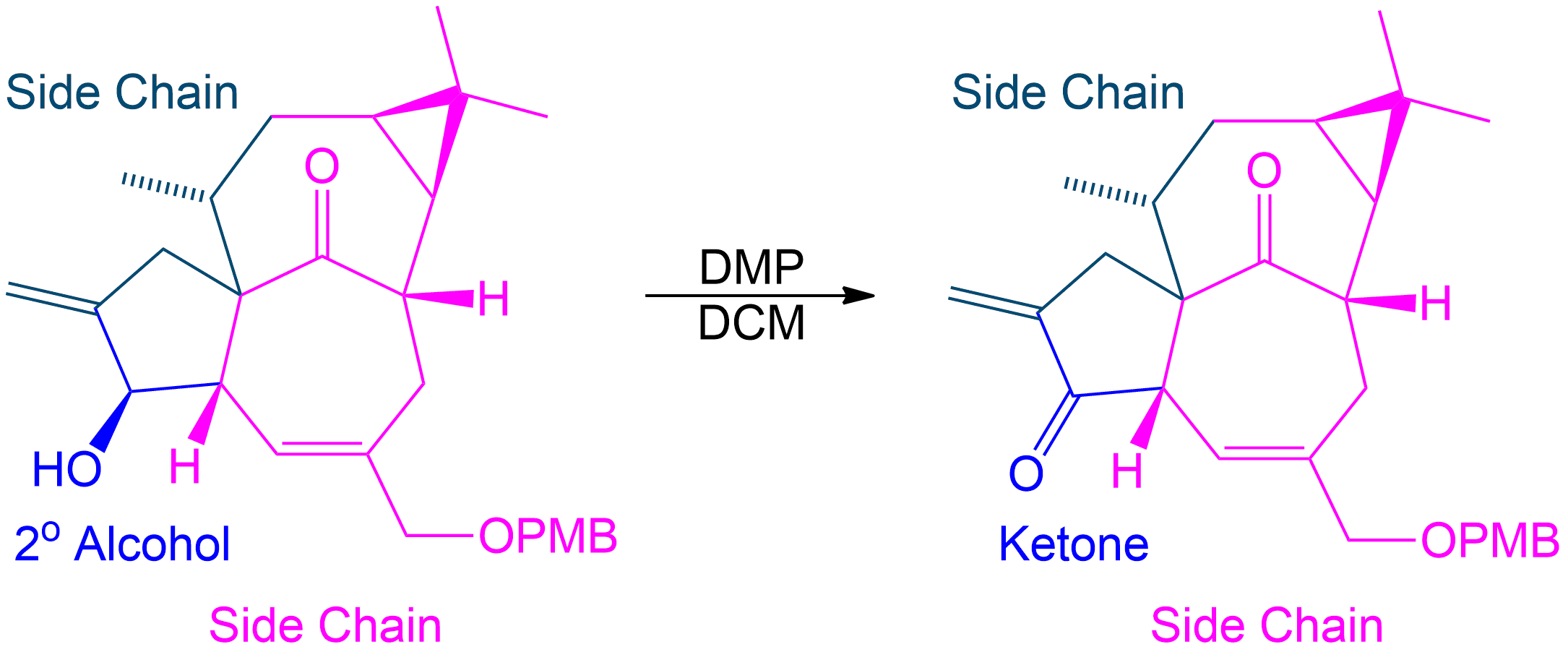
Oxidation of a secondary alcohol intermediate to an ketone. The groundwork to determine the product is similar to how a primary alcohol is converted.

<AccordionGroup>
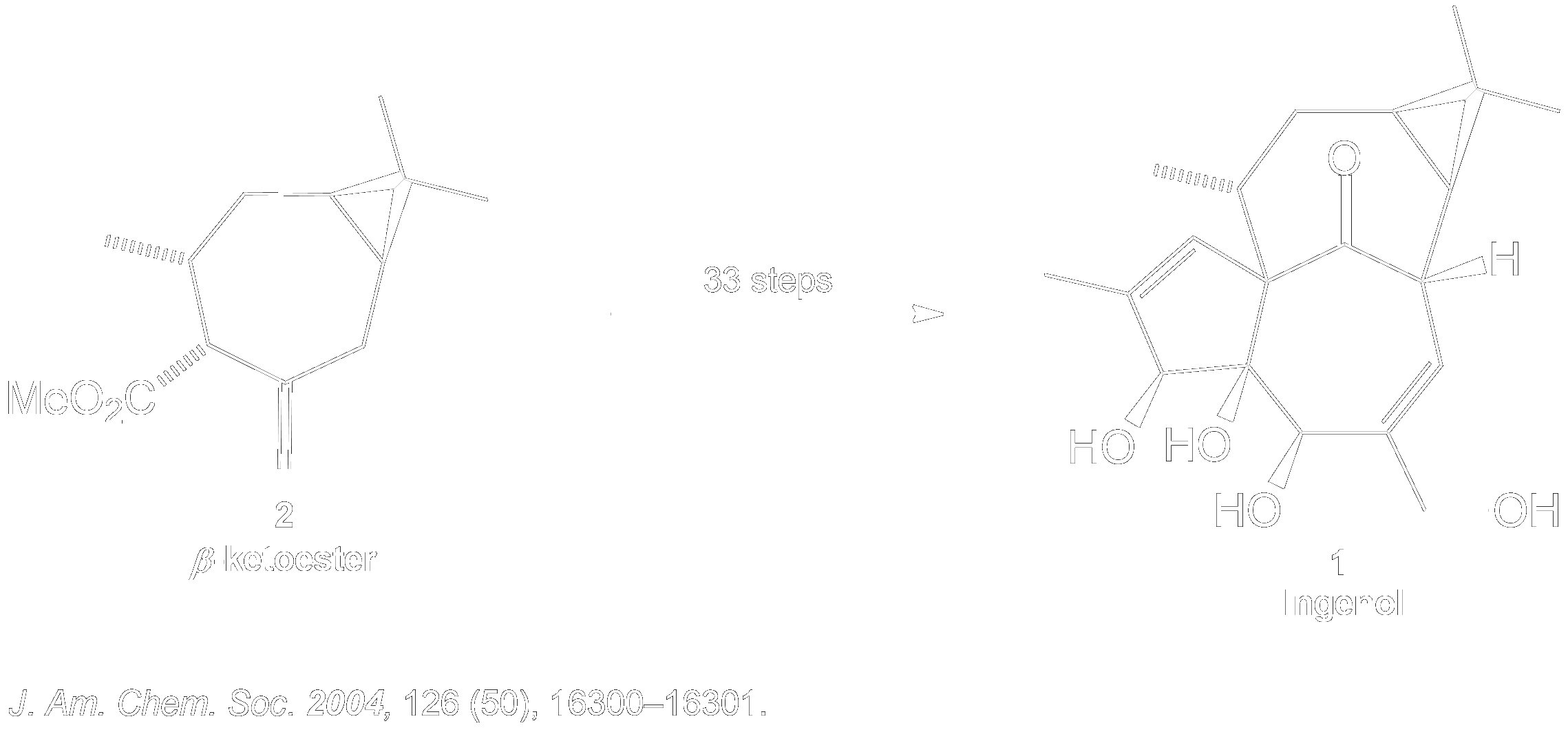
  <Accordion title="Where did this Reaction come from?">
    <div className="text-center">
      <div>
        <a href="https://pubs.acs.org/doi/10.1021/jo00170a070" target="_blank" rel="noopener noreferrer">
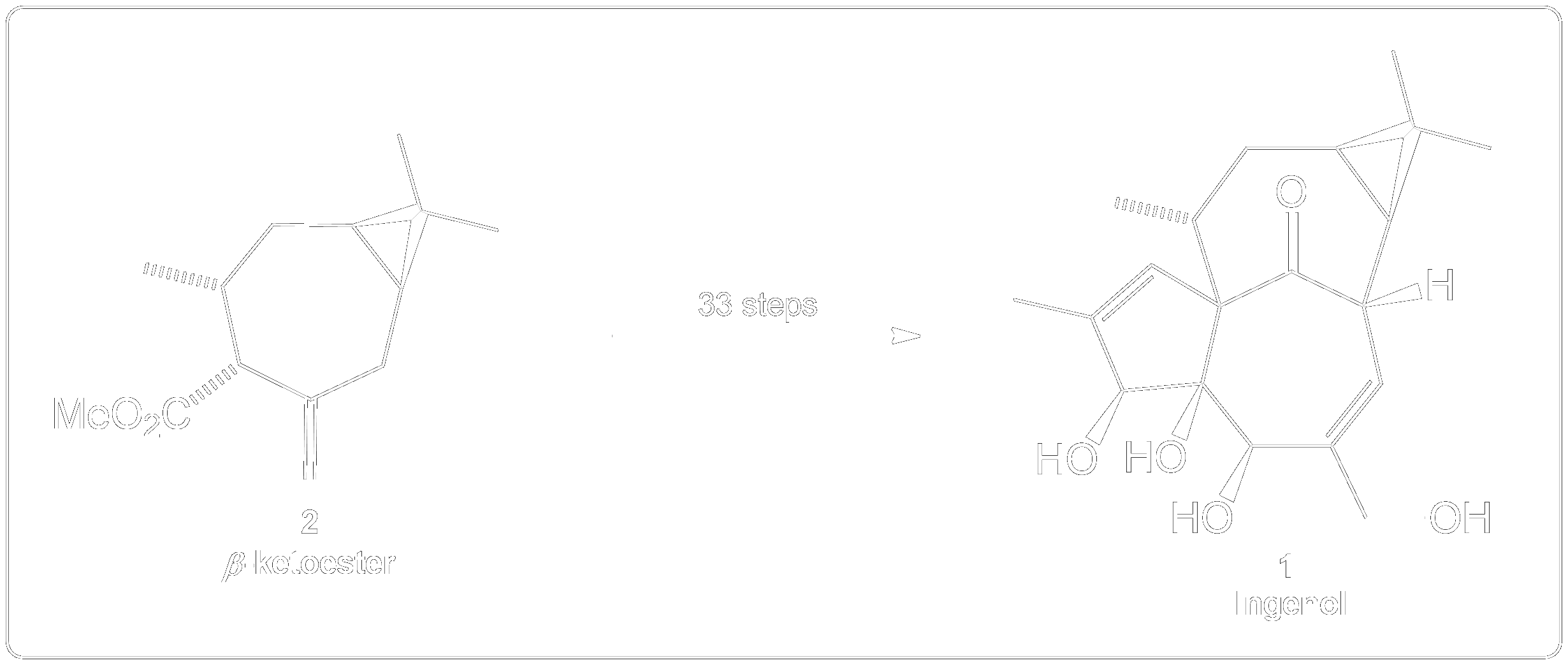
          <img noZoom className="block dark:hidden" src="https://mintcdn.com/reactionrepo-bd9a1c17/wY1qsYNhECm9ojlG/reactions/dess-martin-oxidation/ingenolnoboxnewlight.png?fit=max&auto=format&n=wY1qsYNhECm9ojlG&q=85&s=cf1fd970f675c8bf849797e24b72d17a" alt="Hero Light" title="" width="2278" height="1060" data-path="reactions/dess-martin-oxidation/ingenolnoboxnewlight.png" />

          <img noZoom className="hidden dark:block" src="https://mintcdn.com/reactionrepo-bd9a1c17/wY1qsYNhECm9ojlG/reactions/dess-martin-oxidation/ingenolnoboxnewdark.png?fit=max&auto=format&n=wY1qsYNhECm9ojlG&q=85&s=ef03fc47f8cc7404ee92c7cab44755ae" alt="Hero Dark" title="" width="2278" height="1060" data-path="reactions/dess-martin-oxidation/ingenolnoboxnewdark.png" />
        </a>
      </div>

      <p className="mt-2 text-sm font-bold text-gray-600 dark:text-gray-400">
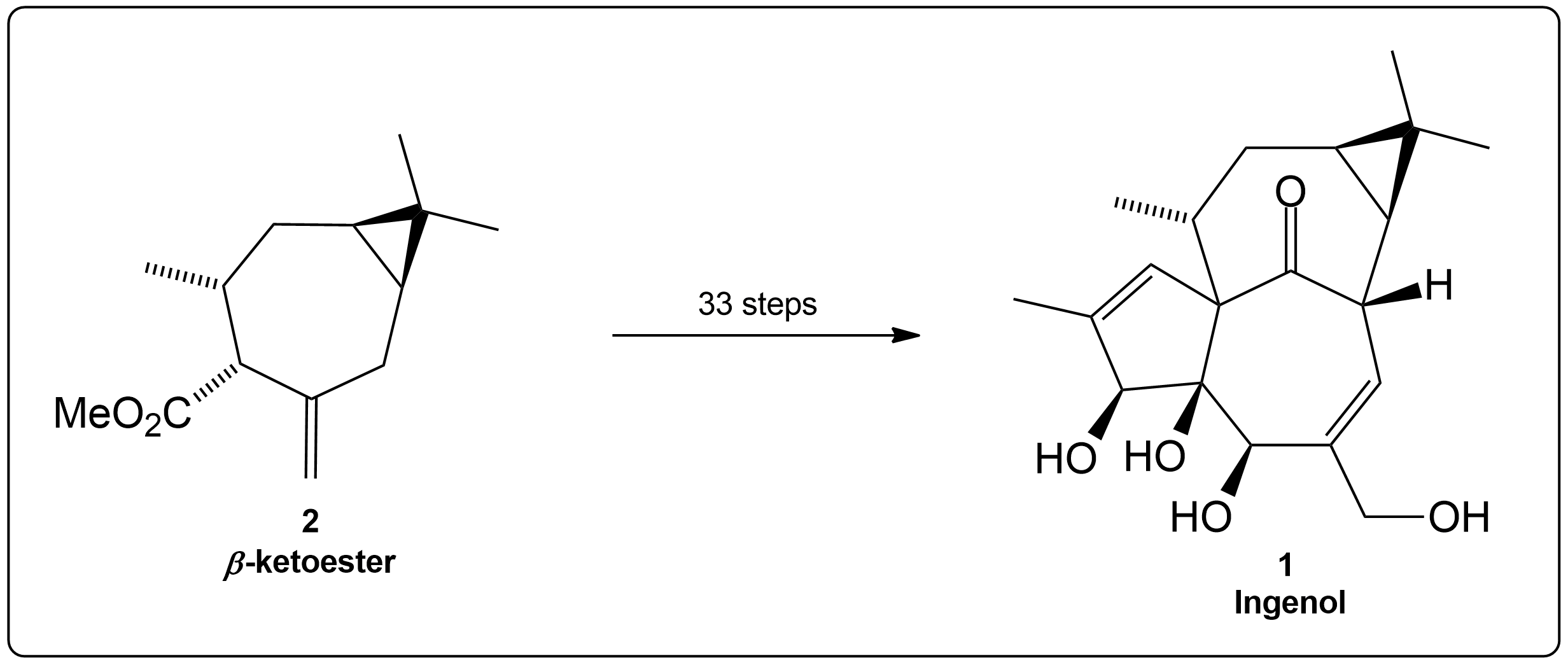
        Synthesis Overview of the Total Synthesis of Ingenol.
      </p>

      <p className="mt-2 text-sm text-gray-600 dark:text-gray-400">
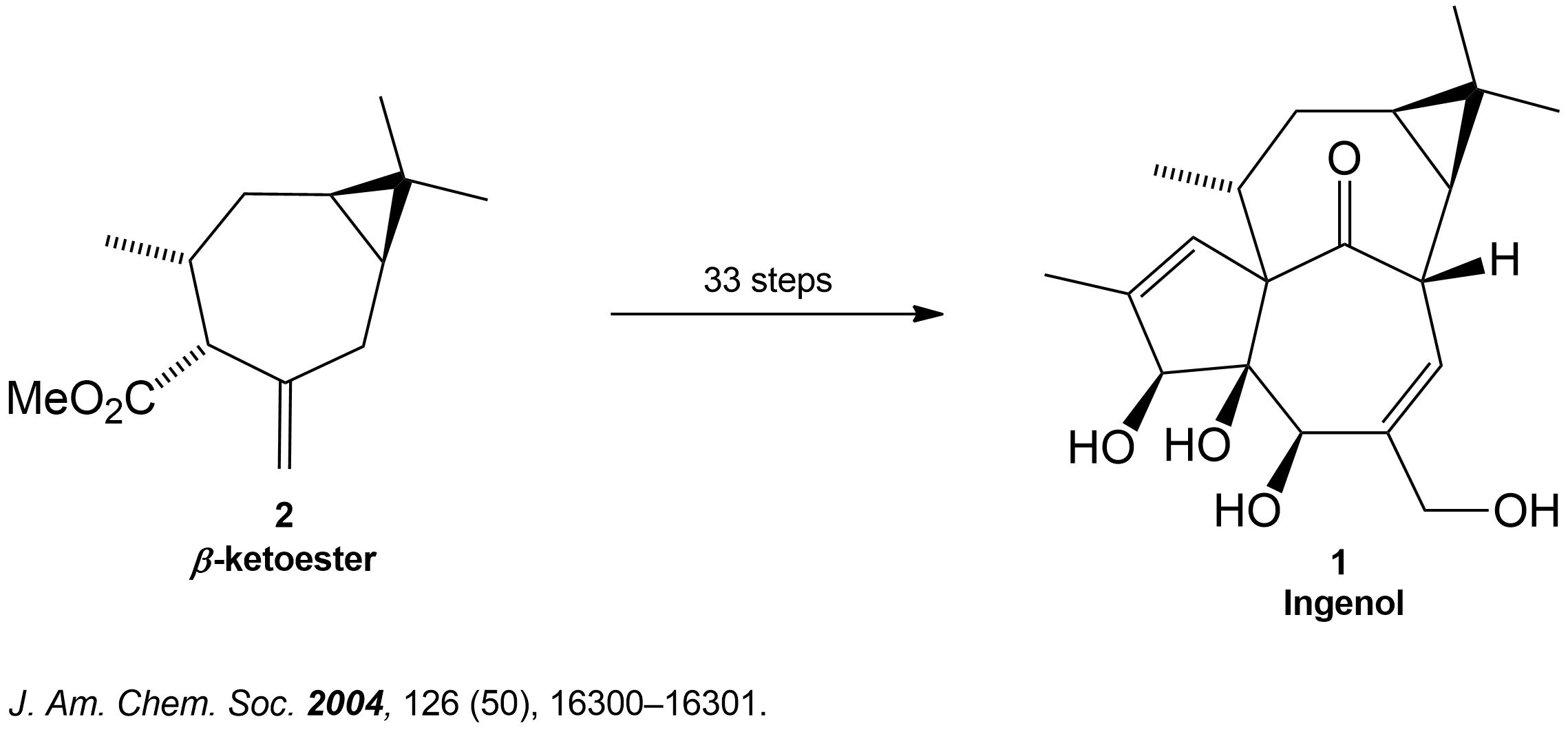
        𝛽-ketoester (2) is subjected through a 32 steps synthesis path to form the target compound Ingenol (1). <sup>**3**</sup>
      </p>
    </div>

    For simplicity, this image summarizes the start and end products of the synthesis in the original paper by [Nickel et al. (2004)](https://doi.org/10.1021/ja044123l), showing the starting material and the overall product. The full pathway is not shown. This is to maintain clarity and focus on building towards when Dess-Martin oxidation is used.
  </Accordion>

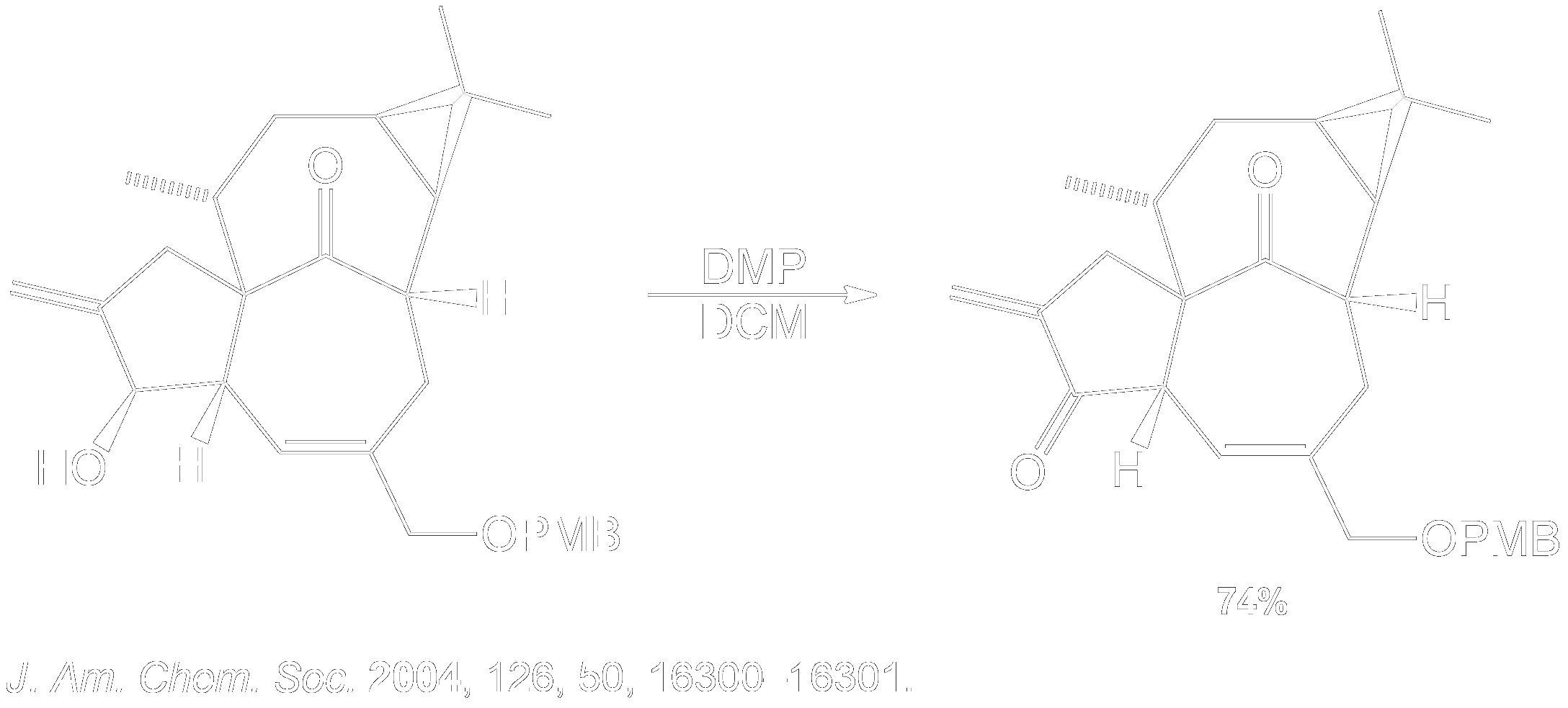
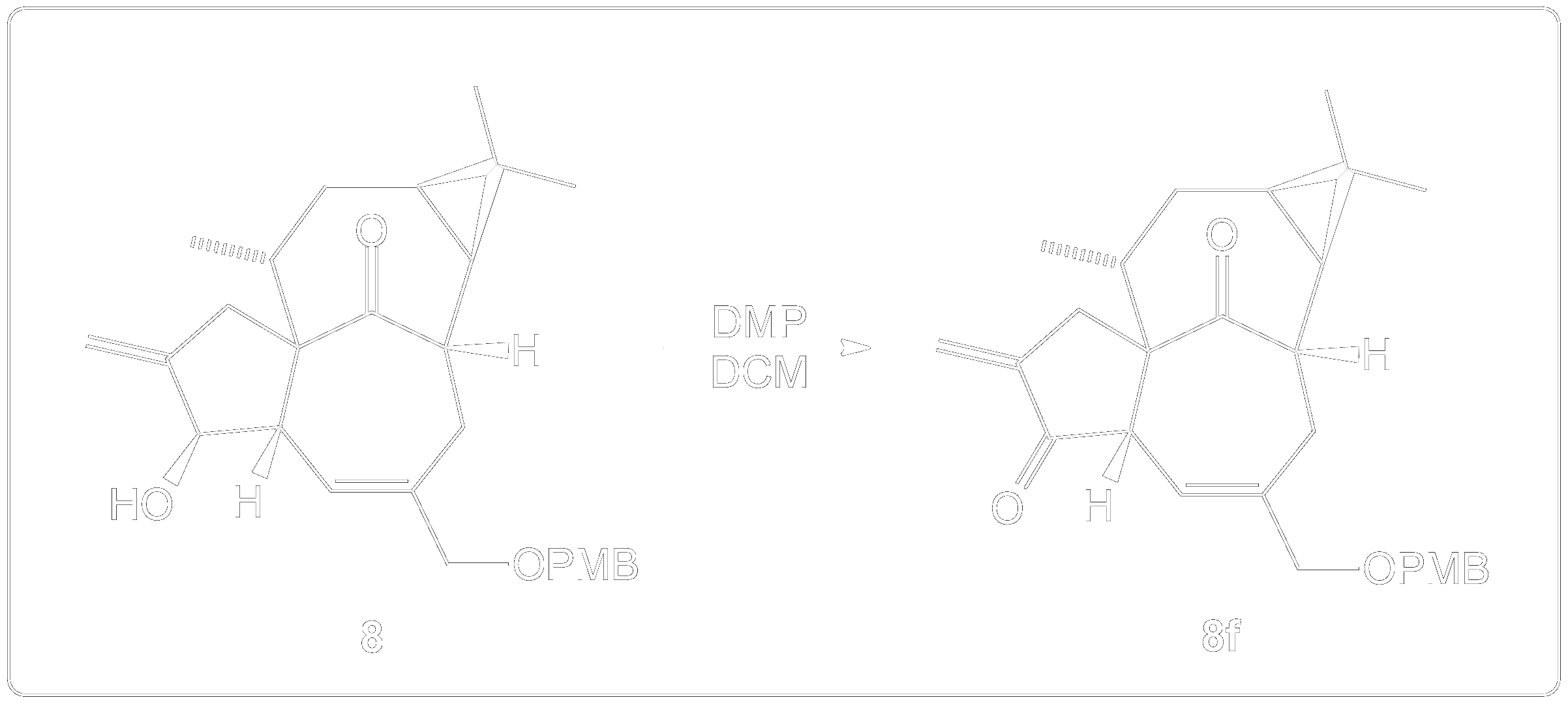
  <Accordion title="How is Dess-Martin Oxidation used?">
    <div className="text-center">
      <div>
        <a href="https://pubs.acs.org/doi/10.1021/ja044123l" target="_blank" rel="noopener noreferrer">
          <img noZoom className="block dark:hidden" src="https://mintcdn.com/reactionrepo-bd9a1c17/wY1qsYNhECm9ojlG/reactions/dess-martin-oxidation/ingenoloxlight.png?fit=max&auto=format&n=wY1qsYNhECm9ojlG&q=85&s=052470dbf4bd0376f5f10e66123f7663" alt="Hero Light" title="" width="2399" height="1075" data-path="reactions/dess-martin-oxidation/ingenoloxlight.png" />

          <img noZoom className="hidden dark:block" src="https://mintcdn.com/reactionrepo-bd9a1c17/wY1qsYNhECm9ojlG/reactions/dess-martin-oxidation/ingenoloxdark.png?fit=max&auto=format&n=wY1qsYNhECm9ojlG&q=85&s=3d752ce1ef1cf09ed062dd7ee5eedffa" alt="Hero Dark" title="" width="2404" height="1079" data-path="reactions/dess-martin-oxidation/ingenoloxdark.png" />
        </a>
      </div>

      <p className="mt-2 text-sm font-bold text-gray-600 dark:text-gray-400">
        Dess-Martin Oxidation Usage in Intermediate Formation.
      </p>

      <p className="mt-2 text-sm text-gray-600 dark:text-gray-400">
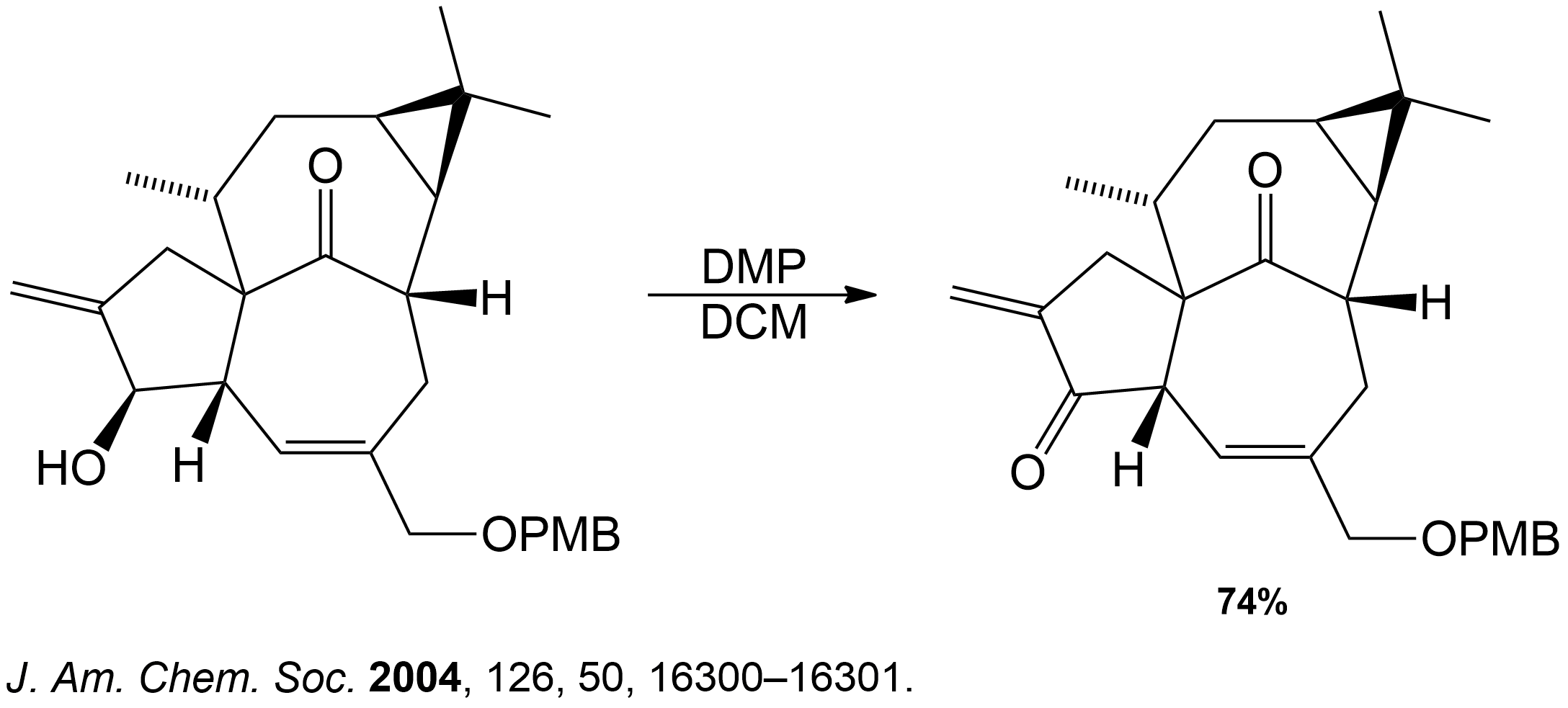
        This reaction showing the Dess-Martin oxidation of the alcohol intermediate was part of the overall synthesis pathway of the formation of Ingenol. Ingenol is the parent compound of several naturally occurring ingenanes with varied peripheral functionalities. These ingenanes display a range of interesting biological profiles, from tumor-promoting to anti-leukemic and anti-HIV activities. <sup>**3**</sup>
      </p>
    </div>

    One key step in the synthesis involved the oxidation of a secondary alcohol intermediate (8) to a ketone intermediate (8f) using Dess-Martin periodinane (DMP) in dichloromethane (DCM). This transformation was achieved with a 74% yield and was crucial in advancing the synthesis. <sup>**3**</sup>
  </Accordion>
</AccordionGroup>

<Steps>
  <Step title="Identify the Right Reagents">
    <img className="block dark:hidden" src="https://mintcdn.com/reactionrepo-bd9a1c17/AqE5enEskAdOSf_C/images/ReagentsDMP.png?fit=max&auto=format&n=AqE5enEskAdOSf_C&q=85&s=a1a874af7ae39a5c98dc972ded3f21c1" alt="Hero Light" width="1382" height="952" data-path="images/ReagentsDMP.png" />

    <img className="hidden dark:block" src="https://mintcdn.com/reactionrepo-bd9a1c17/AqE5enEskAdOSf_C/images/ReagentsDMPdark.png?fit=max&auto=format&n=AqE5enEskAdOSf_C&q=85&s=e333364608d36b5b5b5888aea4a880c5" alt="Hero Dark" width="1384" height="954" data-path="images/ReagentsDMPdark.png" />

    Dess Martin Oxidation is always performed with DMP and a solvent, DCM, in our case which applies to both primary and secondary alcohol oxidations.

    <Note> Once again, if you did not read the [**Reagent Variations section**](/reactionrepo/docs/oxidation-reactions/dess-martin-oxidation/#reagent-variations) on the Dess-Martin Oxidation Overview, please check it out. It is highly recommended to review the information as it covers the variations and key characteristics of key Dess-Martin periodinane (DMP). </Note>
  </Step>

  <Step title="Identify the Key Features of the Compound">
    **Alcohol Type**

    <img className="block dark:hidden" src="https://mintcdn.com/reactionrepo-bd9a1c17/AqE5enEskAdOSf_C/images/AlcoholsNewR3Light.png?fit=max&auto=format&n=AqE5enEskAdOSf_C&q=85&s=913acf540038c272446708b204907ee0" alt="Hero Light" width="1221" height="510" data-path="images/AlcoholsNewR3Light.png" />

    <img className="hidden dark:block" src="https://mintcdn.com/reactionrepo-bd9a1c17/AqE5enEskAdOSf_C/images/AlcoholsNewR3Dark.png?fit=max&auto=format&n=AqE5enEskAdOSf_C&q=85&s=3784939b56dea47d0ef01be8e6342cdc" alt="Hero Dark" width="1221" height="503" data-path="images/AlcoholsNewR3Dark.png" />

    These are the 3 main types of alcohols:

    * Primary
    * Secondary
    * Tertiary
    <Warning> Tertiary alcohols cannot go through Dess-Martin oxidation. </Warning>

    * Primary alcohols can go through Dess-Martin Oxidation to become an **Aldehyde**.

    By identifying the Alcohol Type, you now know the **product** to expect.
  </Step>

  <Step title="Identifying Side Chains and Alcohol Conversion">
    <div className="text-center">
      <div>
        <img className="block dark:hidden" src="https://mintcdn.com/reactionrepo-bd9a1c17/IFWEEywjS-o2nCIa/reactions/dess-martin-oxidation/DMPSecondaryQ1LightHighlighted.png?fit=max&auto=format&n=IFWEEywjS-o2nCIa&q=85&s=0889ae6116d598274fa1f6ce115c709d" alt="Hero Light" title="" width="2170" height="913" data-path="reactions/dess-martin-oxidation/DMPSecondaryQ1LightHighlighted.png" />

        <img className="hidden dark:block" src="https://mintcdn.com/reactionrepo-bd9a1c17/IFWEEywjS-o2nCIa/reactions/dess-martin-oxidation/DMPSecondaryQ1DarkHighlighted.png?fit=max&auto=format&n=IFWEEywjS-o2nCIa&q=85&s=227897c687daf1e05c079f18c8243ac2" alt="Hero Dark" title="" width="2170" height="913" data-path="reactions/dess-martin-oxidation/DMPSecondaryQ1DarkHighlighted.png" />
      </div>

      <p className="mt-2 text-sm font-bold text-gray-600 dark:text-gray-400">
        Tracking Side Chains and Alcohol Conversion in Dess-Martin Oxidation
      </p>

      <p className="mt-2 text-sm text-gray-600 dark:text-gray-400">
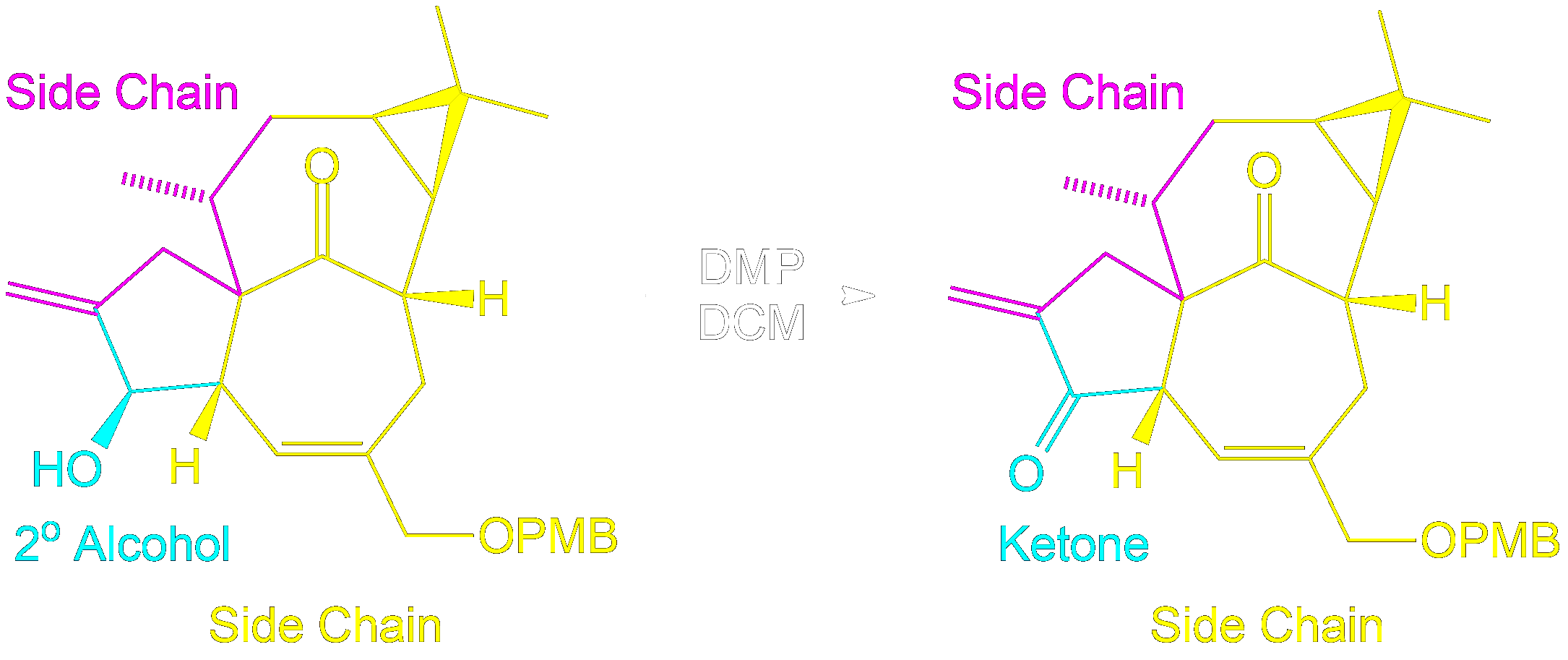
        In Dess-Martin oxidation of secondary alcohols, the colored side chains represent R groups that remain unchanged during the reaction.
      </p>
    </div>

    The alcohol group is selectively oxidized to form a ketone. For educational purposes,parts of the molecule are assigned and used as placeholders to demonstrate the reaction. Students! Please use parts of the molecule as placeholders: R¹ can be one part of the molecule on one side of the molecule and R² can be the remainder of the full molecule (except the secondary alcohol and the first side chain of course). This allows for easy reconstruction of the molecule after oxidation, to visually see the selective nature of the reaction.

    <Tip>The molecule isn’t taken apart during the reaction, but for understanding the process, we conceptually take it apart to visualize the changes. This allows for easy reconstruction of the molecule after oxidation, emphasizing the selective nature of the reaction for educational purposes.</Tip>

    1. **Identify Side Chains (R¹ and R²)**: Use parts of the molecule as placeholders (R¹ and R²), representing parts of the molecule flanking the alcohol group.

    2. **Understand Their Role**: These placeholders help track the unchanged parts of the molecule, aiding in visualizing the structure before and after the reaction.

    3. **Focus on the Reaction Center**: The secondary alcohol is selectively oxidized to form a ketone. The placeholders show how the structure is altered.

    4. **Reassign Side Chains**: After the reaction, reattach the placeholders (R¹ and R²) to the new ketone, demonstrating the unchanged nature of the side chains.

    Once you've identified the correct reaction and product, you can now proceed to doing the mechanism.
  </Step>
</Steps>

## Mechanism for 2° Alcohol

This section is a brief overview on how to perform the mechanism for a 2° Alcohol (Secondary) using the example from above.

<Steps>
  <Step title="Reactive Intermediate Formation">
    <div className="text-center">
      <div>
        <img className="block dark:hidden" src="https://mintcdn.com/reactionrepo-bd9a1c17/wY1qsYNhECm9ojlG/reactions/dess-martin-oxidation/light1.png?fit=max&auto=format&n=wY1qsYNhECm9ojlG&q=85&s=1c2b4fd34777d3889c24867975d5d30b" alt="Hero Light" title="" width="1154" height="675" data-path="reactions/dess-martin-oxidation/light1.png" />

        <img className="hidden dark:block" src="https://mintcdn.com/reactionrepo-bd9a1c17/IFWEEywjS-o2nCIa/reactions/dess-martin-oxidation/dark1.png?fit=max&auto=format&n=IFWEEywjS-o2nCIa&q=85&s=01af0575565f8ede0e8882df7072e760" alt="Hero Dark" title="" width="1154" height="675" data-path="reactions/dess-martin-oxidation/dark1.png" />
      </div>

      <p className="mt-2 text-sm font-bold text-gray-600 dark:text-gray-400">
        Formation of Reactive Intermediate with Secondary Alcohol
      </p>

      <p className="mt-2 text-sm text-gray-600 dark:text-gray-400">
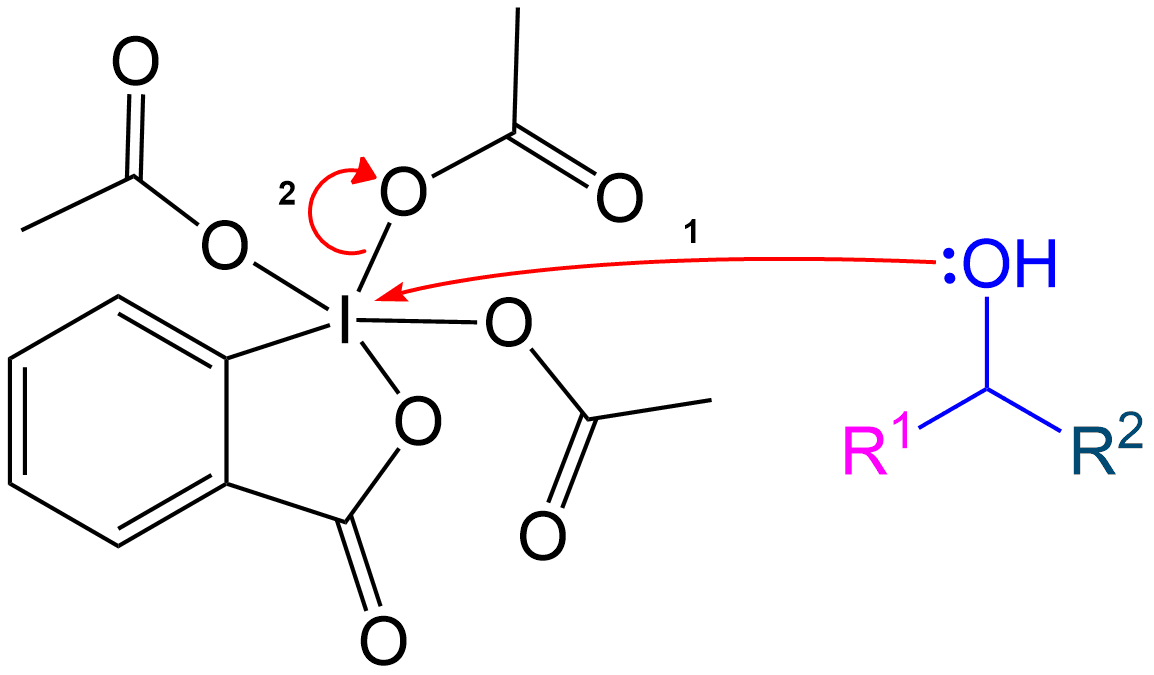
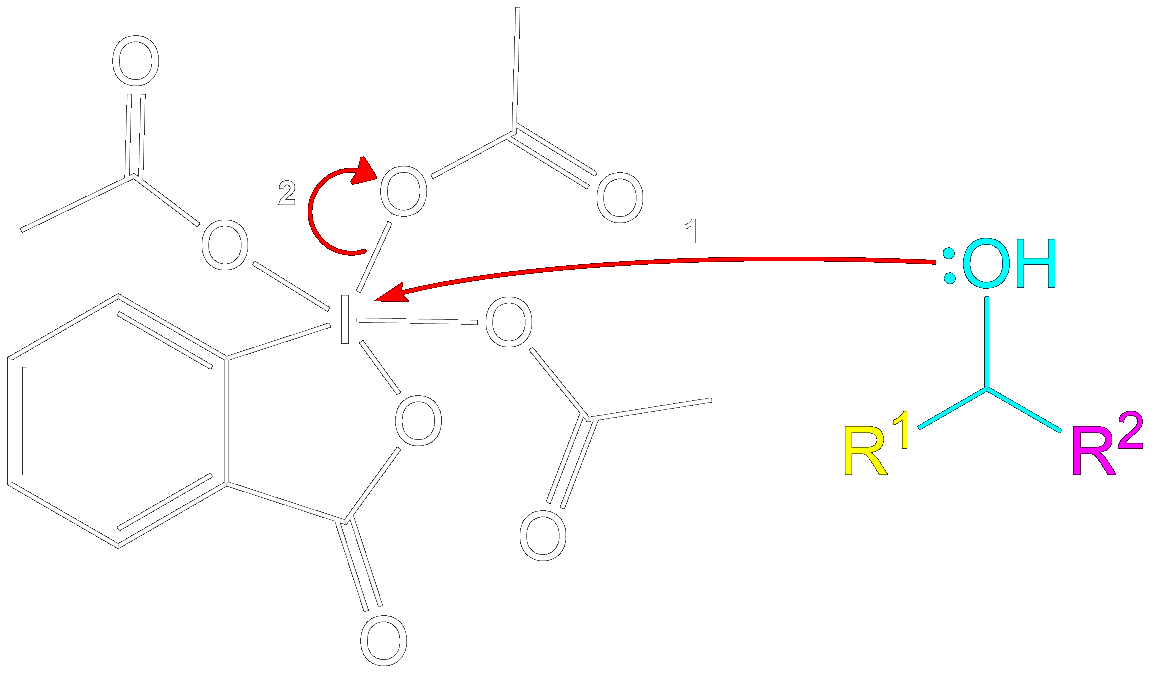
        The mechanism follows the same steps as the primary alcohol oxidation but includes an additional side chain.
      </p>
    </div>

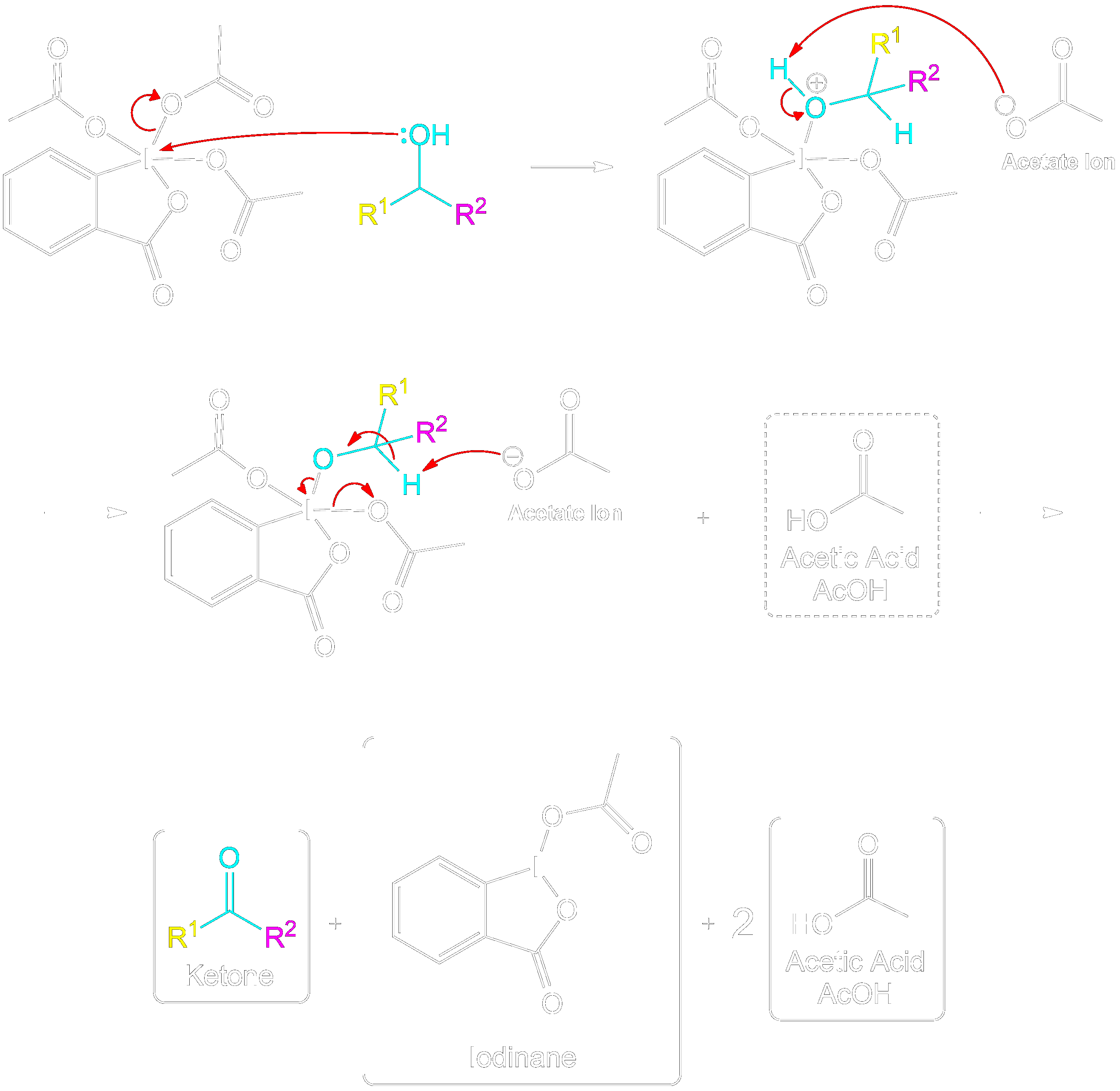
    In this step, the secondary alcohol group (-OH) reacts with the Dess-Martin Periodinane (DMP), similar to the primary alcohol mechanism. The difference lies in the presence of an additional side chain (R²) attached to the carbon bearing the hydroxyl group.

    <Accordion title="See the Shortform Version of this Step">
      <img className="block dark:hidden" src="https://mintcdn.com/reactionrepo-bd9a1c17/wY1qsYNhECm9ojlG/reactions/dess-martin-oxidation/lightshort1sec.png?fit=max&auto=format&n=wY1qsYNhECm9ojlG&q=85&s=71ad4528349f6443a764009f8435fc83" alt="Hero Light" width="1154" height="516" data-path="reactions/dess-martin-oxidation/lightshort1sec.png" />

      <img className="hidden dark:block" src="https://mintcdn.com/reactionrepo-bd9a1c17/IFWEEywjS-o2nCIa/reactions/dess-martin-oxidation/darkshort1sec.png?fit=max&auto=format&n=IFWEEywjS-o2nCIa&q=85&s=65043a93cb5aaf115be8ab2b092e2f55" alt="Hero Dark" width="1154" height="516" data-path="reactions/dess-martin-oxidation/darkshort1sec.png" />
    </Accordion>
  </Step>

  <Step title="Stabilization with Acetate Ion">
    <div className="text-center">
      <div>
        <img className="block dark:hidden" src="https://mintcdn.com/reactionrepo-bd9a1c17/wY1qsYNhECm9ojlG/reactions/dess-martin-oxidation/seclightmech2.png?fit=max&auto=format&n=wY1qsYNhECm9ojlG&q=85&s=8ad2f8bfe570abd4adaf153e20d9fb06" alt="Hero Light" title="" width="1095" height="778" data-path="reactions/dess-martin-oxidation/seclightmech2.png" />

        <img className="hidden dark:block" src="https://mintcdn.com/reactionrepo-bd9a1c17/wY1qsYNhECm9ojlG/reactions/dess-martin-oxidation/secdarkmech2.png?fit=max&auto=format&n=wY1qsYNhECm9ojlG&q=85&s=d70b24c629541a6845fe68499d83ff33" alt="Hero Dark" title="" width="1095" height="778" data-path="reactions/dess-martin-oxidation/secdarkmech2.png" />
      </div>

      <p className="mt-2 text-sm font-bold text-gray-600 dark:text-gray-400">
        Stabilization of Reactive Intermediate Using an Acetate Ion
      </p>

      <p className="mt-2 text-sm text-gray-600 dark:text-gray-400">
        The intermediate is stabilized by the expelled OAc group (Acetoxy group).The expelled acetoxy group becomes an acetate ion (CH₃COO⁻).
      </p>
    </div>

    After the initial reaction, the intermediate is stabilized by the expulsion of the acetoxy group (OAc). In the molecule, the OAc group is initially an acetoxy group (CH₃COO-). However, once it is expelled from the Dess-Martin Periodinane (DMP), it becomes an acetate ion (CH₃COO⁻). This occurs because the acetoxy group acts as a good leaving group, taking an extra electron pair with it and becoming a stable, negatively charged acetate ion.

    <Accordion title="See the Shortform Version of this Step">
      <img className="block dark:hidden" src="https://mintcdn.com/reactionrepo-bd9a1c17/wY1qsYNhECm9ojlG/reactions/dess-martin-oxidation/lightshort2sec2.png?fit=max&auto=format&n=wY1qsYNhECm9ojlG&q=85&s=d921022db69ebf2d46b7d111d41b3915" alt="Hero Light" width="964" height="768" data-path="reactions/dess-martin-oxidation/lightshort2sec2.png" />

      <img className="hidden dark:block" src="https://mintcdn.com/reactionrepo-bd9a1c17/IFWEEywjS-o2nCIa/reactions/dess-martin-oxidation/darkshort2sec2.png?fit=max&auto=format&n=IFWEEywjS-o2nCIa&q=85&s=803afa421c5a527bb20b5a3a3bbf247e" alt="Hero Dark" width="964" height="768" data-path="reactions/dess-martin-oxidation/darkshort2sec2.png" />
    </Accordion>
  </Step>

  <Step title="Ketone Formation and Acetic Acid Recovery">
    <div className="text-center">
      <div>
        <img className="block dark:hidden" src="https://mintcdn.com/reactionrepo-bd9a1c17/wY1qsYNhECm9ojlG/reactions/dess-martin-oxidation/seclightmech3.png?fit=max&auto=format&n=wY1qsYNhECm9ojlG&q=85&s=50d9348fcc499fe50cf5143a8b43858e" alt="Hero Light" title="" width="1752" height="671" data-path="reactions/dess-martin-oxidation/seclightmech3.png" />

        <img className="hidden dark:block" src="https://mintcdn.com/reactionrepo-bd9a1c17/wY1qsYNhECm9ojlG/reactions/dess-martin-oxidation/secdarkmech3.png?fit=max&auto=format&n=wY1qsYNhECm9ojlG&q=85&s=a3a8a6f53aea63cd01835574a9fbb7da" alt="Hero Dark" title="" width="1752" height="671" data-path="reactions/dess-martin-oxidation/secdarkmech3.png" />
      </div>

      <p className="mt-2 text-sm font-bold text-gray-600 dark:text-gray-400">
        Formation of Ketone Product and Recovery of Acetic Acid.
      </p>

      <p className="mt-2 text-sm text-gray-600 dark:text-gray-400">
        Acetic acid is recovered, and the intermediate becomes a ketone after proton transfer.
      </p>
    </div>

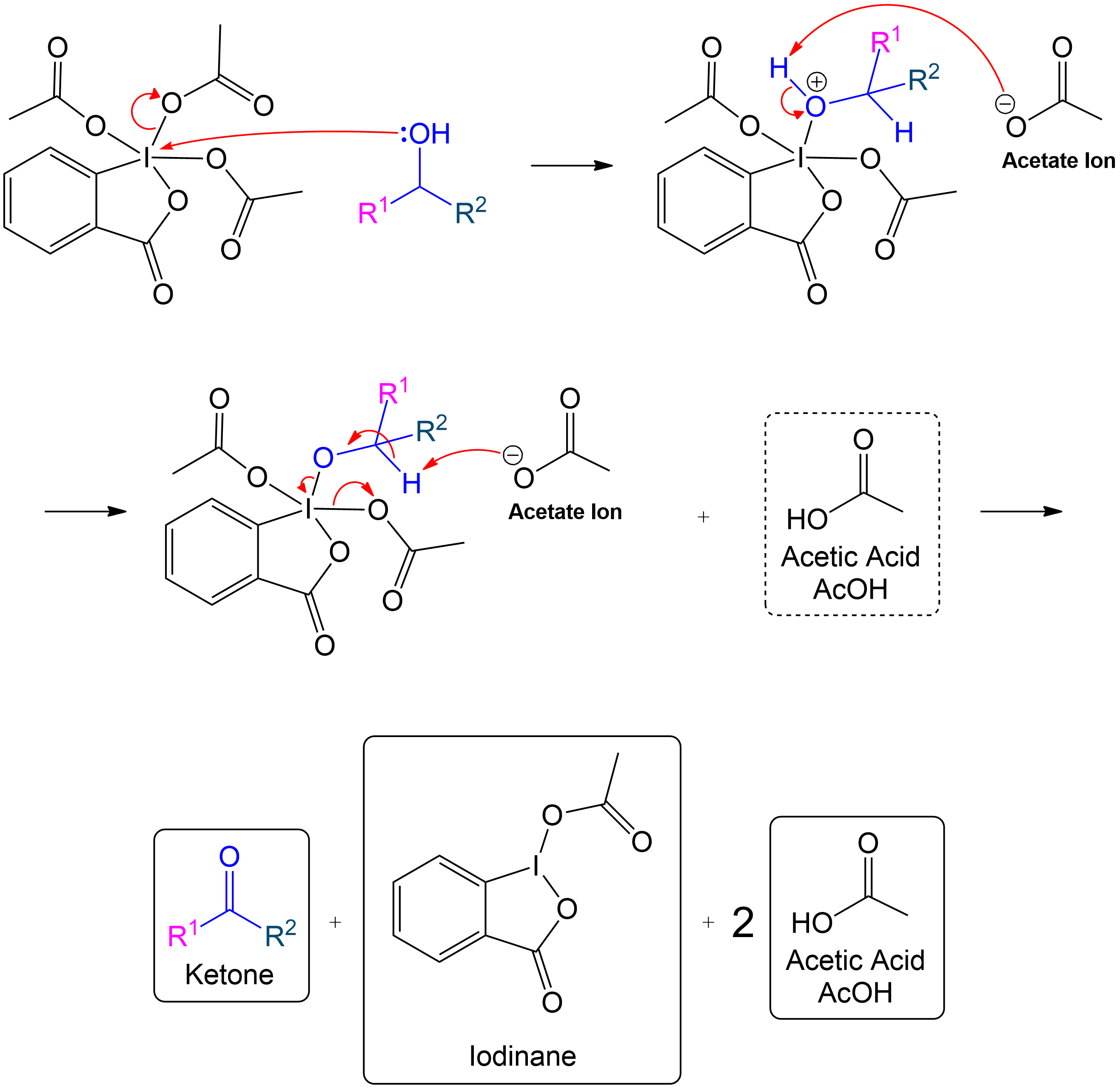
    In this step, one mole of acetic acid is recovered. The intermediate undergoes a proton transfer, initiated by another acetate ion, resulting in the formation of the ketone product and acetic acid as a by-product.

    <Accordion title="See the Shortform Version of this Step">
      <img className="block dark:hidden" src="https://mintcdn.com/reactionrepo-bd9a1c17/wY1qsYNhECm9ojlG/reactions/dess-martin-oxidation/lightshort3sec2.png?fit=max&auto=format&n=wY1qsYNhECm9ojlG&q=85&s=bbf7578611149d1479b532cdc0111395" alt="Hero Light" width="1631" height="671" data-path="reactions/dess-martin-oxidation/lightshort3sec2.png" />

      <img className="hidden dark:block" src="https://mintcdn.com/reactionrepo-bd9a1c17/IFWEEywjS-o2nCIa/reactions/dess-martin-oxidation/darkshort3sec2.png?fit=max&auto=format&n=IFWEEywjS-o2nCIa&q=85&s=e9016f0366dae012bc28803cbb9d7e0b" alt="Hero Dark" width="1631" height="671" data-path="reactions/dess-martin-oxidation/darkshort3sec2.png" />
    </Accordion>
  </Step>

  <Step title="Final Overall Products">
    <div className="text-center">
      <div>
        <img className="block dark:hidden" src="https://mintcdn.com/reactionrepo-bd9a1c17/IFWEEywjS-o2nCIa/reactions/dess-martin-oxidation/Lightprod.png?fit=max&auto=format&n=IFWEEywjS-o2nCIa&q=85&s=c6efa3b85f900e62e1137a75a09d6bd9" alt="Hero Light" title="" width="1879" height="840" data-path="reactions/dess-martin-oxidation/Lightprod.png" />

        <img className="hidden dark:block" src="https://mintcdn.com/reactionrepo-bd9a1c17/IFWEEywjS-o2nCIa/reactions/dess-martin-oxidation/Darkprod.png?fit=max&auto=format&n=IFWEEywjS-o2nCIa&q=85&s=62cf399a0744d8baff29e00ed58098f0" alt="Hero Dark" title="" width="1879" height="840" data-path="reactions/dess-martin-oxidation/Darkprod.png" />
      </div>

      <p className="mt-2 text-sm font-bold text-gray-600 dark:text-gray-400">
        Final Products of Dess-Martin Oxidation with Secondary Alcohol
      </p>

      <p className="mt-2 text-sm text-gray-600 dark:text-gray-400">
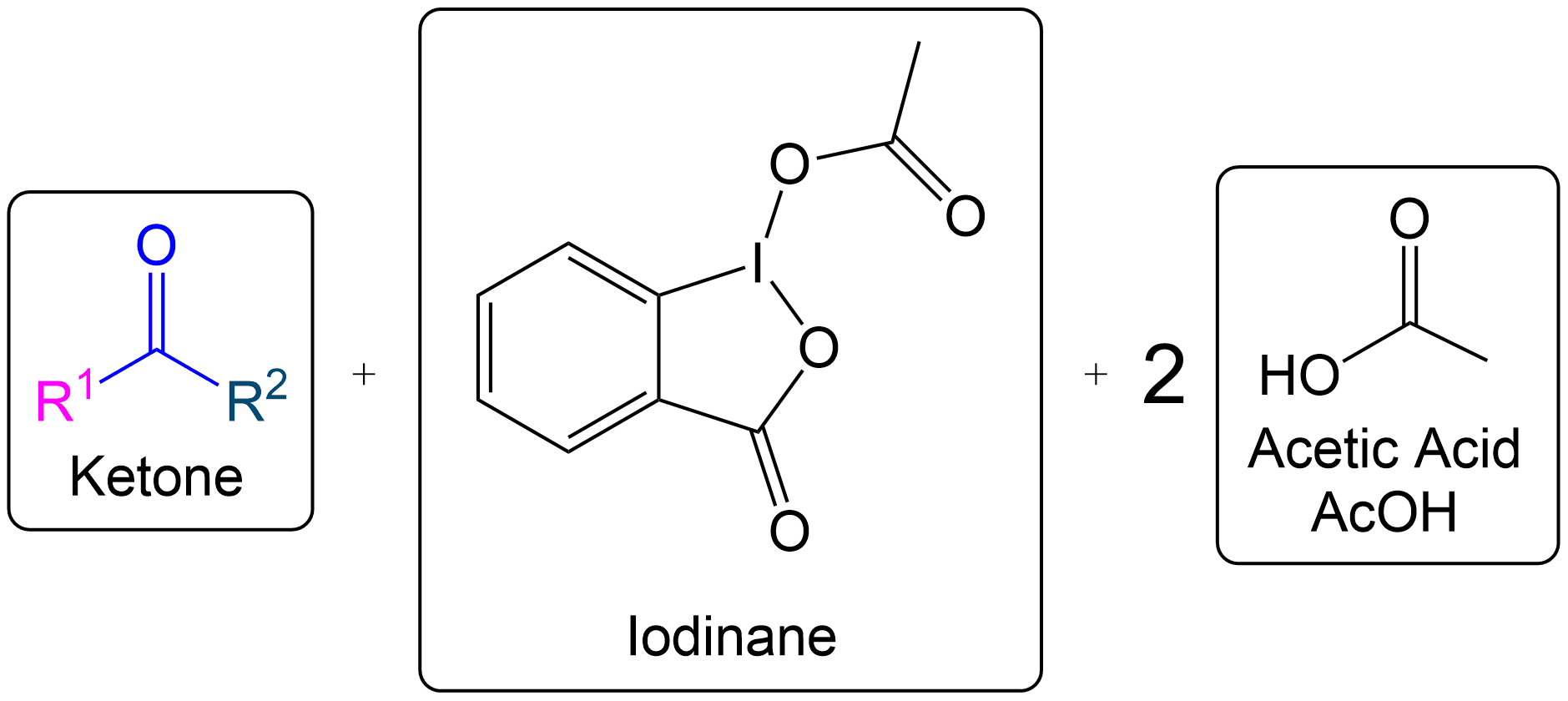
        The products are similar to those in the primary alcohol oxidation mechanism, with the key difference being the formation of a ketone instead of an aldehyde.
      </p>
    </div>

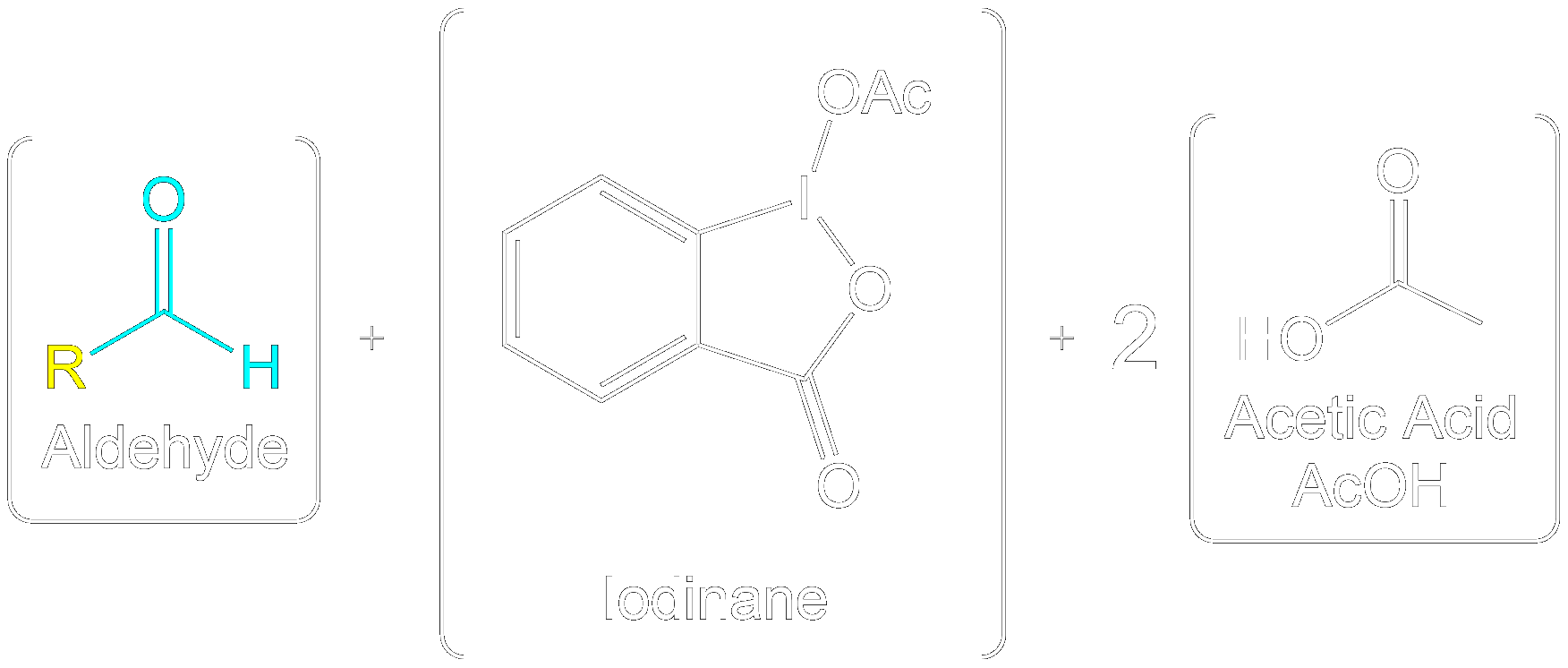
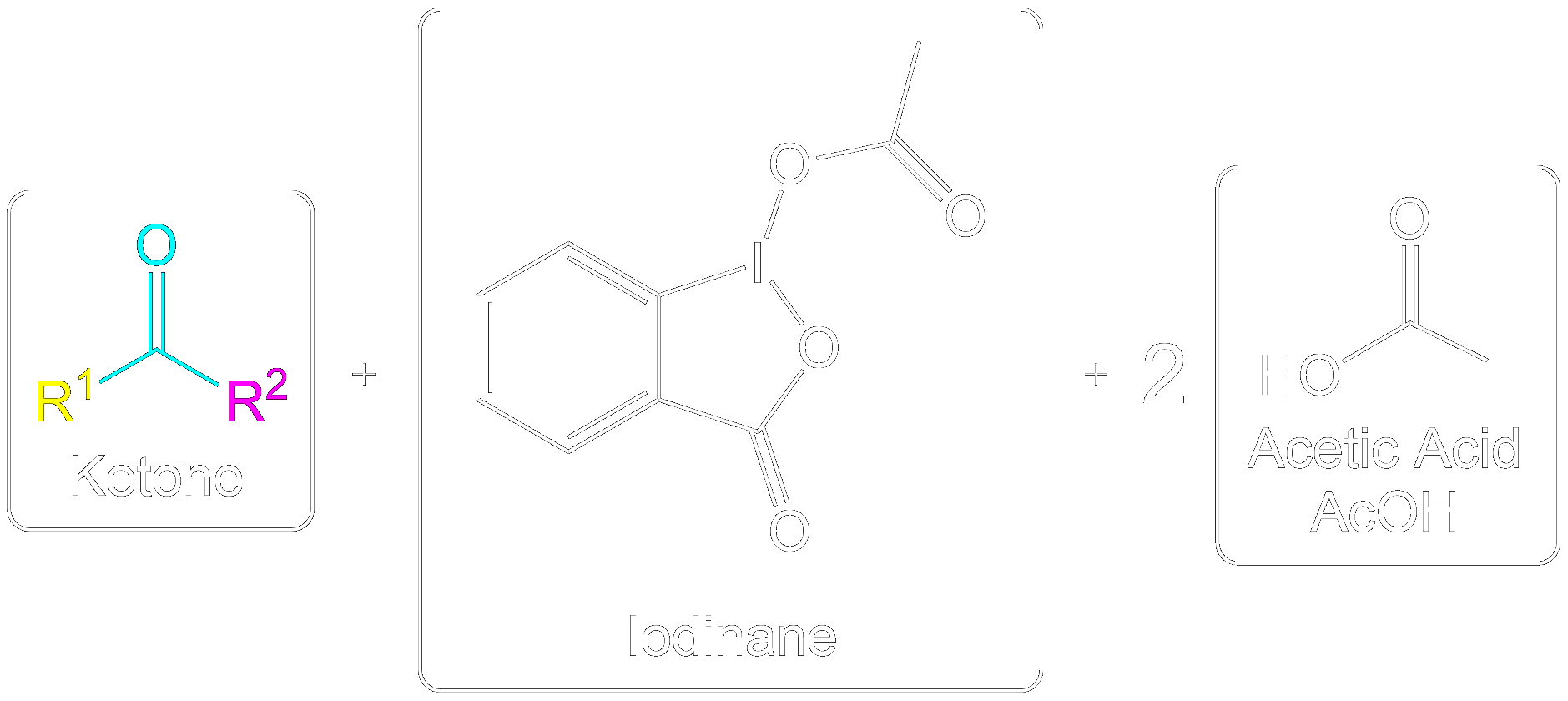
    The final products of the Dess-Martin oxidation for secondary alcohols include the ketone formed from the secondary alcohol, iodinane as a by-product, and the recovery of two moles of acetic acid.

    <Accordion title="See the Shortform Version of the Products">
      <img className="block dark:hidden" src="https://mintcdn.com/reactionrepo-bd9a1c17/wY1qsYNhECm9ojlG/reactions/dess-martin-oxidation/secprod1lite.png?fit=max&auto=format&n=wY1qsYNhECm9ojlG&q=85&s=0462bfbbe7891afe4fb4a48b6909f02d" alt="Hero Light" width="1752" height="746" data-path="reactions/dess-martin-oxidation/secprod1lite.png" />

      <img className="hidden dark:block" src="https://mintcdn.com/reactionrepo-bd9a1c17/wY1qsYNhECm9ojlG/reactions/dess-martin-oxidation/secprod1dark.png?fit=max&auto=format&n=wY1qsYNhECm9ojlG&q=85&s=30541260bbf47048bf87c3fc5330a2aa" alt="Hero Dark" width="1752" height="746" data-path="reactions/dess-martin-oxidation/secprod1dark.png" />
    </Accordion>
  </Step>
</Steps>

## Sample Problems

Test your Knowledge.

### Question 1

Predict the Product.

<img className="block dark:hidden" src="https://mintcdn.com/reactionrepo-bd9a1c17/IFWEEywjS-o2nCIa/reactions/dess-martin-oxidation/DMPSecondaryQ2LightGuess.png?fit=max&auto=format&n=IFWEEywjS-o2nCIa&q=85&s=91b83dda575a425fc781c04c9cf85078" alt="Hero Light" width="2625" height="606" data-path="reactions/dess-martin-oxidation/DMPSecondaryQ2LightGuess.png" />

<img className="hidden dark:block" src="https://mintcdn.com/reactionrepo-bd9a1c17/IFWEEywjS-o2nCIa/reactions/dess-martin-oxidation/DMPSecondaryQ2DarkGuess.png?fit=max&auto=format&n=IFWEEywjS-o2nCIa&q=85&s=073af829a4c43a5f1828e8c7ec5ed6f8" alt="Hero Dark" width="2625" height="606" data-path="reactions/dess-martin-oxidation/DMPSecondaryQ2DarkGuess.png" />

<Note> You do not need to calculate yield </Note>

<Accordion title="Reveal the Answer.">
  <div className="text-center">
    <div>
      <img className="block dark:hidden" src="https://mintcdn.com/reactionrepo-bd9a1c17/IFWEEywjS-o2nCIa/reactions/dess-martin-oxidation/DMPSecondaryQ2Light.png?fit=max&auto=format&n=IFWEEywjS-o2nCIa&q=85&s=aa09feb962b78ef0f90ef7dbb83ec0bb" alt="Hero Light" title="" width="2589" height="586" data-path="reactions/dess-martin-oxidation/DMPSecondaryQ2Light.png" />

      <img className="hidden dark:block" src="https://mintcdn.com/reactionrepo-bd9a1c17/IFWEEywjS-o2nCIa/reactions/dess-martin-oxidation/DMPQ1AnsD.png?fit=max&auto=format&n=IFWEEywjS-o2nCIa&q=85&s=c8026c377eebda56e54e237293ee7e4c" alt="Hero Dark" title="" width="2589" height="586" data-path="reactions/dess-martin-oxidation/DMPQ1AnsD.png" />
    </div>

    <p className="mt-2 text-sm font-bold text-gray-600 dark:text-gray-400">
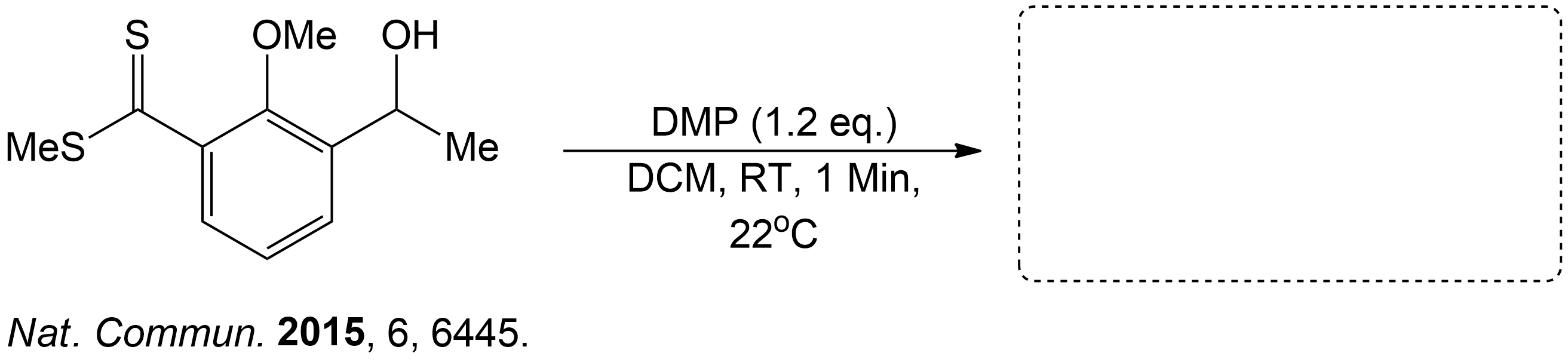
      This compound was a secondary alcohol which was oxidized to a ketone.
    </p>

    <p className="mt-2 text-sm text-gray-600 dark:text-gray-400">
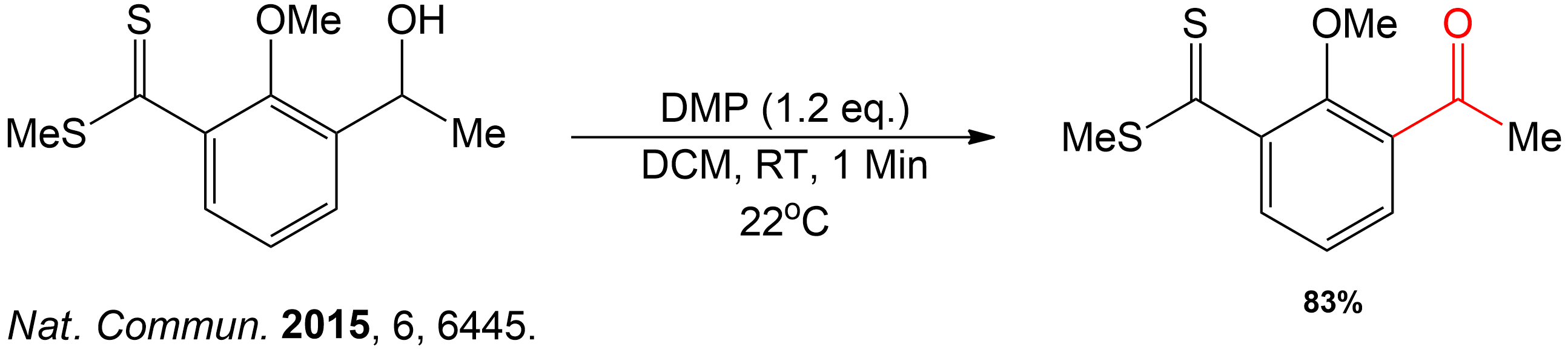
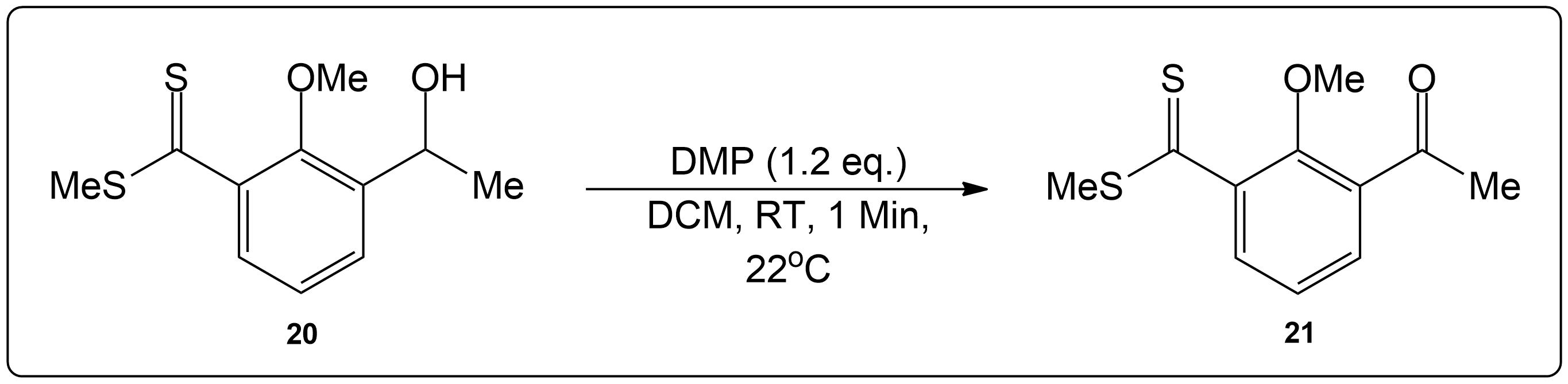
      The alcohol intermediate was oxidized to a ketone using Dess-Martin periodinane (DMP) in dichloromethane (DCM) in room temperature (RT) for 1 minute.
    </p>
  </div>

  This transformation was achieved with an 83% yield and preserved the sulfur-containing functionalities <sup>**4**</sup>

  <Note> The **83%** was reported in the [paper](https://doi.org/10.1038/ncomms7445) where this reaction came from, you do did not need to calculate this. </Note>
</Accordion>

<AccordionGroup>
  <Accordion title="Where did this Reaction come from?">
    <div className="text-center">
      <div>
        <a href="https://doi.org/10.1038/ncomms7445" target="_blank" rel="noopener noreferrer">
          <img noZoom className="block dark:hidden" src="https://mintcdn.com/reactionrepo-bd9a1c17/IFWEEywjS-o2nCIa/reactions/dess-martin-oxidation/DMPSecondarylightnoBox3.png?fit=max&auto=format&n=IFWEEywjS-o2nCIa&q=85&s=9288b6765ce185b5413aaac26c38bad3" alt="Hero Light" title="" width="4751" height="1250" data-path="reactions/dess-martin-oxidation/DMPSecondarylightnoBox3.png" />

          <img noZoom className="hidden dark:block" src="https://mintcdn.com/reactionrepo-bd9a1c17/IFWEEywjS-o2nCIa/reactions/dess-martin-oxidation/DMPSecondaryDarknoBox3.png?fit=max&auto=format&n=IFWEEywjS-o2nCIa&q=85&s=98cc2c739d2a954aebd0076ff53e15c1" alt="Hero Dark" title="" width="4751" height="1242" data-path="reactions/dess-martin-oxidation/DMPSecondaryDarknoBox3.png" />
        </a>
      </div>

      <p className="mt-2 text-sm font-bold text-gray-600 dark:text-gray-400">
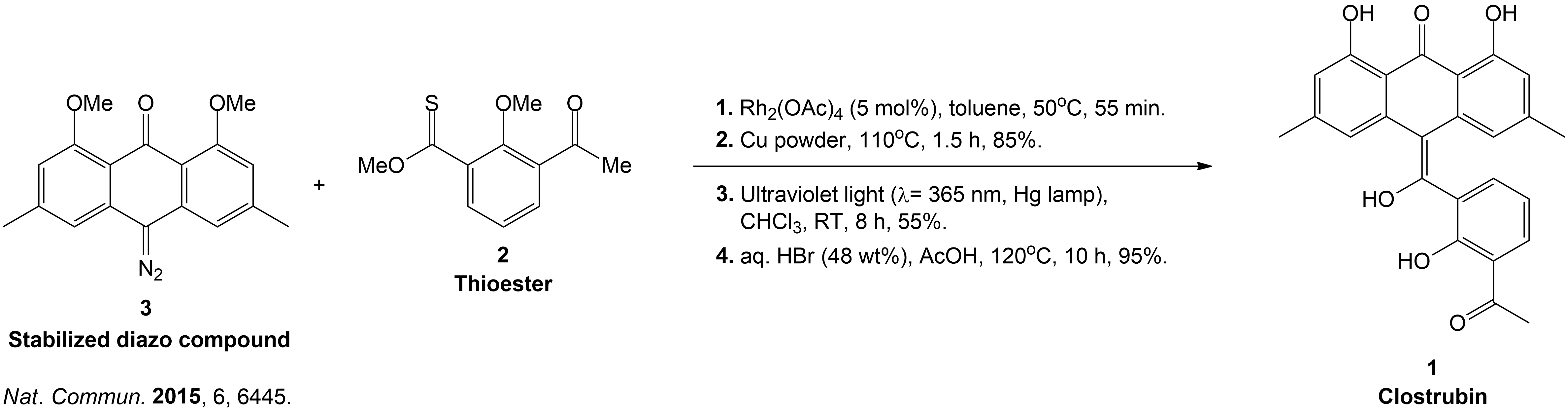
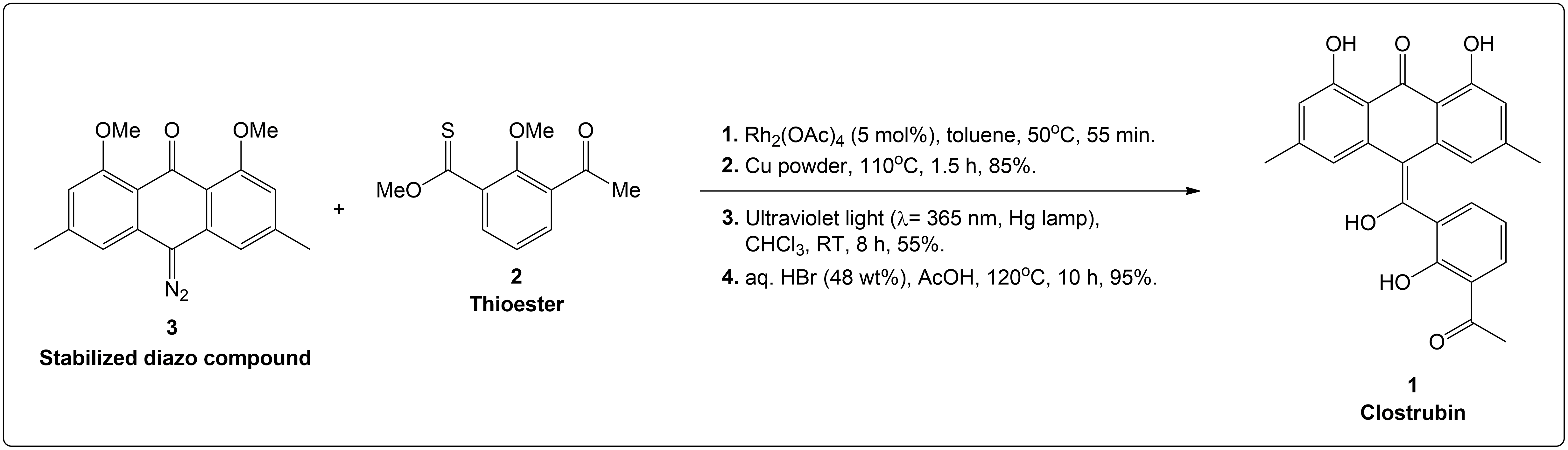
        Completion of the synthesis of Clostrubin.
      </p>

      <p className="mt-2 text-sm text-gray-600 dark:text-gray-400">
        The completion of the Clostrubin (1) synthesis using a stabilized diazo compound and a thioester with several conditions. This caused the formation of a metal-carbenoid intermediate, which was reduced to an episulfide intermediate to a tetrasubstituted olefin, followed by ultraviolet light-induced electrocyclization and final global deprotection, which yielded the desired natural product efficiently.
      </p>
    </div>

    For simplicity, this image summarizes the start and end products of the synthesis in the original paper by [Yang et al. (2015)](https://doi.org/10.1038/ncomms7445), highlighting key reactions and the overall product. The full pathway is not shown to maintain clarity and focus on building towards when Dess-Martin oxidation is used.
  </Accordion>

  <Accordion title="How is Dess-Martin Oxidation used?">
    <div className="text-center">
      <div>
        <a href="https://doi.org/10.1038/ncomms7445" target="_blank" rel="noopener noreferrer">
          <img noZoom className="block dark:hidden" src="https://mintcdn.com/reactionrepo-bd9a1c17/IFWEEywjS-o2nCIa/reactions/dess-martin-oxidation/DMPSecondaryguessboxl.png?fit=max&auto=format&n=IFWEEywjS-o2nCIa&q=85&s=17cdc6ef0a6004e1a0320217c6d6981b" alt="Hero Light" title="" width="4927" height="1415" data-path="reactions/dess-martin-oxidation/DMPSecondaryguessboxl.png" />

          <img noZoom className="hidden dark:block" src="https://mintcdn.com/reactionrepo-bd9a1c17/IFWEEywjS-o2nCIa/reactions/dess-martin-oxidation/DMPSecondaryguessboxd.png?fit=max&auto=format&n=IFWEEywjS-o2nCIa&q=85&s=3b578f67de91a1d52c41ec64c6f540b0" alt="Hero Dark" title="" width="4931" height="1419" data-path="reactions/dess-martin-oxidation/DMPSecondaryguessboxd.png" />
        </a>
      </div>

      <p className="mt-2 text-sm font-bold text-gray-600 dark:text-gray-400" />

      <p className="mt-2 text-sm text-gray-600 dark:text-gray-400" />
    </div>

    This reaction showing the Dess-Martin oxidation of this alcohol intermediate was part of the overall synthesis pathway of the formation of Clostrubin. Clostrubin is a potent antibiotic against methicillin- and vancomycin-resistant bacteria, which was synthesized through a series of steps, including the desilylation of a silylated intermediate during acid workup, which ultmately resulted in the formation of a secondary alcohol intermediate.

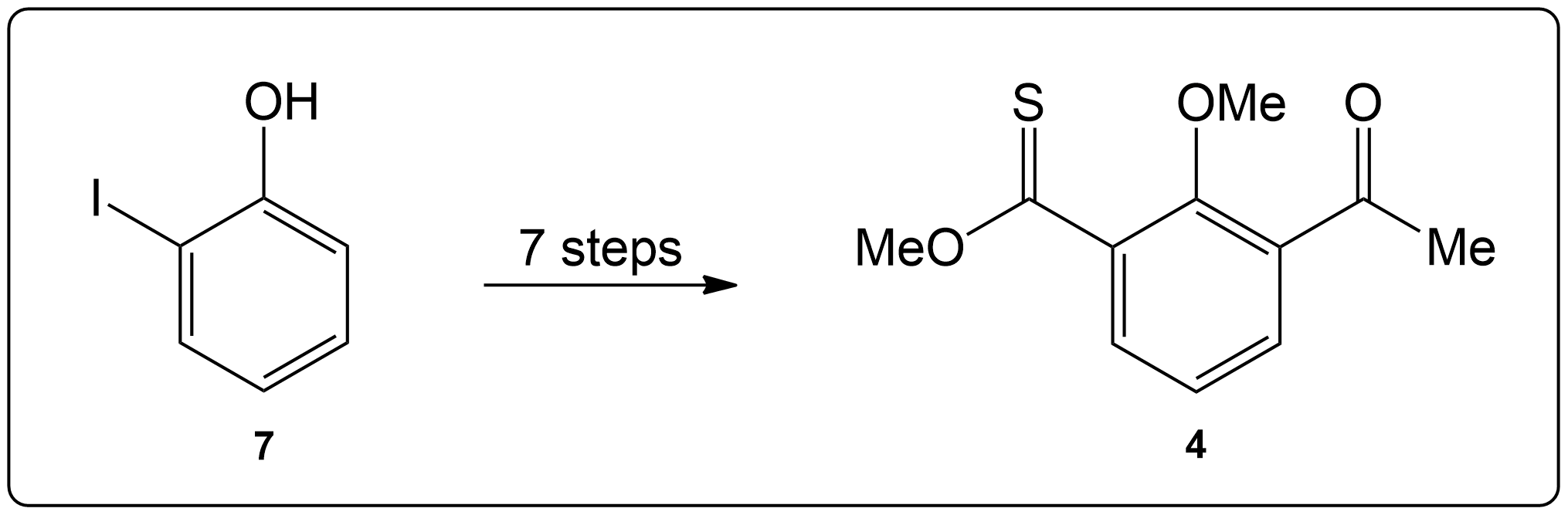
    One main reagent used to form clostrubin was the thioester compound (4)

    <img className="block dark:hidden" src="https://mintcdn.com/reactionrepo-bd9a1c17/IFWEEywjS-o2nCIa/reactions/dess-martin-oxidation/clos7to4light.png?fit=max&auto=format&n=IFWEEywjS-o2nCIa&q=85&s=399d8685b680e304aa8da392d118e2dc" alt="Hero Light" title="" width="2030" height="667" data-path="reactions/dess-martin-oxidation/clos7to4light.png" />

    <img className="hidden dark:block" src="https://mintcdn.com/reactionrepo-bd9a1c17/IFWEEywjS-o2nCIa/reactions/dess-martin-oxidation/clos7to4dark.png?fit=max&auto=format&n=IFWEEywjS-o2nCIa&q=85&s=7d968762cfc6ba29f066ffaea2a541b1" alt="Hero Dark" title="" width="2030" height="667" data-path="reactions/dess-martin-oxidation/clos7to4dark.png" />

    2-Iodophenol underwent a 7-step synthesis to form the needed thioester required to form clostrubin.<sup>**4**</sup>

    <img className="block dark:hidden" src="https://mintcdn.com/reactionrepo-bd9a1c17/IFWEEywjS-o2nCIa/reactions/dess-martin-oxidation/clos20to21light.png?fit=max&auto=format&n=IFWEEywjS-o2nCIa&q=85&s=0af226109f58a58c6dcff5c1dd7ef728" alt="Hero Light" title="" width="2730" height="669" data-path="reactions/dess-martin-oxidation/clos20to21light.png" />

    <img className="hidden dark:block" src="https://mintcdn.com/reactionrepo-bd9a1c17/IFWEEywjS-o2nCIa/reactions/dess-martin-oxidation/clos20to21darkk.png?fit=max&auto=format&n=IFWEEywjS-o2nCIa&q=85&s=342d442efd98d57007ae90912d3b6675" alt="Hero Dark" title="" width="2727" height="666" data-path="reactions/dess-martin-oxidation/clos20to21darkk.png" />

    A crucial step in this multi-step process to form the thioester was the oxidation of a secondary alcohol intermediate (20) formed in the synthesis pathway to a ketone intermediate (21) using Dess-Martin periodinane (DMP) in dichloromethane (DCM) at room temperature for 1 minute. The resulting ketone intermediate was then further utilized in subsequent steps to form the needed thioester required to synthesize Clostrubin.<sup>**4**</sup>
  </Accordion>
</AccordionGroup>

### Question 2

Propose a Mechanism for this Reaction.
<img className="block dark:hidden" src="https://mintcdn.com/reactionrepo-bd9a1c17/IFWEEywjS-o2nCIa/reactions/dess-martin-oxidation/DMPMechanismQ1Light.png?fit=max&auto=format&n=IFWEEywjS-o2nCIa&q=85&s=670d03830081a1ab78ad861d3a090910" alt="Hero Light" width="2023" height="617" data-path="reactions/dess-martin-oxidation/DMPMechanismQ1Light.png" />

<img className="hidden dark:block" src="https://mintcdn.com/reactionrepo-bd9a1c17/IFWEEywjS-o2nCIa/reactions/dess-martin-oxidation/DMPRealMechanismQ1Dark.png?fit=max&auto=format&n=IFWEEywjS-o2nCIa&q=85&s=3d5d570632da17daea73d8194da77337" alt="Hero Dark" width="2023" height="617" data-path="reactions/dess-martin-oxidation/DMPRealMechanismQ1Dark.png" />

<Accordion title="Reveal the Answer.">
  <Steps>
    <Step title="Identify the necessary side chain and product.">
      <div className="text-center">
        <div>
          <img className="block dark:hidden" src="https://mintcdn.com/reactionrepo-bd9a1c17/IFWEEywjS-o2nCIa/reactions/dess-martin-oxidation/DMPMechanismQ1LightHighlighted.png?fit=max&auto=format&n=IFWEEywjS-o2nCIa&q=85&s=28033e18585485bc340ebfa716772049" alt="Hero Light" title="" width="2037" height="657" data-path="reactions/dess-martin-oxidation/DMPMechanismQ1LightHighlighted.png" />

          <img className="hidden dark:block" src="https://mintcdn.com/reactionrepo-bd9a1c17/IFWEEywjS-o2nCIa/reactions/dess-martin-oxidation/DMPMechanismQ1DarkHighlighted.png?fit=max&auto=format&n=IFWEEywjS-o2nCIa&q=85&s=9166e3ea88460dd59a05593c470a1500" alt="Hero Dark" title="" width="2037" height="657" data-path="reactions/dess-martin-oxidation/DMPMechanismQ1DarkHighlighted.png" />
        </div>

        <p className="mt-2 text-sm font-bold text-gray-600 dark:text-gray-400">
          This compound was a primary alcohol.
        </p>

        <p className="mt-2 text-sm text-gray-600 dark:text-gray-400">
          Start by identifying the non-alcohol portion of the molecule and determine the product.
        </p>
      </div>

      Colored side chains in these diagrams represent constant R groups. Focus on the central alcohol, which transforms into a ketone or aldehyde. Use the colored chains to track and restore these groups post-reaction, highlighting the selective oxidation process. Once you have done this proceed to the mechanism.
    </Step>

    <Step title="Perform the Mechanism for Primary Alcohols">
      <img className="block dark:hidden" src="https://mintcdn.com/reactionrepo-bd9a1c17/IFWEEywjS-o2nCIa/reactions/dess-martin-oxidation/fullprimmechl.png?fit=max&auto=format&n=IFWEEywjS-o2nCIa&q=85&s=7b4665671956b5785ed41500b98197f6" alt="Hero Light" title="" width="2630" height="2534" data-path="reactions/dess-martin-oxidation/fullprimmechl.png" />

      <img className="hidden dark:block" src="https://mintcdn.com/reactionrepo-bd9a1c17/wY1qsYNhECm9ojlG/reactions/dess-martin-oxidation/primsdfull.png?fit=max&auto=format&n=wY1qsYNhECm9ojlG&q=85&s=84d685ab7a8f7dd5b3aa00508ff8f70b" alt="Hero Dark" title="" width="2631" height="2534" data-path="reactions/dess-martin-oxidation/primsdfull.png" />
    </Step>

    <Step title="Reconstruct the final product.">
      <img className="block dark:hidden" src="https://mintcdn.com/reactionrepo-bd9a1c17/IFWEEywjS-o2nCIa/reactions/dess-martin-oxidation/dmpmechlight.gif?s=3d7ce8ded66d3be7169c9ec94fca961d" alt="Hero Light" title="" width="800" height="424" data-path="reactions/dess-martin-oxidation/dmpmechlight.gif" />

      <img className="hidden dark:block" src="https://mintcdn.com/reactionrepo-bd9a1c17/IFWEEywjS-o2nCIa/reactions/dess-martin-oxidation/dmpmechdark.gif?s=00e2830bbea0c56afe7df4b21bc5484f" alt="Hero Dark" title="" width="800" height="424" data-path="reactions/dess-martin-oxidation/dmpmechdark.gif" />

      This should form the expected Ketone product as a result of oxidation of the primary alcohol on this compound.
    </Step>
  </Steps>
</Accordion>

<AccordionGroup>
  <Accordion title="Where did this Reaction come from?">
    <div className="text-center">
      <div>
        <a href="https://doi.org/10.1021/ol000289p" target="_blank" rel="noopener noreferrer">
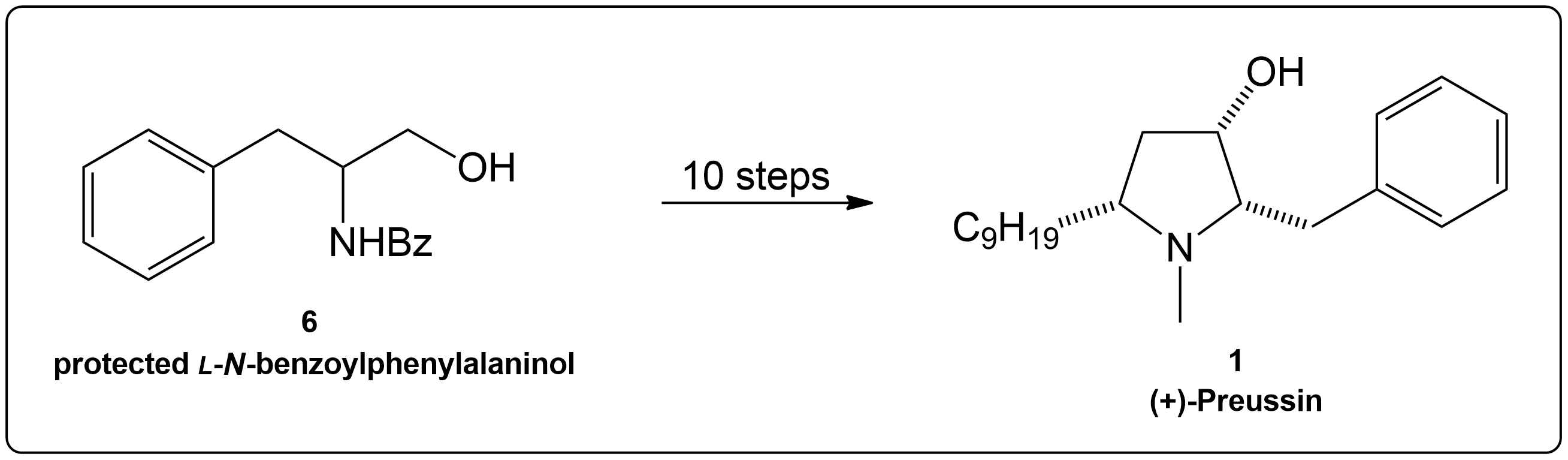
          <img noZoom className="block dark:hidden" src="https://mintcdn.com/reactionrepo-bd9a1c17/wY1qsYNhECm9ojlG/reactions/dess-martin-oxidation/preu6to1light4.png?fit=max&auto=format&n=wY1qsYNhECm9ojlG&q=85&s=11cc44a211b33755b9054a7587702946" alt="Hero Light" title="" width="2448" height="739" data-path="reactions/dess-martin-oxidation/preu6to1light4.png" />

          <img noZoom className="hidden dark:block" src="https://mintcdn.com/reactionrepo-bd9a1c17/wY1qsYNhECm9ojlG/reactions/dess-martin-oxidation/preu6to1dark4.png?fit=max&auto=format&n=wY1qsYNhECm9ojlG&q=85&s=81bc5b779e7031efa64d45af97c4964a" alt="Hero Dark" title="" width="2448" height="739" data-path="reactions/dess-martin-oxidation/preu6to1dark4.png" />
        </a>
      </div>

      <p className="mt-2 text-sm font-bold text-gray-600 dark:text-gray-400">
        Completion of the synthesis of (+)-Preussin.
      </p>

      <p className="mt-2 text-sm text-gray-600 dark:text-gray-400">
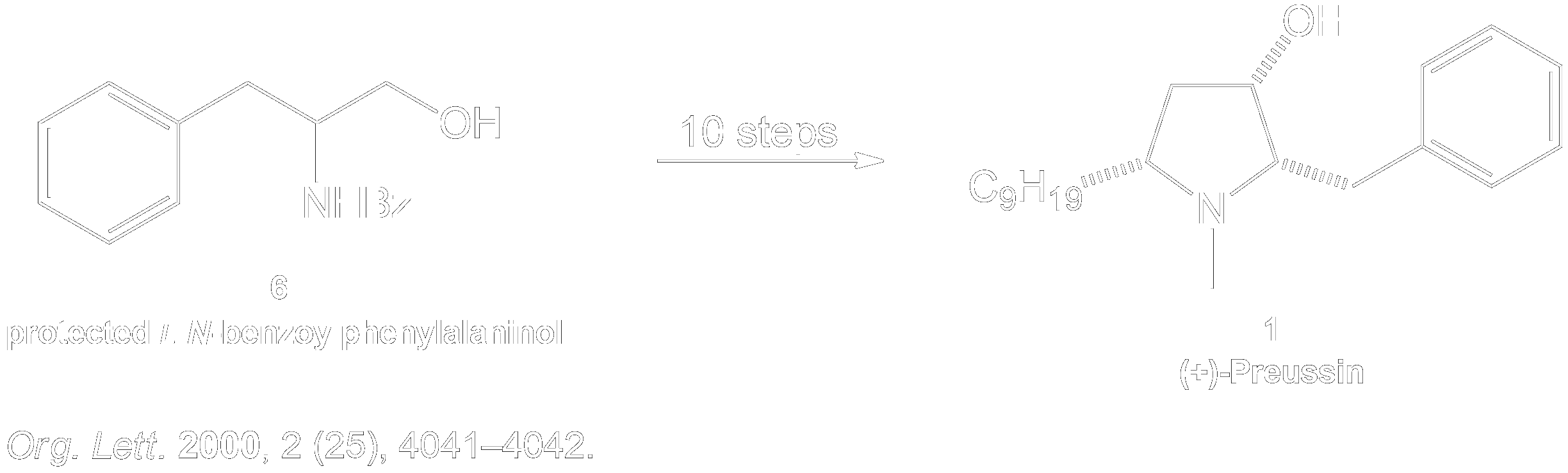
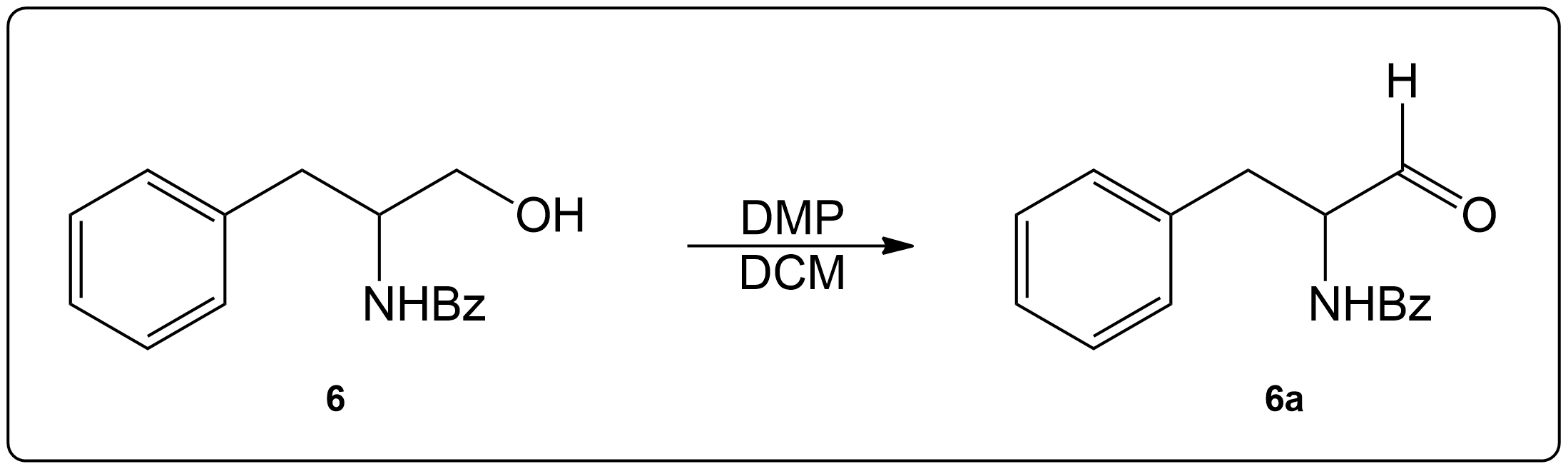
        Scheme for the enantioselective total synthesis of (+)-Preussin (1) from protected L-N-benzoylphenylalaninol (6) over 10 steps.
      </p>
    </div>

    For simplicity, this image summarizes the start and end products of the synthesis in the original paper by [Lee et al. (2000)](https://doi.org/10.1021/ol000289p), highlighting the starting and the end product. The full pathway is not shown to maintain clarity and focus on building towards when Dess-Martin oxidation is used.
  </Accordion>

  <Accordion title="How is Dess-Martin Oxidation used?">
    <div className="text-center">
      <div>
        <a href="https://doi.org/10.1021/ol000289p" target="_blank" rel="noopener noreferrer">
          <img noZoom className="block dark:hidden" src="https://mintcdn.com/reactionrepo-bd9a1c17/wY1qsYNhECm9ojlG/reactions/dess-martin-oxidation/preu6to6aboxl.png?fit=max&auto=format&n=wY1qsYNhECm9ojlG&q=85&s=0af2421ece07a802445fc2813ab7ba03" alt="Hero Light" title="" width="2198" height="657" data-path="reactions/dess-martin-oxidation/preu6to6aboxl.png" />

          <img noZoom className="hidden dark:block" src="https://mintcdn.com/reactionrepo-bd9a1c17/wY1qsYNhECm9ojlG/reactions/dess-martin-oxidation/preu6to6aboxd.png?fit=max&auto=format&n=wY1qsYNhECm9ojlG&q=85&s=2d9037ef3e43a70270b11d1687d00d44" alt="Hero Dark" title="" width="2200" height="660" data-path="reactions/dess-martin-oxidation/preu6to6aboxd.png" />
        </a>
      </div>

      <p className="mt-2 text-sm font-bold text-gray-600 dark:text-gray-400" />

      <p className="mt-2 text-sm text-gray-600 dark:text-gray-400" />
    </div>

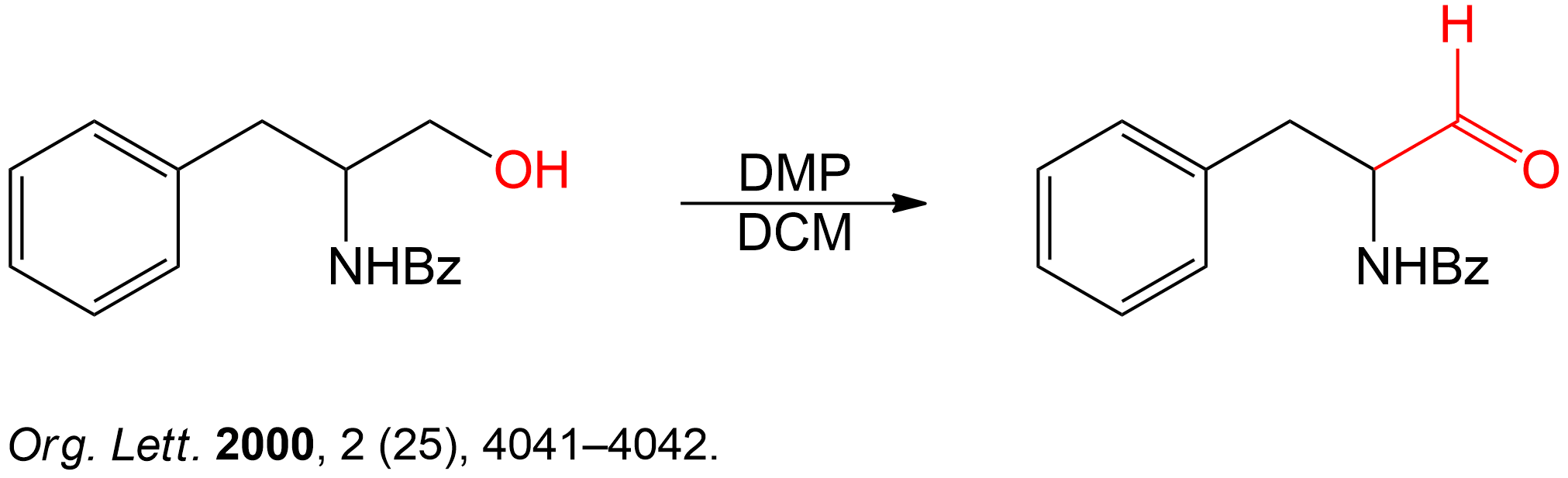
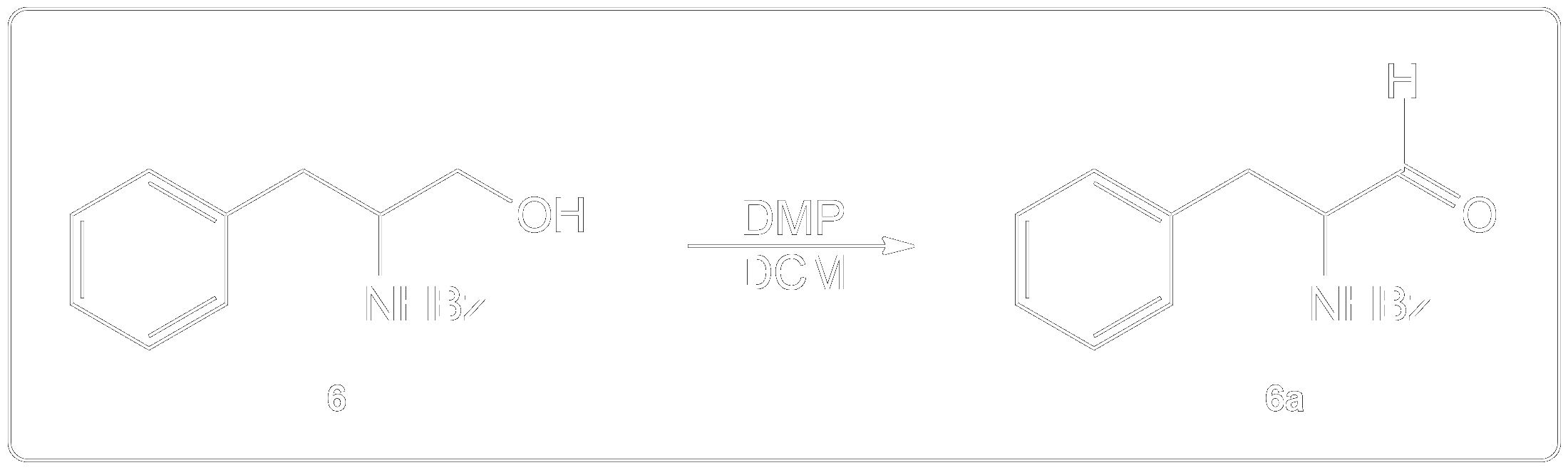
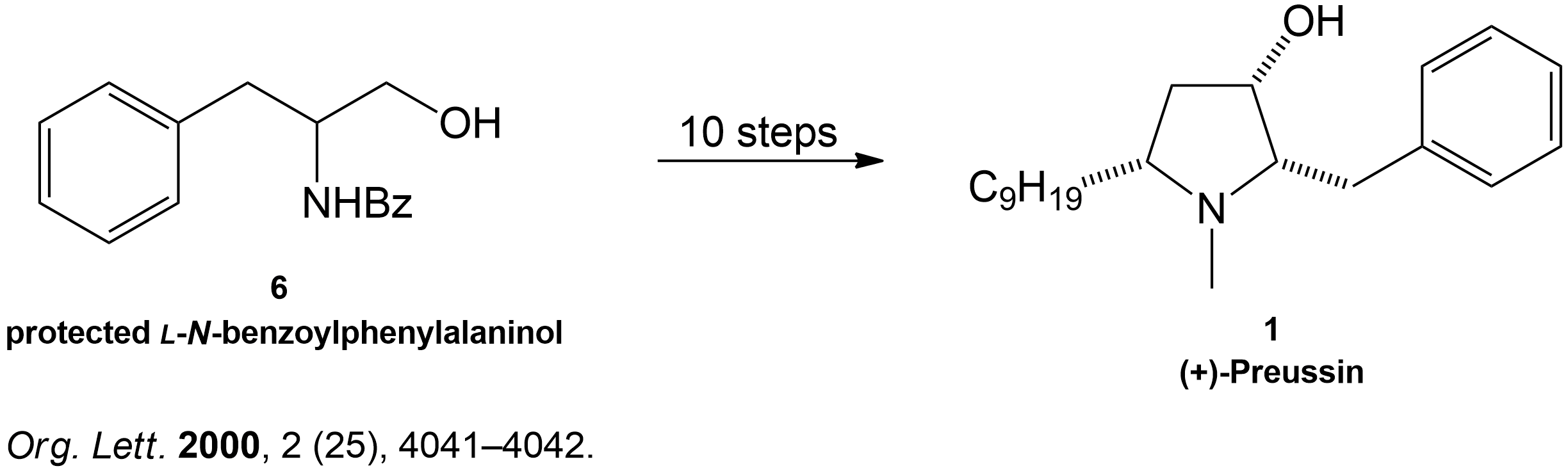
    This reaction showing the Dess-Martin oxidation of this alcohol intermediate was part of the overall synthesis pathway of the formation of (+)-Preussin, a potent antifungal agent, which was synthesized using protected L-N-benzoyl phenylalaninol as a starting material.<sup>**5**</sup>

    A crucial step in this synthesis was the oxidation of the primary alcohol compound: protected L-N-benzoyl phenylalaninol (6). It was subsequently was converted to a aldehyde intermediate (6a) using Dess-Martin periodinane (DMP) in dichloromethane (DCM). The resulting aldehyde intermediate was then further utilized in the synthesis pathway to synthesize (+)-Preussin. <sup>**5**</sup>
  </Accordion>
</AccordionGroup>

## Summary

The reaction entry summary. Find the general scheme and full summarized mechanisms here.

### General Scheme

This section briefly summarizes what can and cannot undergo reactions.

<img className="block dark:hidden" src="https://mintcdn.com/reactionrepo-bd9a1c17/wY1qsYNhECm9ojlG/reactions/dess-martin-oxidation/summarylight1.png?fit=max&auto=format&n=wY1qsYNhECm9ojlG&q=85&s=28e2fe88581e2aaf2bb3bae875ac11a2" alt="Hero Light" width="4107" height="367" data-path="reactions/dess-martin-oxidation/summarylight1.png" />

<img className="hidden dark:block" src="https://mintcdn.com/reactionrepo-bd9a1c17/wY1qsYNhECm9ojlG/reactions/dess-martin-oxidation/summarydark1.png?fit=max&auto=format&n=wY1qsYNhECm9ojlG&q=85&s=d8d85ff711c8530577526d1a20db9735" alt="Hero Dark" width="4107" height="367" data-path="reactions/dess-martin-oxidation/summarydark1.png" />

* 1° Alcohols (Primary) get oxidized to **Aldehydes**.
* 2° Alcohols (Secondary) get oxidized to **Ketones**.
* 3° Alcohols (Tertiary) **do not** get oxidized at all.

### General Mechanism

This section briefly summarizes steps to find the product and perform the mechanisms.

**Quick steps to finding the product for any alcohol**

1. Identify the reagents.
2. Assign side chains (non alcohol part).
3. Selectively convert Alcohol to correct product based on alcohol type. Nothing else.
4. Keep the side chains (non alcohol part) the same and piece together the full molecule together again.
<Accordion title="Full Primary Mechanism">
  <img className="block dark:hidden" src="https://mintcdn.com/reactionrepo-bd9a1c17/IFWEEywjS-o2nCIa/reactions/dess-martin-oxidation/fullprimmechl.png?fit=max&auto=format&n=IFWEEywjS-o2nCIa&q=85&s=7b4665671956b5785ed41500b98197f6" alt="Hero Light" title="" width="2630" height="2534" data-path="reactions/dess-martin-oxidation/fullprimmechl.png" />

  <img className="hidden dark:block" src="https://mintcdn.com/reactionrepo-bd9a1c17/wY1qsYNhECm9ojlG/reactions/dess-martin-oxidation/primsdfull.png?fit=max&auto=format&n=wY1qsYNhECm9ojlG&q=85&s=84d685ab7a8f7dd5b3aa00508ff8f70b" alt="Hero Dark" title="" width="2631" height="2534" data-path="reactions/dess-martin-oxidation/primsdfull.png" />
</Accordion>

<Accordion title="Full Secondary Mechanism">
  <img className="block dark:hidden" src="https://mintcdn.com/reactionrepo-bd9a1c17/IFWEEywjS-o2nCIa/reactions/dess-martin-oxidation/DMPFullSeclight.png?fit=max&auto=format&n=IFWEEywjS-o2nCIa&q=85&s=5b970fb1be3c968c1f1351b89edcaebd" alt="Hero Light" title="" width="2633" height="2559" data-path="reactions/dess-martin-oxidation/DMPFullSeclight.png" />

  <img className="hidden dark:block" src="https://mintcdn.com/reactionrepo-bd9a1c17/IFWEEywjS-o2nCIa/reactions/dess-martin-oxidation/DMPFullSecdark.png?fit=max&auto=format&n=IFWEEywjS-o2nCIa&q=85&s=5c87dcff0254ee8fa8b832fde44ea227" alt="Hero Dark" title="" width="2633" height="2564" data-path="reactions/dess-martin-oxidation/DMPFullSecdark.png" />
</Accordion>

<Tip>Always remember to repeatedly practice your mechanisms and getting your reagents correct. Take advantage of our materials and/or keep practicing on a whiteboard or paper until you get it right every single time. </Tip>

## References

<div>
  <a href="https://doi.org/10.1021/jo00170a070" target="_blank" rel="noopener noreferrer">
    <img noZoom className="block dark:hidden" src="https://mintcdn.com/reactionrepo-bd9a1c17/wY1qsYNhECm9ojlG/reactions/dess-martin-oxidation/lightcitation.png?fit=max&auto=format&n=wY1qsYNhECm9ojlG&q=85&s=d6d78d7f9626922ff4033eacdd758a8a" alt="Hero Light" title="" width="2732" height="367" data-path="reactions/dess-martin-oxidation/lightcitation.png" />

    <img noZoom className="hidden dark:block" src="https://mintcdn.com/reactionrepo-bd9a1c17/IFWEEywjS-o2nCIa/reactions/dess-martin-oxidation/darkcitation.png?fit=max&auto=format&n=IFWEEywjS-o2nCIa&q=85&s=ad1ee2cebd8a372a0aff2aa9c1e4259e" alt="Hero Dark" title="" width="2734" height="367" data-path="reactions/dess-martin-oxidation/darkcitation.png" />
  </a>
</div>

1. Dess, D. B.; Martin, J. C. Readily Accessible 12-I-51 Oxidant for the Conversion of Primary and Secondary Alcohols to Aldehydes and Ketones. *J. Org. Chem.* **1983**, *48*, 4155–4156. DOI: [10.1021/jo00170a070](https://doi.org/10.1021/jo00356a052)

<div>
  <a href="https://doi.org/10.1021/ja8071918" target="_blank" rel="noopener noreferrer">
    <img noZoom className="block dark:hidden" src="https://mintcdn.com/reactionrepo-bd9a1c17/IFWEEywjS-o2nCIa/reactions/dess-martin-oxidation/cortiboxnewlight.png?fit=max&auto=format&n=IFWEEywjS-o2nCIa&q=85&s=65392335abca4ec872754492af420958" alt="Cortistatin A Light" width="3240" height="952" data-path="reactions/dess-martin-oxidation/cortiboxnewlight.png" />

    <img noZoom className="hidden dark:block" src="https://mintcdn.com/reactionrepo-bd9a1c17/IFWEEywjS-o2nCIa/reactions/dess-martin-oxidation/cortiboxnewdark.png?fit=max&auto=format&n=IFWEEywjS-o2nCIa&q=85&s=acb458c269d319e53acf70b8808a6b0b" alt="Cortistatin A Dark" width="3244" height="956" data-path="reactions/dess-martin-oxidation/cortiboxnewdark.png" />
  </a>
</div>

2. Lee, H. M.; Nieto-Oberhuber, C.; Shair, M. D. Enantioselective synthesis of (+)-cortistatin A, a potent and selective inhibitor of endothelial cell proliferation. *J. Am. Chem. Soc.* **2008**, *130* (50), 16864–16866. DOI: [10.1021/ja8071918](https://doi.org/10.1021/ja8071918)

<div>
  <a href="https://doi.org/10.1021/ja044123l" target="_blank" rel="noopener noreferrer">
    <img noZoom className="block dark:hidden" src="https://mintcdn.com/reactionrepo-bd9a1c17/IFWEEywjS-o2nCIa/reactions/dess-martin-oxidation/ingenolboxnewlight.png?fit=max&auto=format&n=IFWEEywjS-o2nCIa&q=85&s=2f7bc828ca11973c966d400aacb1f5c4" alt="Ingenol Light" width="2464" height="1045" data-path="reactions/dess-martin-oxidation/ingenolboxnewlight.png" />

    <img noZoom className="hidden dark:block" src="https://mintcdn.com/reactionrepo-bd9a1c17/IFWEEywjS-o2nCIa/reactions/dess-martin-oxidation/ingenolboxnewdark.png?fit=max&auto=format&n=IFWEEywjS-o2nCIa&q=85&s=c37c64ed16b552fa9c36b7ede51861b6" alt="Ingenol Dark" width="2460" height="1043" data-path="reactions/dess-martin-oxidation/ingenolboxnewdark.png" />
  </a>
</div>

3. Nickel, A.; Maruyama, T.; Tang, H.; Murphy, P. D.; Greene, B.; Yusuff, N.; Wood, J. L. Total synthesis of ingenol. *J. Am. Chem. Soc.* **2004**, *126* (50), 16300–16301. DOI: [10.1021/ja044123l](https://doi.org/10.1021/ja044123l)

<div>
  <a href="https://doi.org/10.1038/ncomms7445" target="_blank" rel="noopener noreferrer">
    <img noZoom className="block dark:hidden" src="https://mintcdn.com/reactionrepo-bd9a1c17/IFWEEywjS-o2nCIa/reactions/dess-martin-oxidation/DMPSecondaryguessboxl.png?fit=max&auto=format&n=IFWEEywjS-o2nCIa&q=85&s=17cdc6ef0a6004e1a0320217c6d6981b" alt="Clostrubin Light" width="4927" height="1415" data-path="reactions/dess-martin-oxidation/DMPSecondaryguessboxl.png" />

    <img noZoom className="hidden dark:block" src="https://mintcdn.com/reactionrepo-bd9a1c17/IFWEEywjS-o2nCIa/reactions/dess-martin-oxidation/DMPSecondaryguessboxd.png?fit=max&auto=format&n=IFWEEywjS-o2nCIa&q=85&s=3b578f67de91a1d52c41ec64c6f540b0" alt="Clostrubin Dark" width="4931" height="1419" data-path="reactions/dess-martin-oxidation/DMPSecondaryguessboxd.png" />
  </a>
</div>

4. Yang, M.; Li, J.; Li, A. Total synthesis of clostrubin. *Nat. Commun.* **2015**, *6*, 6445. DOI: [10.1038/ncomms7445](https://doi.org/10.1038/ncomms7445)

<div>
  <a href="https://doi.org/10.1021/ol000289p" target="_blank" rel="noopener noreferrer">
    <img noZoom className="block dark:hidden" src="https://mintcdn.com/reactionrepo-bd9a1c17/wY1qsYNhECm9ojlG/reactions/dess-martin-oxidation/preuboxlight.png?fit=max&auto=format&n=wY1qsYNhECm9ojlG&q=85&s=8614a98279e774e66df8ac6fe4afa320" alt="Preussin Light" width="2617" height="767" data-path="reactions/dess-martin-oxidation/preuboxlight.png" />

    <img noZoom className="hidden dark:block" src="https://mintcdn.com/reactionrepo-bd9a1c17/wY1qsYNhECm9ojlG/reactions/dess-martin-oxidation/preuboxdark.png?fit=max&auto=format&n=wY1qsYNhECm9ojlG&q=85&s=25fd479ed0b7c0915339006af88ad99c" alt="Preussin Dark" width="2617" height="767" data-path="reactions/dess-martin-oxidation/preuboxdark.png" />
  </a>
</div>

5. Lee, K.-Y.; Kim, Y.-H.; Oh, C.-Y.; Ham, W\.-H. Facile and efficient total synthesis of (+)-preussin. *Org. Lett.* **2000**, *2* (25), 4041–4042. DOI: [10.1021/ol000289p](https://doi.org/10.1021/ol000289p)