> ## Documentation Index
> Fetch the complete documentation index at: https://reactionrepo.com/llms.txt
> Use this file to discover all available pages before exploring further.

# Wolff-Kishner Reduction

> Method to convert Aldehydes and Ketones to Methylenes
<img className="block dark:hidden -mt-0" src="https://mintcdn.com/reactionrepo-bd9a1c17/jrXUYHUApPdH4-EL/reactions/wolff-kishner-reduction-images/overviewdark.png?fit=max&auto=format&n=jrXUYHUApPdH4-EL&q=85&s=bcaa3a525ac872588f918344c599deab" alt="Hero Light" width="1362" height="740" data-path="reactions/wolff-kishner-reduction-images/overviewdark.png" />

<img className="hidden dark:block -mt-0" src="https://mintcdn.com/reactionrepo-bd9a1c17/jrXUYHUApPdH4-EL/reactions/wolff-kishner-reduction-images/overviewlight.png?fit=max&auto=format&n=jrXUYHUApPdH4-EL&q=85&s=29e7f6dcc4f826344f8e03a600adb63a" alt="Hero Dark" width="1364" height="742" data-path="reactions/wolff-kishner-reduction-images/overviewlight.png" />

<>
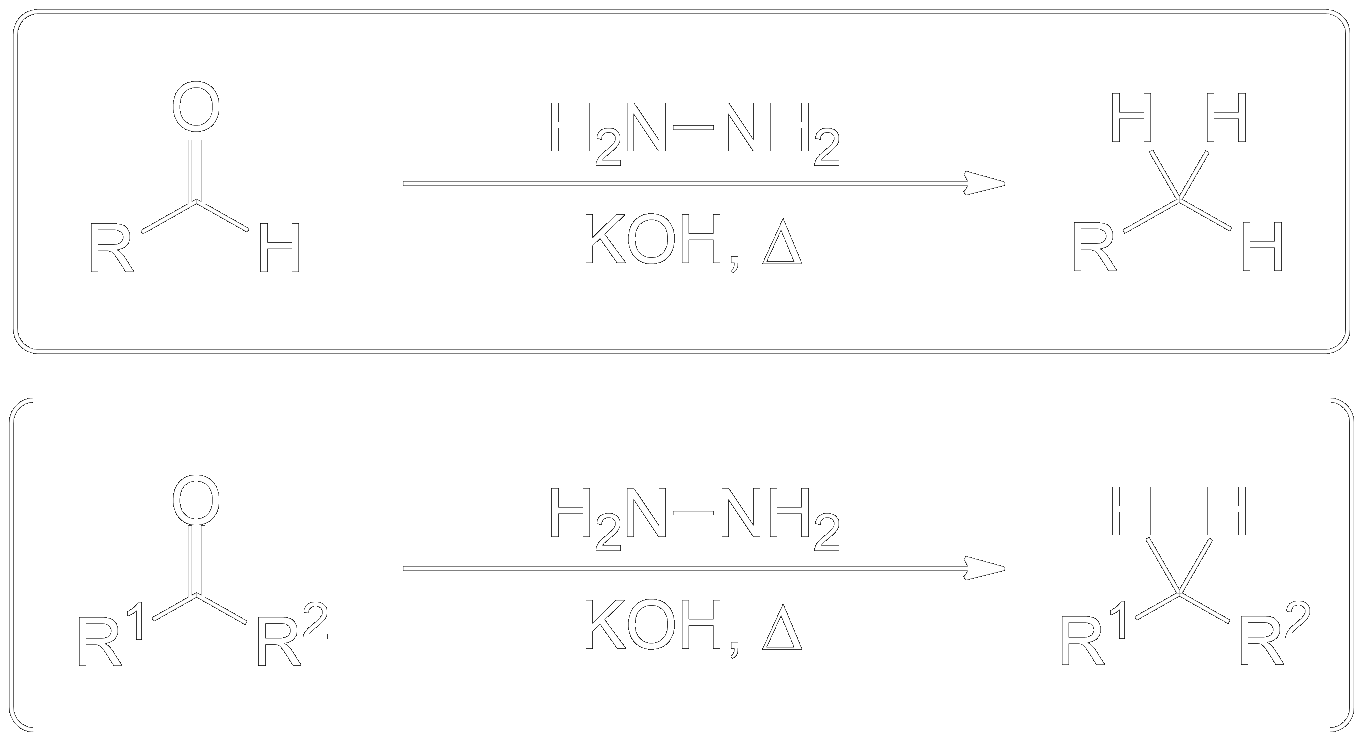
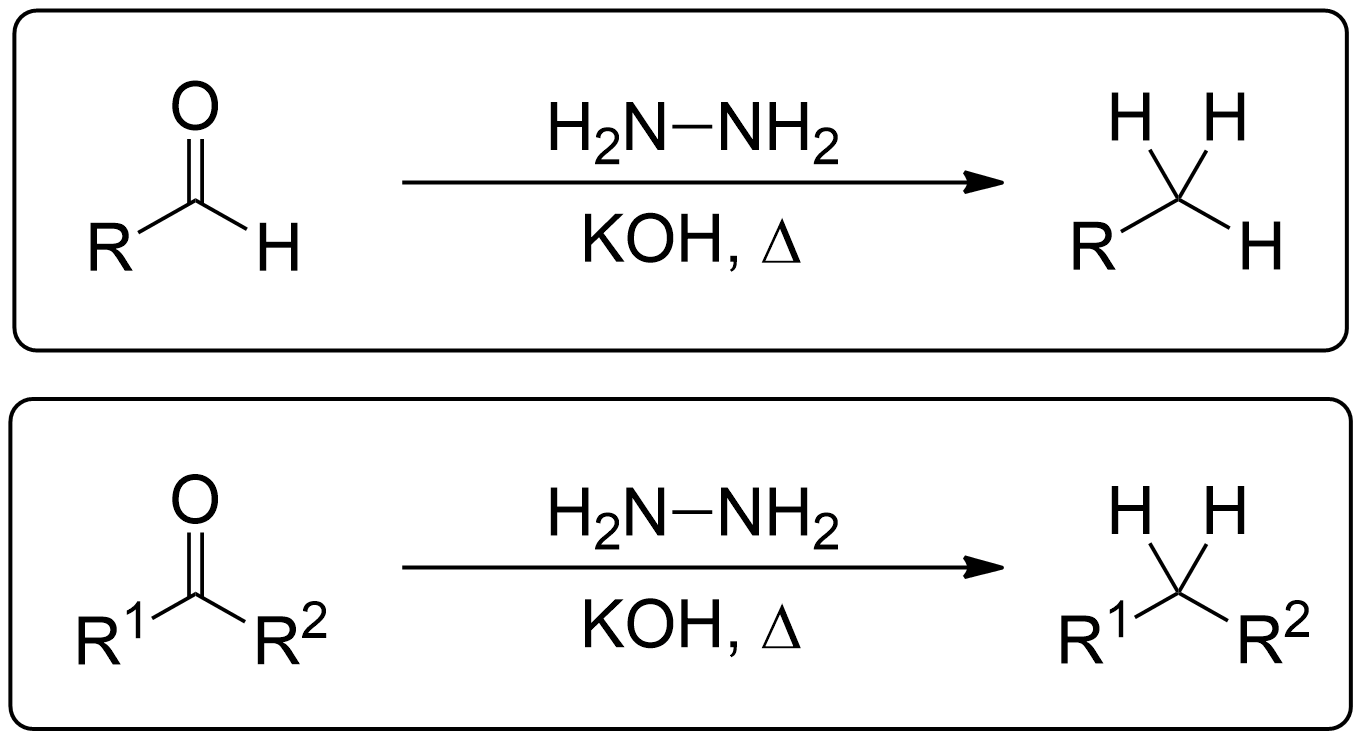
  {`The Wolff–Kishner reduction is a classic organic reaction that reduces aldehydes and ketones to alkanes by converting the carbonyl group to a methylene group (alkane). `}

  <Tooltip tip={<div className="text-left leading-tight" style={{ fontSize: '11px', lineHeight: '1.2' }}>Kishner, N. Wolff–Kishner reduction; Huang–Minlon modification. <em>J. Russ. Phys. Chem. Soc.</em> <strong>1911</strong>, <em>43</em>, 582–595.</div>}>
    <sup><a id="fnref1" href="#fn1" className="underline text-blue-600 dark:text-blue-400 text-xs">\[1]</a></sup>
  </Tooltip>

  {' '}

  <Tooltip
    tip={<div className="text-left leading-tight" style={{ fontSize: '11px', lineHeight: '1.2' }}>Wolff, L. Methode zum Ersatz des Sauerstoffatoms der Ketone und Aldehyde durch Wasserstoff. <em>Justus Liebigs Ann. Chem.</em> <strong>1912</strong>, <em>394</em>, 86–108. <br /><span style={{ fontWeight: '600' }}>DOI:</span>{' '}
<a href="https://doi.org/10.1002/jlac.19123940107" target="_blank" rel="noopener noreferrer" className="underline text-blue-700 dark:text-blue-400">
  https://doi.org/10.1002/jlac.19123940107
</a>
</div>}
  >
    <sup><a id="fnref2" href="#fn2" className="underline text-blue-600 dark:text-blue-400 text-xs">\[2]</a></sup>
  </Tooltip>

  {' '}

  <Tooltip tip={<div className="text-left leading-tight" style={{ fontSize: '11px', lineHeight: '1.2' }}>Clayden, J.; Greeves, N.; Warren, S. Organic Chemistry, 2nd ed.; Oxford University Press: Oxford, <strong>2012</strong>.</div>}>
    <sup><a id="fnref3" href="#fn3" className="underline text-blue-600 dark:text-blue-400 text-xs">\[3]</a></sup>
  </Tooltip>

  {' '}

  <Tooltip tip={<div className="text-left leading-tight" style={{ fontSize: '12.5px', lineHeight: '1.2' }}>Verma, D. K.; Dewangan, Y.; Verma, C. Handbook of Organic Name Reactions. Elsevier, <strong>2023</strong>; pp 155–241.</div>}>
    <sup><a id="fnref4" href="#fn4" className="underline text-blue-600 dark:text-blue-400 text-xs">\[4]</a></sup>
  </Tooltip>

  {` First reported by Nikolai Kishner in 1911 and independently by Ludwig Wolff in 1912, this reaction is especially useful for base-stable substrates where acidic conditions (like in the Clemmensen reduction) would be unsuitable. `}

  <Tooltip tip={<div className="text-left leading-tight" style={{ fontSize: '11px', lineHeight: '1.2' }}>Kishner, N. Wolff–Kishner reduction; Huang–Minlon modification. <em>J. Russ. Phys. Chem. Soc.</em> <strong>1911</strong>, <em>43</em>, 582–595.</div>}>
    <sup><a id="fnref1-repeat" href="#fn1" className="underline text-blue-600 dark:text-blue-400 text-xs">\[1]</a></sup>
  </Tooltip>

  {' '}

  <Tooltip
    tip={<div className="text-left leading-tight" style={{ fontSize: '11px', lineHeight: '1.2' }}>Wolff, L. Methode zum Ersatz des Sauerstoffatoms der Ketone und Aldehyde durch Wasserstoff. <em>Justus Liebigs Ann. Chem.</em> <strong>1912</strong>, <em>394</em>, 86–108. <br /><span style={{ fontWeight: '600' }}>DOI:</span>{' '}
<a href="https://doi.org/10.1002/jlac.19123940107" target="_blank" rel="noopener noreferrer" className="underline text-blue-700 dark:text-blue-400">
  https://doi.org/10.1002/jlac.19123940107
</a>
</div>}
  >
    <sup><a id="fnref2-repeat" href="#fn2" className="underline text-blue-600 dark:text-blue-400 text-xs">\[2]</a></sup>
  </Tooltip>

  {' '}

  <Tooltip tip={<div className="text-left leading-tight" style={{ fontSize: '11px', lineHeight: '1.2' }}>Clayden, J.; Greeves, N.; Warren, S. Organic Chemistry, 2nd ed.; Oxford University Press: Oxford, <strong>2012</strong>.</div>}>
    <sup><a id="fnref3-repeat" href="#fn3" className="underline text-blue-600 dark:text-blue-400 text-xs">\[3]</a></sup>
  </Tooltip>

  {' '}

  <Tooltip tip={<div className="text-left leading-tight" style={{ fontSize: '12.5px', lineHeight: '1.2' }}>Verma, D. K.; Dewangan, Y.; Verma, C. Handbook of Organic Name Reactions. Elsevier, <strong>2023</strong>; pp 155–241.</div>}>
    <sup><a id="fnref4-repeat" href="#fn4" className="underline text-blue-600 dark:text-blue-400 text-xs">\[4]</a></sup>
  </Tooltip>
</>

## Predicting the Product

<>
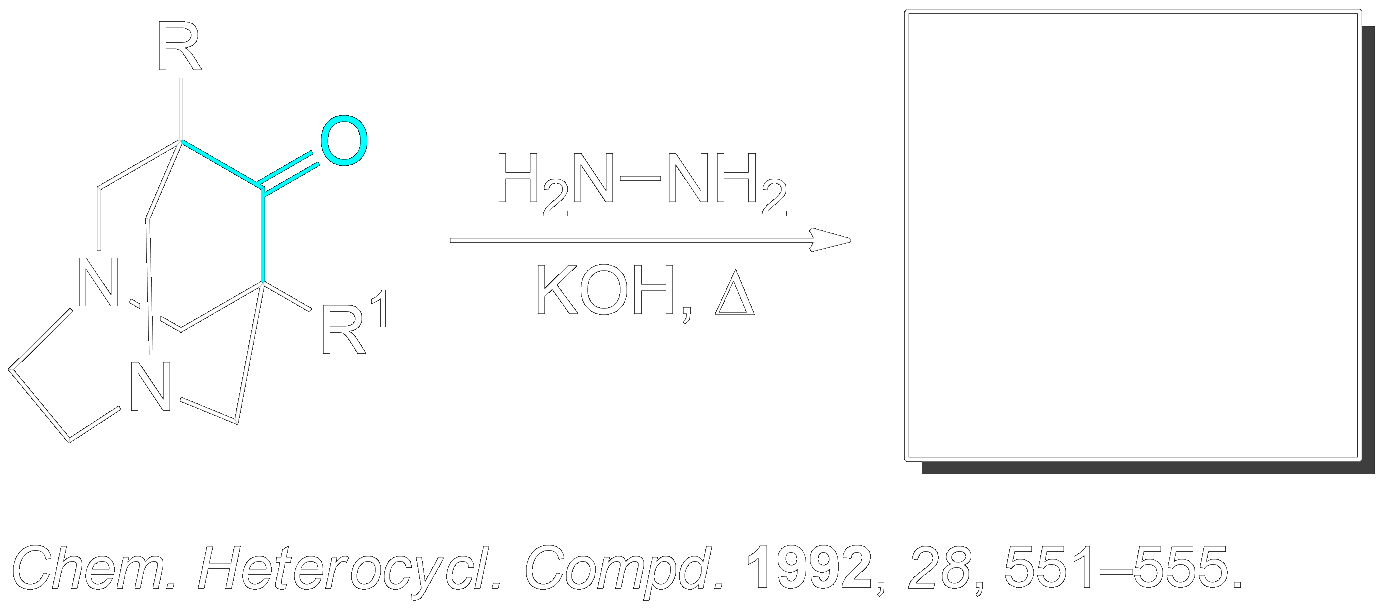
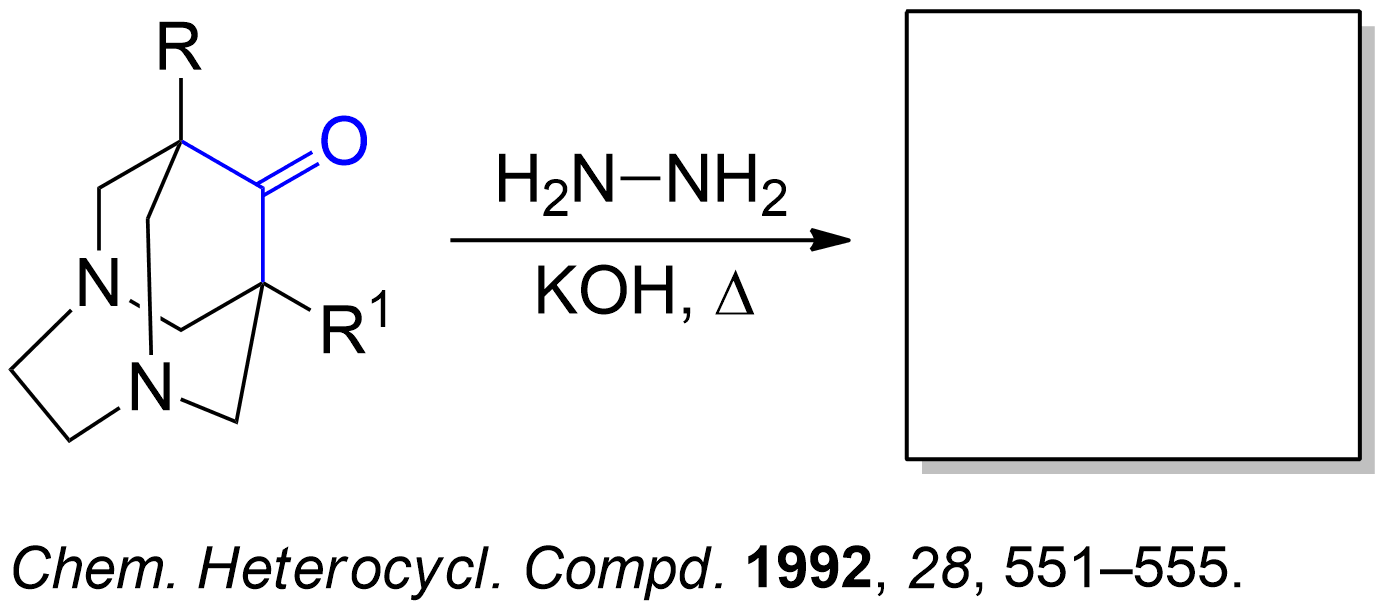
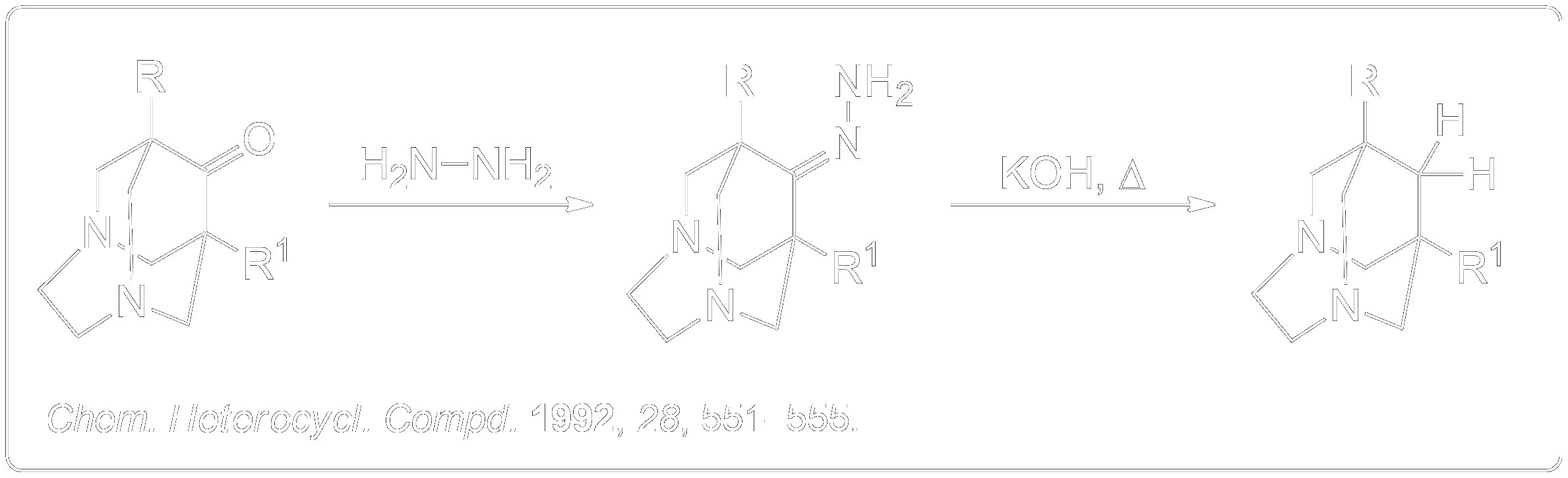
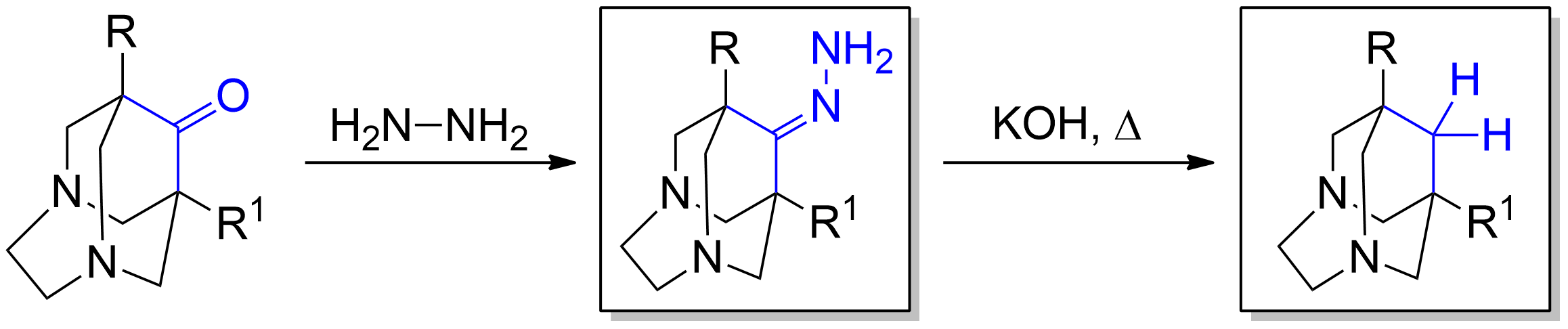
  {`This section is a brief overview on how to find the product for a ketone using an example from Kuznetsov et al. (1992). `}

  <Tooltip
    tip={
  <div
    className="text-left leading-tight"
    style={{ fontSize: '11px', lineHeight: '1.2' }}
  >
    Kuznetsov, A. I.; Vladimirova, I. A.; Serova, T. M.; Moskovkin, A. S.{' '}
    <a
      href="https://doi.org/10.1007/BF00475255"
      target="_blank"
      rel="noopener noreferrer"
      className="underline text-blue-700 dark:text-blue-400"
    >
      Heteroadamantanes and Their Derivatives. 17. Wolff–Kishner Reduction of 3,6-Diazahomoadamantan-9-ones.
    </a>{' '}
    Chem. Heterocycl. Compd. <strong>1992</strong>, <em>28</em>, 551–555. <br />
    <span style={{ fontWeight: '600' }}>DOI:</span>{' '}
    <a
      href="https://doi.org/10.1007/BF00475255"
      target="_blank"
      rel="noopener noreferrer"
      className="underline text-blue-700 dark:text-blue-400"
    >
      https://doi.org/10.1007/BF00475255
    </a>
  </div>
}
  >
    <sup><a id="fnref5" href="#fn5" className="underline text-blue-600 dark:text-blue-400 text-xs">\[5]</a></sup>
  </Tooltip>

  {' '}

  {`The mechanism and steps are the same for aldehyde conversion.`}
</>

<img className="block dark:hidden mt-6" src="https://mintcdn.com/reactionrepo-bd9a1c17/jrXUYHUApPdH4-EL/reactions/wolff-kishner-reduction-images/examplelight.png?fit=max&auto=format&n=jrXUYHUApPdH4-EL&q=85&s=12d8db1cb4d69611210a8b037a3d95e0" alt="Hero Light" width="1386" height="611" data-path="reactions/wolff-kishner-reduction-images/examplelight.png" />

<img className="hidden dark:block mt-6" src="https://mintcdn.com/reactionrepo-bd9a1c17/jrXUYHUApPdH4-EL/reactions/wolff-kishner-reduction-images/exampledark.png?fit=max&auto=format&n=jrXUYHUApPdH4-EL&q=85&s=dbdca5380317c7d37c9874d9d8b40e6a" alt="Hero Dark" width="1386" height="611" data-path="reactions/wolff-kishner-reduction-images/exampledark.png" />

<AccordionGroup>
  <Accordion title="Where is this Reaction from?">
    <div className="text-center">
      <div>
        <a href="" target="_blank" rel="noopener noreferrer">
          <img noZoom className="block dark:hidden mt-2" src="https://mintcdn.com/reactionrepo-bd9a1c17/jrXUYHUApPdH4-EL/reactions/wolff-kishner-reduction-images/citation1light.png?fit=max&auto=format&n=jrXUYHUApPdH4-EL&q=85&s=e0609b2de7374dcf74349e8f2d97a100" alt="Hero Light" title="" width="2244" height="1907" data-path="reactions/wolff-kishner-reduction-images/citation1light.png" />

          <img noZoom className="hidden dark:block mt-2" src="https://mintcdn.com/reactionrepo-bd9a1c17/jrXUYHUApPdH4-EL/reactions/wolff-kishner-reduction-images/citation1dark.png?fit=max&auto=format&n=jrXUYHUApPdH4-EL&q=85&s=631960700f93d714ec0a340c2ba8ff9f" alt="Hero Dark" title="" width="2244" height="1907" data-path="reactions/wolff-kishner-reduction-images/citation1dark.png" />
        </a>
      </div>

      <p className="mt-2 text-sm font-bold text-gray-600 dark:text-gray-400">
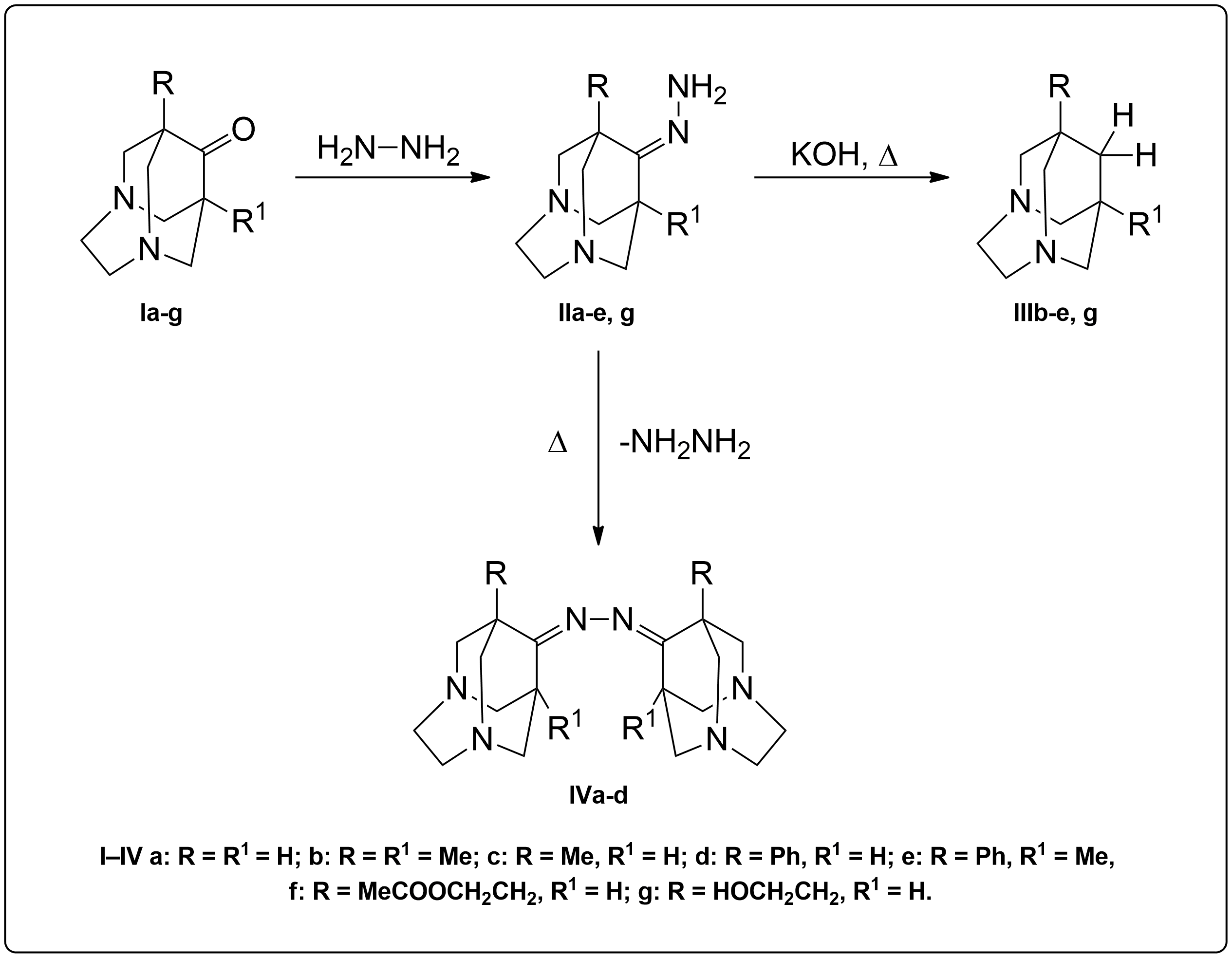
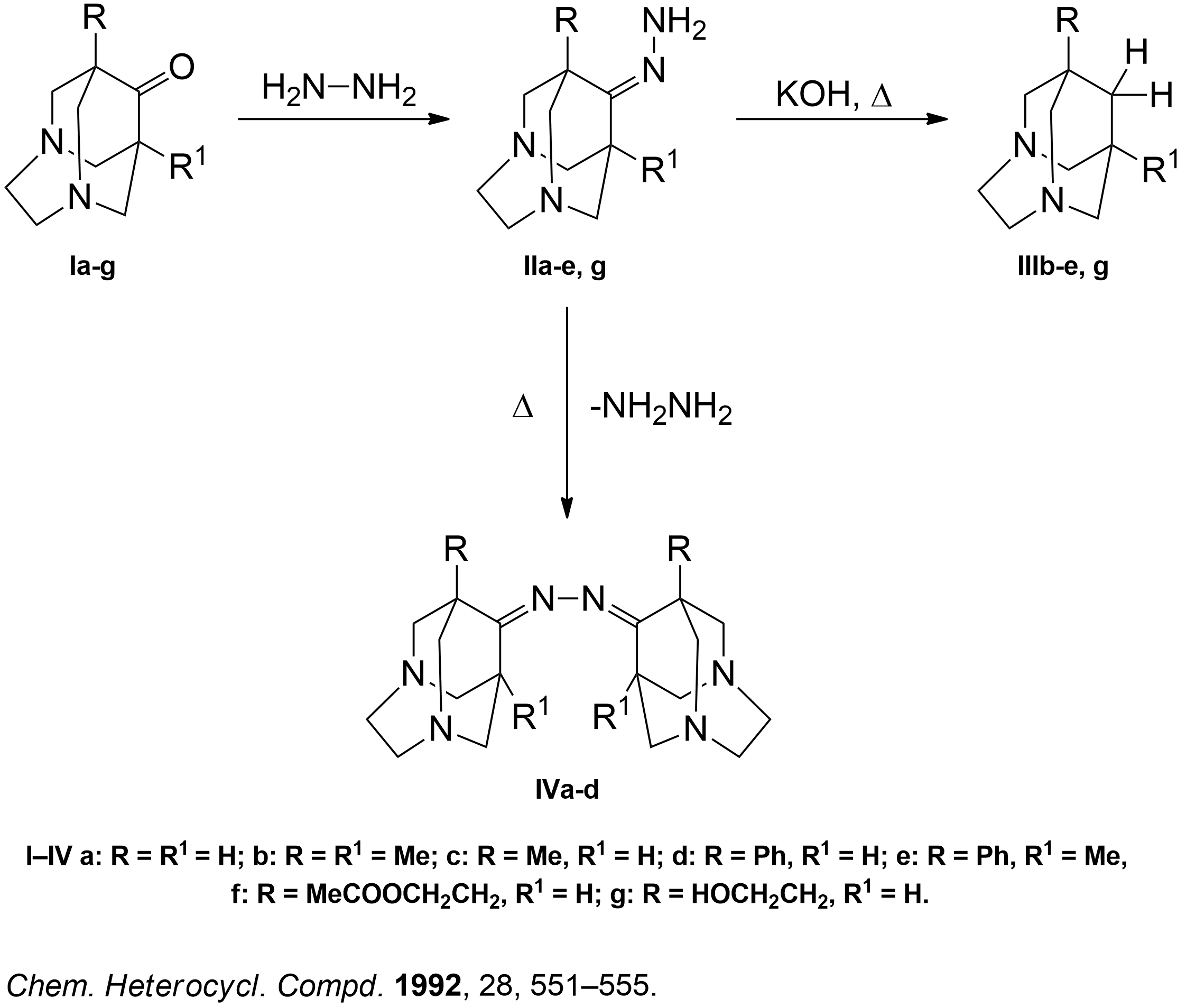
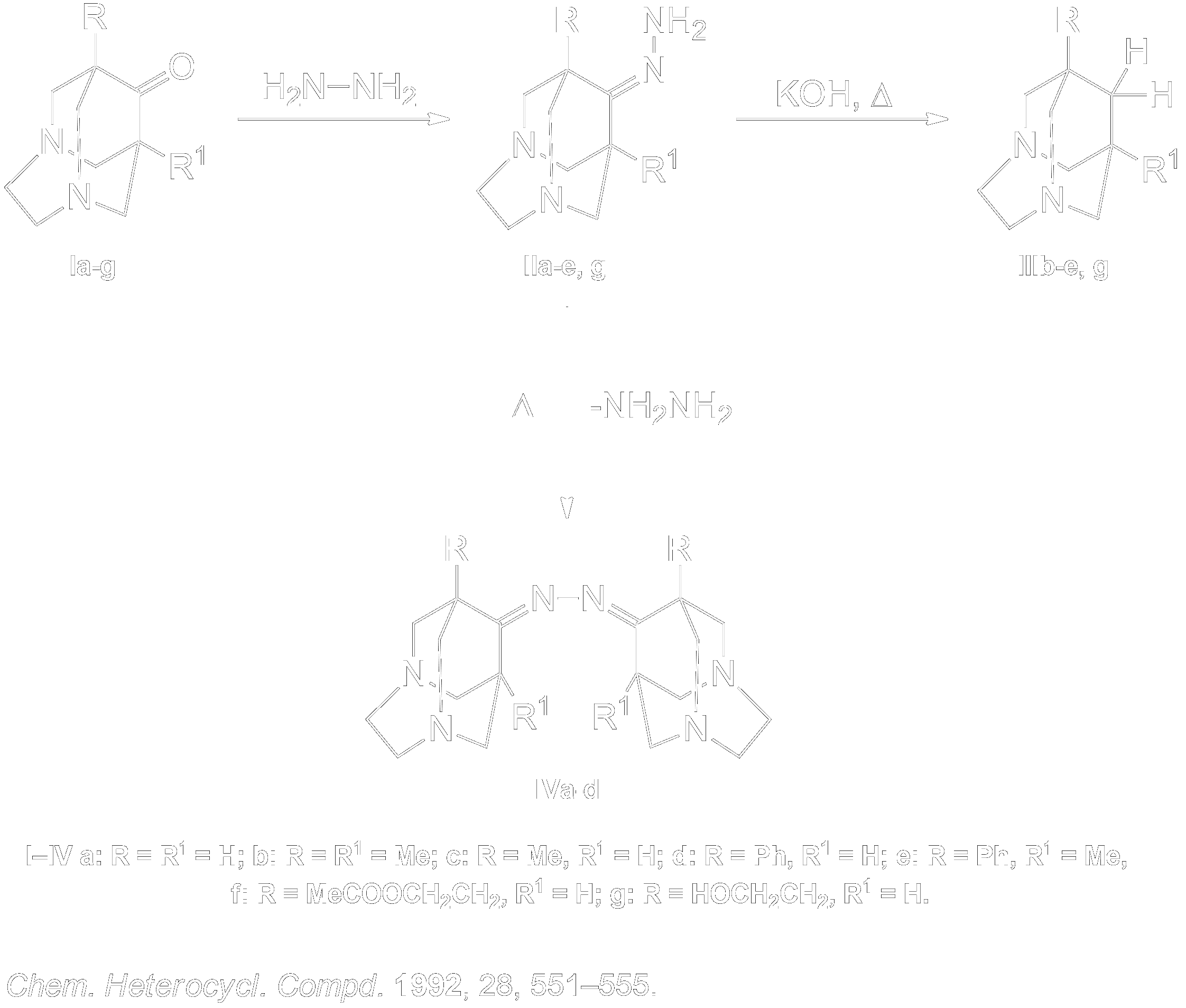
        Reduction of 3,6-diazahomoadamantan-9-ones (Ia–g) as described by Kuznetsov et al.
      </p>

      <p className="mt-2 text-sm text-gray-600 dark:text-gray-400">
        Depending on the pathway, the methylene product or azine product is formed.
      </p>
    </div>

    This study explores the Wolff–Kishner reduction of 3,6-diazahomoadamantan-9-ones (Ia–g), yielding either reduced amines (IIIb–e, g) or azine dimers (IVa–d) depending on substitution. While substituted hydrazones (IIb–e, g) undergo clean reduction to the corresponding amines, the unsubstituted hydrazone (IIa) instead forms a stable azine (IVa). The work establishes a reliable synthetic route to these products and confirms their structures using IR, ESR, and mass spectrometry.
  </Accordion>

  <Accordion title="How is this Reaction used in the paper?">
    <div className="text-center">
      <div>
        <a href="" target="_blank" rel="noopener noreferrer">
          <img noZoom className="block dark:hidden mt-2" src="https://mintcdn.com/reactionrepo-bd9a1c17/jrXUYHUApPdH4-EL/reactions/wolff-kishner-reduction-images/citation2light.png?fit=max&auto=format&n=jrXUYHUApPdH4-EL&q=85&s=1d61a723ff499b60f4c741496fcb4601" alt="Hero Light" title="" width="2244" height="1891" data-path="reactions/wolff-kishner-reduction-images/citation2light.png" />

          <img noZoom className="hidden dark:block mt-2" src="https://mintcdn.com/reactionrepo-bd9a1c17/jrXUYHUApPdH4-EL/reactions/wolff-kishner-reduction-images/citation2dark.png?fit=max&auto=format&n=jrXUYHUApPdH4-EL&q=85&s=908825951055df1ab33b4cc30252aca0" alt="Hero Dark" title="" width="2244" height="1891" data-path="reactions/wolff-kishner-reduction-images/citation2dark.png" />
        </a>
      </div>

      <p className="mt-2 text-sm font-bold text-gray-600 dark:text-gray-400">
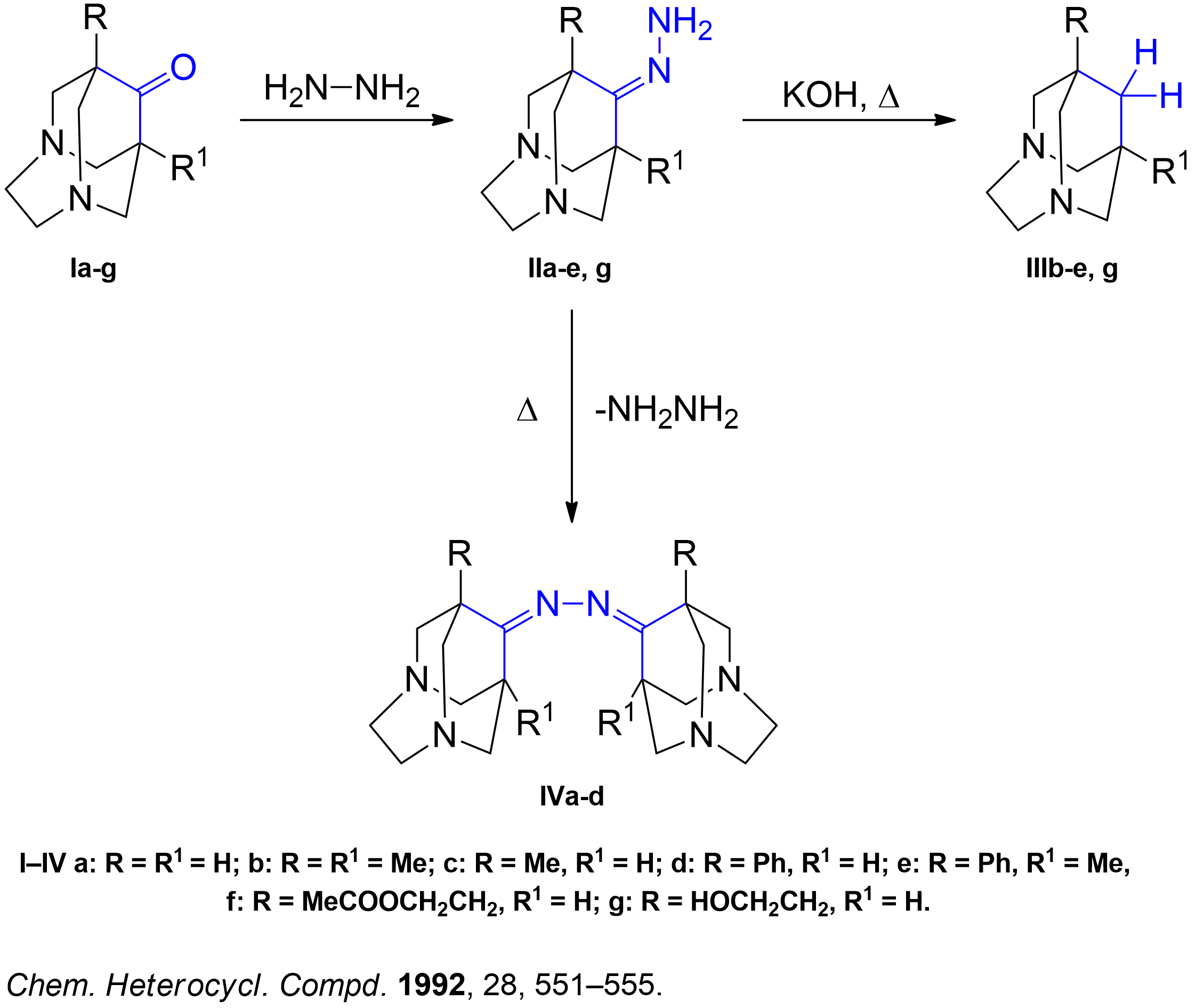
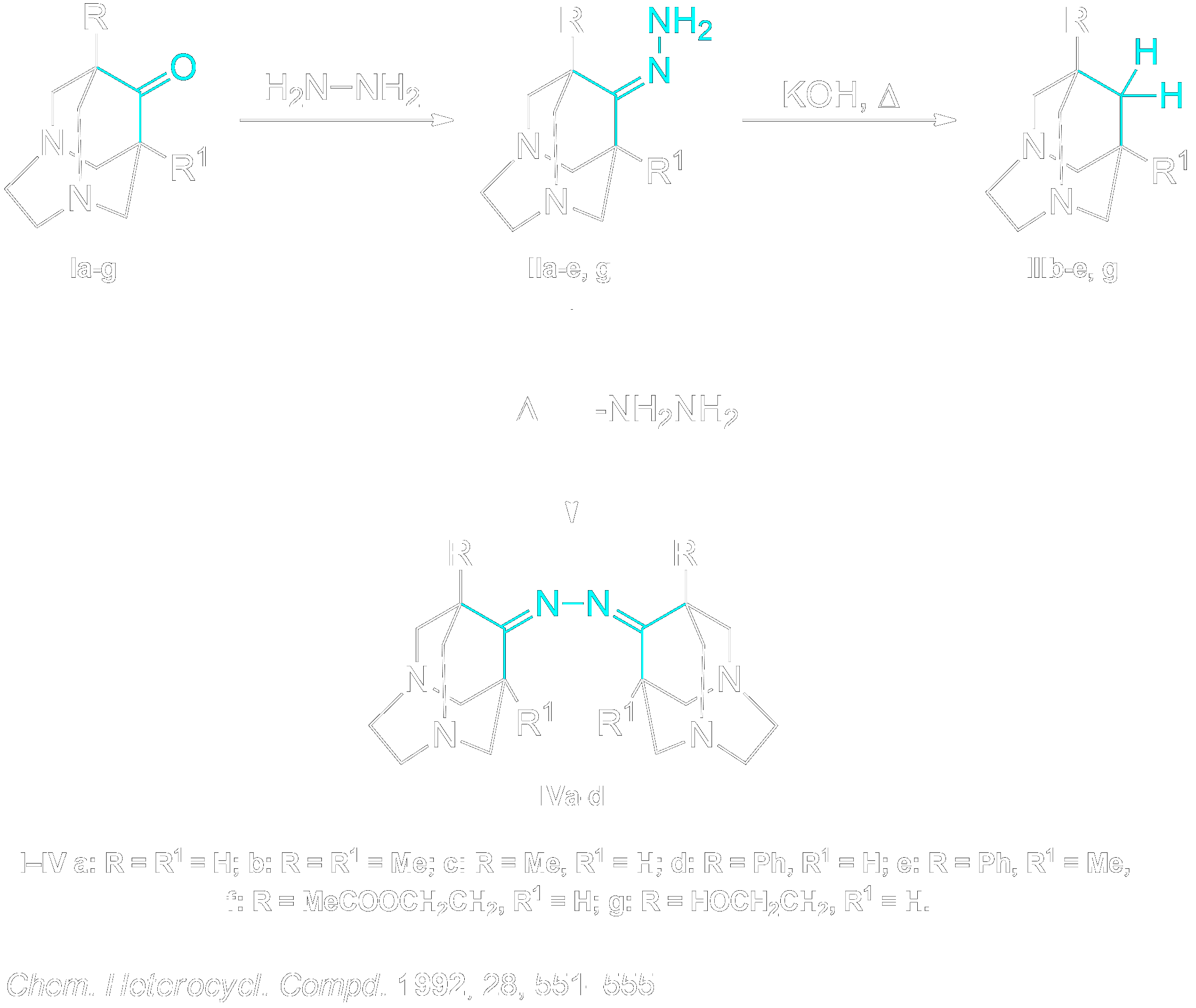
        Schematic representation of the Wolff–Kishner reduction of 3,6-diazahomoadamantan-9-ones (Ia–g) as described by Kuznetsov et al.
      </p>

      <p className="mt-2 text-sm text-gray-600 dark:text-gray-400">
        This reaction yielded 3,6-diazahomoadamantanes (IIIb–e, g) from substituted ketones, while the unsubstituted analog (IIa) formed azine dimer IVa upon thermal decomposition.
      </p>
    </div>

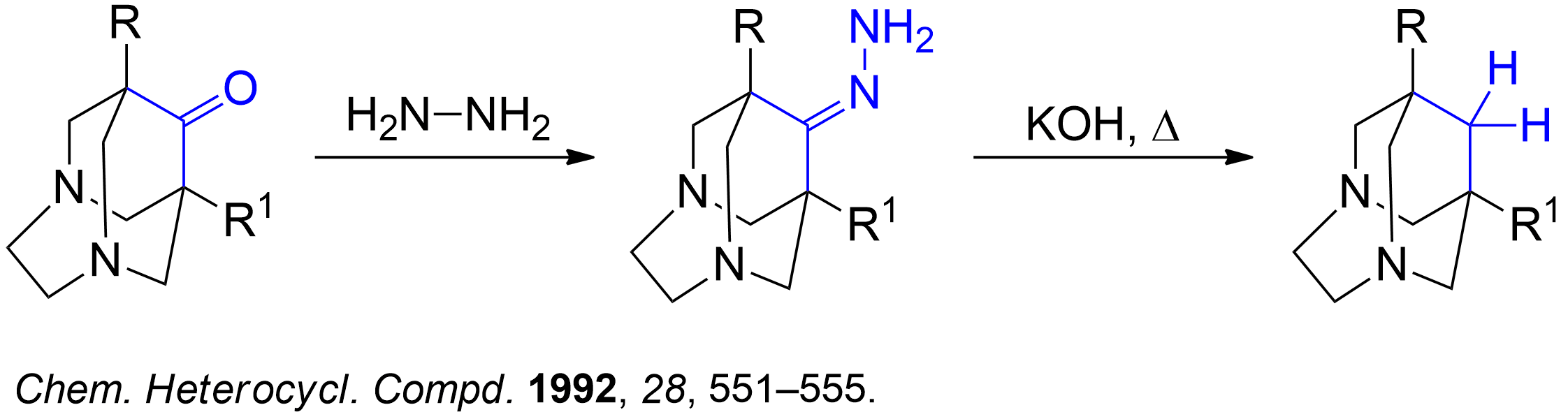
    In this study, the Wolff–Kishner reduction began with the formation of hydrazones by reacting substituted diazahomoadamantanones (Ia–e, Ig) with excess hydrazine hydrate.

    These hydrazones were then subjected to thermal decomposition by heating them with powdered potassium hydroxide at high temperatures (220–240 °C) for 2–3 hours. Upon cooling, the mixtures were extracted with ether, and the crude products were purified either through sublimation or recrystallization.

    This sequence effectively reduced the ketone group to a methylene yielding stable 3,6-diazahomoadamantanes.
  </Accordion>
</AccordionGroup>

<Steps>
  <Step title="Identifying Reagents and Reaction Conditions">
    <a href="" target="_blank" rel="noopener noreferrer">
      <img noZoom className="block dark:hidden" src="https://mintcdn.com/reactionrepo-bd9a1c17/jrXUYHUApPdH4-EL/reactions/wolff-kishner-reduction-images/reagentslight.png?fit=max&auto=format&n=jrXUYHUApPdH4-EL&q=85&s=b35c4185d6a689ab120daaec47b19a91" alt="Hero Light" width="1662" height="529" data-path="reactions/wolff-kishner-reduction-images/reagentslight.png" />

      <img noZoom className="hidden dark:block" src="https://mintcdn.com/reactionrepo-bd9a1c17/jrXUYHUApPdH4-EL/reactions/wolff-kishner-reduction-images/reagentsdark.png?fit=max&auto=format&n=jrXUYHUApPdH4-EL&q=85&s=d4c5bcc47a6032df691790ac721f62f8" alt="Hero Dark" width="1662" height="529" data-path="reactions/wolff-kishner-reduction-images/reagentsdark.png" />
    </a>

    <>
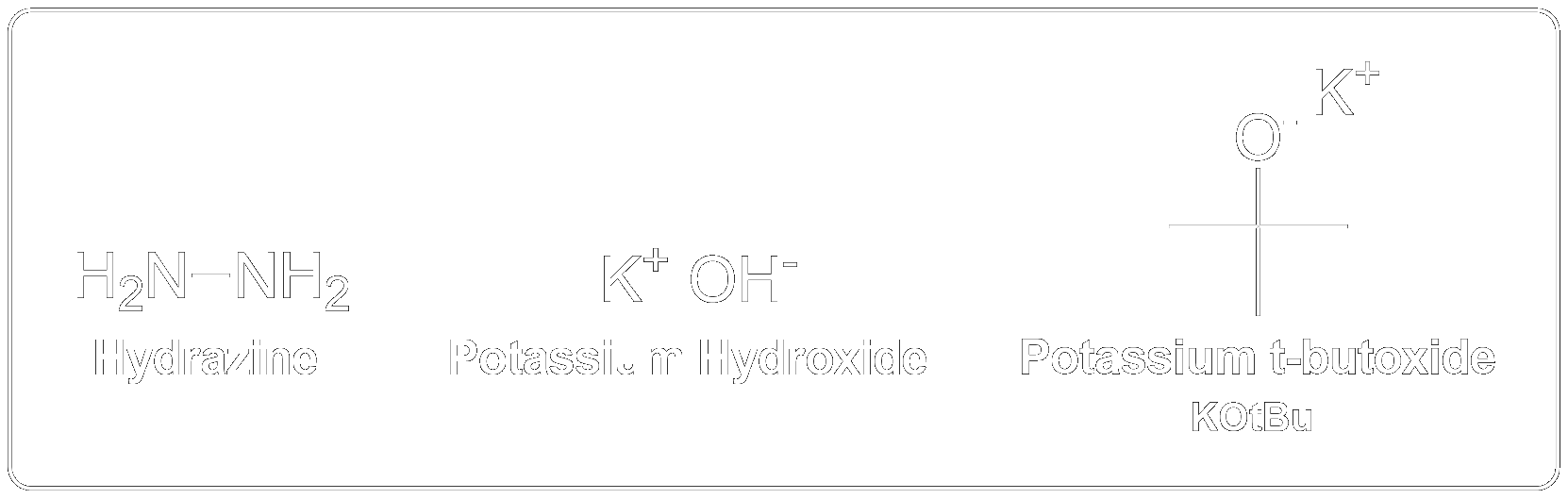
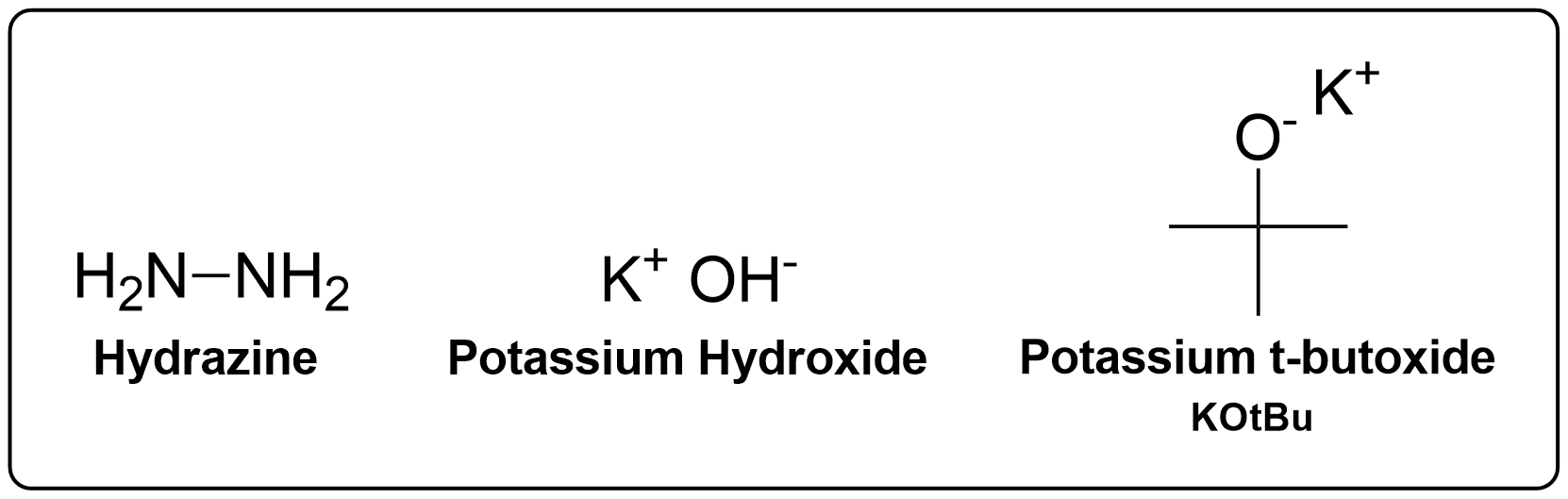
      {`When a carbonyl compound is heated with hydrazine in the presence of a strong base like KOH or KOtBu potassium tert-butoxide, the carbonyl group is converted to a methylene (–CH₂) group.`}{' '}

      <Tooltip
        tip={
<div className="text-left leading-tight" style={{ fontSize: '11px', lineHeight: '1.2' }}>
  Clayden, J.; Greeves, N.; Warren, S. Organic Chemistry, 2nd ed.; Oxford University Press: Oxford, <strong>2012</strong>.
</div>
}
      >
        <sup><a id="fnref3" href="#fn3" className="underline text-blue-600 dark:text-blue-400 text-xs">\[3]</a></sup>
      </Tooltip>

      {' '}

      <Tooltip
        tip={
<div className="text-left leading-tight" style={{ fontSize: '12.5px', lineHeight: '1.2' }}>
  Verma, D. K.; Dewangan, Y.; Verma, C. Handbook of Organic Name Reactions. Elsevier, <strong>2023</strong>; pp 155–241.
</div>
}
      >
        <sup><a id="fnref4" href="#fn4" className="underline text-blue-600 dark:text-blue-400 text-xs">\[4]</a></sup>
      </Tooltip>
    </>
  </Step>

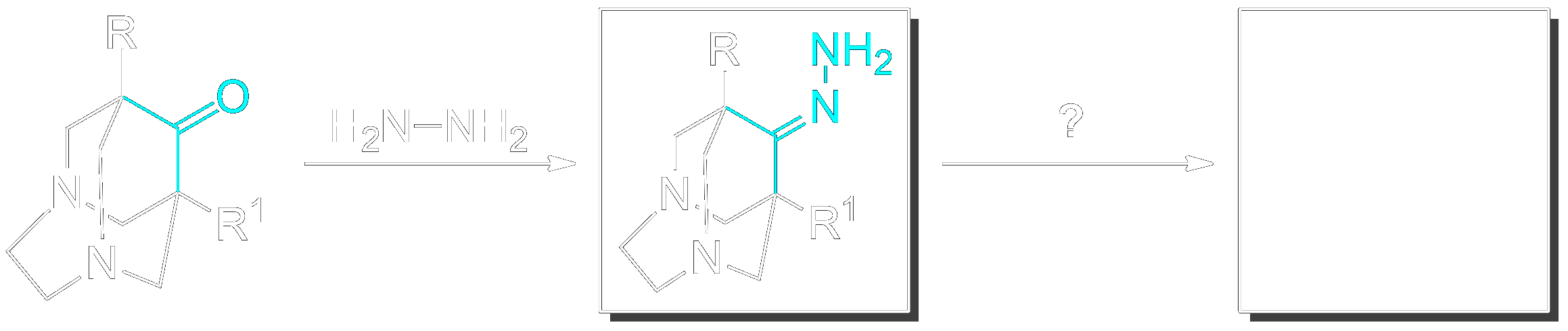
  <Step title="Identify the target carbonyl group and subsequent steps">
    <a href="" target="_blank" rel="noopener noreferrer">
      <img noZoom className="block dark:hidden" src="https://mintcdn.com/reactionrepo-bd9a1c17/jrXUYHUApPdH4-EL/reactions/wolff-kishner-reduction-images/guessoverviewlight.png?fit=max&auto=format&n=jrXUYHUApPdH4-EL&q=85&s=b419c38023a010b5e453c459a8b54aea" alt="Hero Light" width="2316" height="486" data-path="reactions/wolff-kishner-reduction-images/guessoverviewlight.png" />

      <img noZoom className="hidden dark:block" src="https://mintcdn.com/reactionrepo-bd9a1c17/jrXUYHUApPdH4-EL/reactions/wolff-kishner-reduction-images/guessoverviewdark.png?fit=max&auto=format&n=jrXUYHUApPdH4-EL&q=85&s=3daabff33c8c6a22ee30f3b4c8054a13" alt="Hero Dark" width="2316" height="486" data-path="reactions/wolff-kishner-reduction-images/guessoverviewdark.png" />
    </a>

    <>
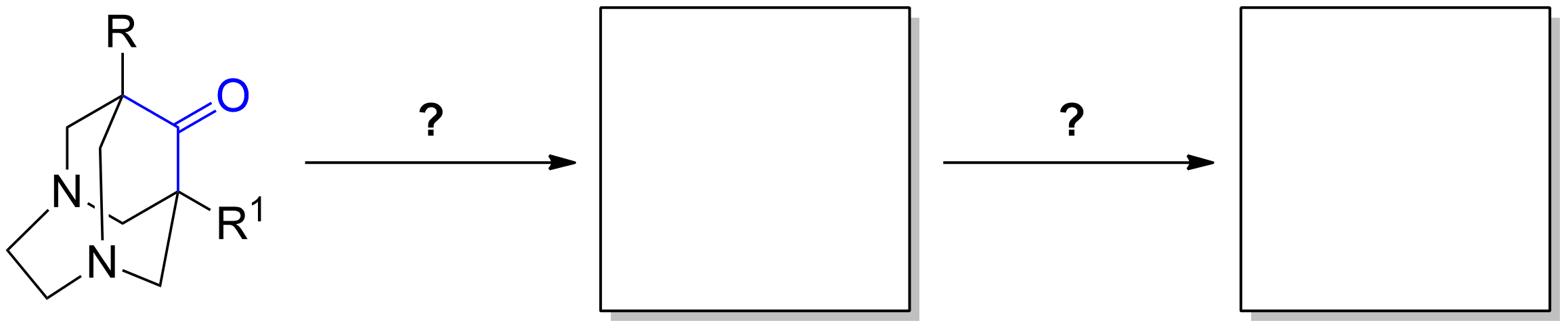
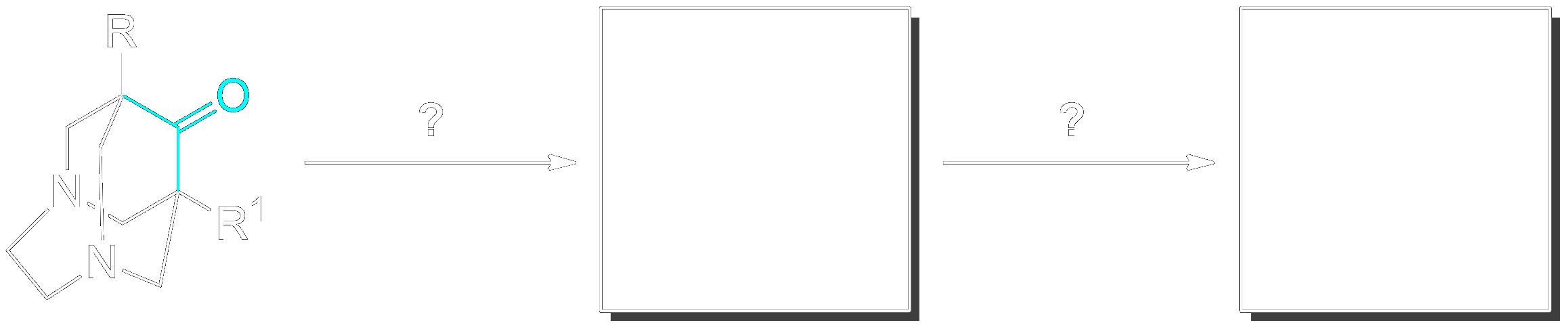
      {`Once we’ve identified the target carbonyl (in this case, a ketone), we can guess two steps are needed to fully convert the carbonyl to the methylene group. Now we need to identify and use the general scheme for Wolff–Kishner to solve for the product.`}{' '}

      <Tooltip
        tip={
<div className="text-left leading-tight" style={{ fontSize: '11px', lineHeight: '1.2' }}>
  Clayden, J.; Greeves, N.; Warren, S. Organic Chemistry, 2nd ed.; Oxford University Press: Oxford, <strong>2012</strong>.
</div>
}
      >
        <sup><a id="fnref3-repeat" href="#fn3" className="underline text-blue-600 dark:text-blue-400 text-xs">\[3]</a></sup>
      </Tooltip>

      {' '}

      <Tooltip
        tip={
<div className="text-left leading-tight" style={{ fontSize: '12.5px', lineHeight: '1.2' }}>
  Verma, D. K.; Dewangan, Y.; Verma, C. Handbook of Organic Name Reactions. Elsevier, <strong>2023</strong>; pp 155–241.
</div>
}
      >
        <sup><a id="fnref4-repeat" href="#fn4" className="underline text-blue-600 dark:text-blue-400 text-xs">\[4]</a></sup>
      </Tooltip>
    </>
  </Step>

  <Step title="Identify the General Scheme">
    <a href="" target="_blank" rel="noopener noreferrer">
      <img noZoom className="block dark:hidden" src="https://mintcdn.com/reactionrepo-bd9a1c17/jrXUYHUApPdH4-EL/reactions/wolff-kishner-reduction-images/overviewmechlight.png?fit=max&auto=format&n=jrXUYHUApPdH4-EL&q=85&s=4b4ae037884f73e47f0b2d1424239168" alt="Hero Light" width="2077" height="386" data-path="reactions/wolff-kishner-reduction-images/overviewmechlight.png" />

      <img noZoom className="hidden dark:block" src="https://mintcdn.com/reactionrepo-bd9a1c17/jrXUYHUApPdH4-EL/reactions/wolff-kishner-reduction-images/overviewmechdarkspacing.png?fit=max&auto=format&n=jrXUYHUApPdH4-EL&q=85&s=970c38ed3b3cddb2b1073b2e71c355b3" alt="Hero Dark" width="2077" height="386" data-path="reactions/wolff-kishner-reduction-images/overviewmechdarkspacing.png" />
    </a>

    <>
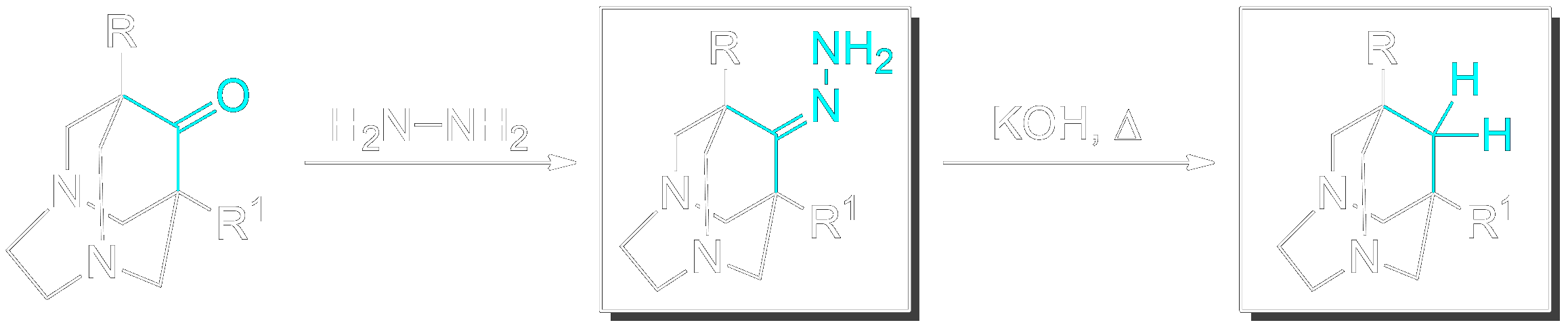
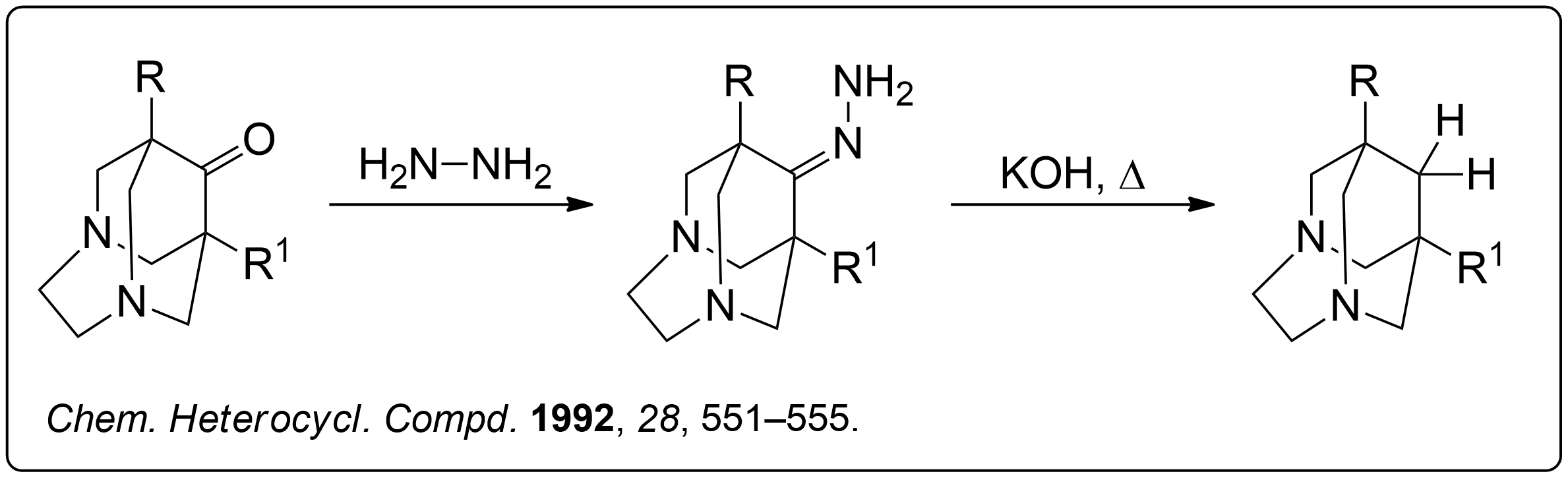
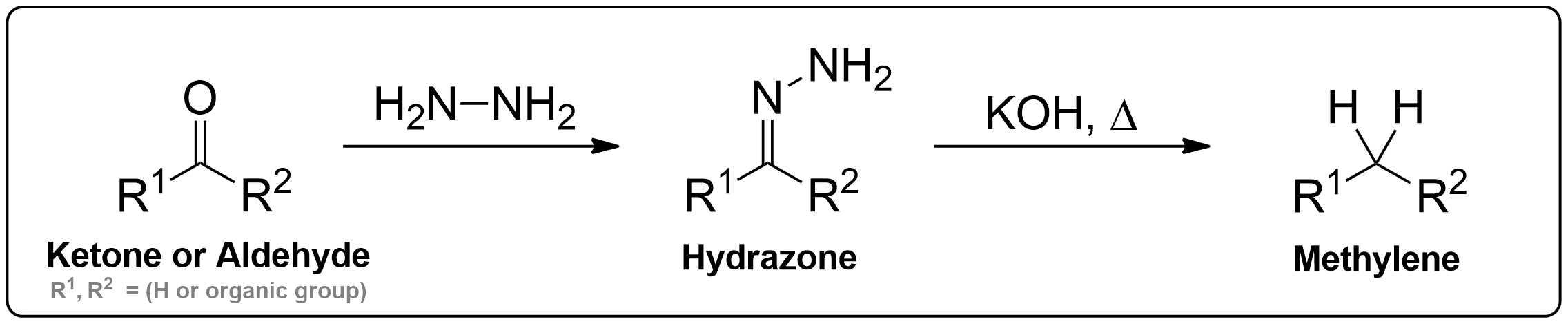
      {`The Wolff–Kishner reaction starts with the ketone (or aldehyde) and converts it to a hydrazone using hydrazine. This is followed by hydrazone conversion to methylene using a strong base such as KOH and heat (Δ).`}{' '}

      <Tooltip
        tip={
<div className="text-left leading-tight" style={{ fontSize: '11px', lineHeight: '1.2' }}>
  Clayden, J.; Greeves, N.; Warren, S. Organic Chemistry, 2nd ed.; Oxford University Press: Oxford, <strong>2012</strong>.
</div>
}
      >
        <sup><a id="fnref3-scheme" href="#fn3" className="underline text-blue-600 dark:text-blue-400 text-xs">\[3]</a></sup>
      </Tooltip>

      {' '}

      <Tooltip
        tip={
<div className="text-left leading-tight" style={{ fontSize: '12.5px', lineHeight: '1.2' }}>
  Verma, D. K.; Dewangan, Y.; Verma, C. Handbook of Organic Name Reactions. Elsevier, <strong>2023</strong>; pp 155–241.
</div>
}
      >
        <sup><a id="fnref4-scheme" href="#fn4" className="underline text-blue-600 dark:text-blue-400 text-xs">\[4]</a></sup>
      </Tooltip>
    </>
  </Step>

  <Step title="Directly apply the scheme to determine product">
    <a href="" target="_blank" rel="noopener noreferrer">
      <img noZoom className="block dark:hidden" src="https://mintcdn.com/reactionrepo-bd9a1c17/jrXUYHUApPdH4-EL/reactions/wolff-kishner-reduction-images/appliedschemelight.png?fit=max&auto=format&n=jrXUYHUApPdH4-EL&q=85&s=60bd743832689c22f5f9857049413b65" alt="Hero Light" width="2244" height="600" data-path="reactions/wolff-kishner-reduction-images/appliedschemelight.png" />

      <img noZoom className="hidden dark:block" src="https://mintcdn.com/reactionrepo-bd9a1c17/jrXUYHUApPdH4-EL/reactions/wolff-kishner-reduction-images/appliedschemedark2.png?fit=max&auto=format&n=jrXUYHUApPdH4-EL&q=85&s=d1d9f82a66b00e991e0b6545999bf315" alt="Hero Dark" width="2244" height="600" data-path="reactions/wolff-kishner-reduction-images/appliedschemedark2.png" />
    </a>

    <>
      {`The scheme can be directly applied as done by Kuznetsov et al. (1992) to create the alkane product.`}{' '}

      <Tooltip
        tip={
  <div
    className="text-left leading-tight"
    style={{ fontSize: '11px', lineHeight: '1.2' }}
  >
    Kuznetsov, A. I.; Vladimirova, I. A.; Serova, T. M.; Moskovkin, A. S.{' '}
    <a
      href="https://doi.org/10.1007/BF00475255"
      target="_blank"
      rel="noopener noreferrer"
      className="underline text-blue-700 dark:text-blue-400"
    >
      Heteroadamantanes and Their Derivatives. 17. Wolff–Kishner Reduction of 3,6-Diazahomoadamantan-9-ones.
    </a>{' '}
    Chem. Heterocycl. Compd. <strong>1992</strong>, <em>28</em>, 551–555. <br />
    <span style={{ fontWeight: '600' }}>DOI:</span>{' '}
    <a
      href="https://doi.org/10.1007/BF00475255"
      target="_blank"
      rel="noopener noreferrer"
      className="underline text-blue-700 dark:text-blue-400"
    >
      https://doi.org/10.1007/BF00475255
    </a>
  </div>
}
      >
        <sup><a id="fnref5" href="#fn5" className="underline text-blue-600 dark:text-blue-400 text-xs">\[5]</a></sup>
      </Tooltip>
    </>
  </Step>
</Steps>

## Mechanism for Carbonyls

This section is a brief overview on how to perform the mechanism for both aldehydes and ketones using the paper from above.
<a href="" target="_blank" rel="noopener noreferrer">
  <img className="block dark:hidden mt-0" src="https://mintcdn.com/reactionrepo-bd9a1c17/jrXUYHUApPdH4-EL/reactions/wolff-kishner-reduction-images/overviewboxedlight.png?fit=max&auto=format&n=jrXUYHUApPdH4-EL&q=85&s=b3396d7df1c132f5abbda0c26711941f" alt="Hero Light" width="2378" height="725" data-path="reactions/wolff-kishner-reduction-images/overviewboxedlight.png" />

  <img className="hidden dark:block mt-0" src="https://mintcdn.com/reactionrepo-bd9a1c17/jrXUYHUApPdH4-EL/reactions/wolff-kishner-reduction-images/overviewboxeddark.png?fit=max&auto=format&n=jrXUYHUApPdH4-EL&q=85&s=c10dcaf73c6ca7fd549560abf8ac0f15" alt="Hero Dark" width="2378" height="725" data-path="reactions/wolff-kishner-reduction-images/overviewboxeddark.png" />
</a>

We know the scheme for this reaction and the product. Lets do the mechanism now.

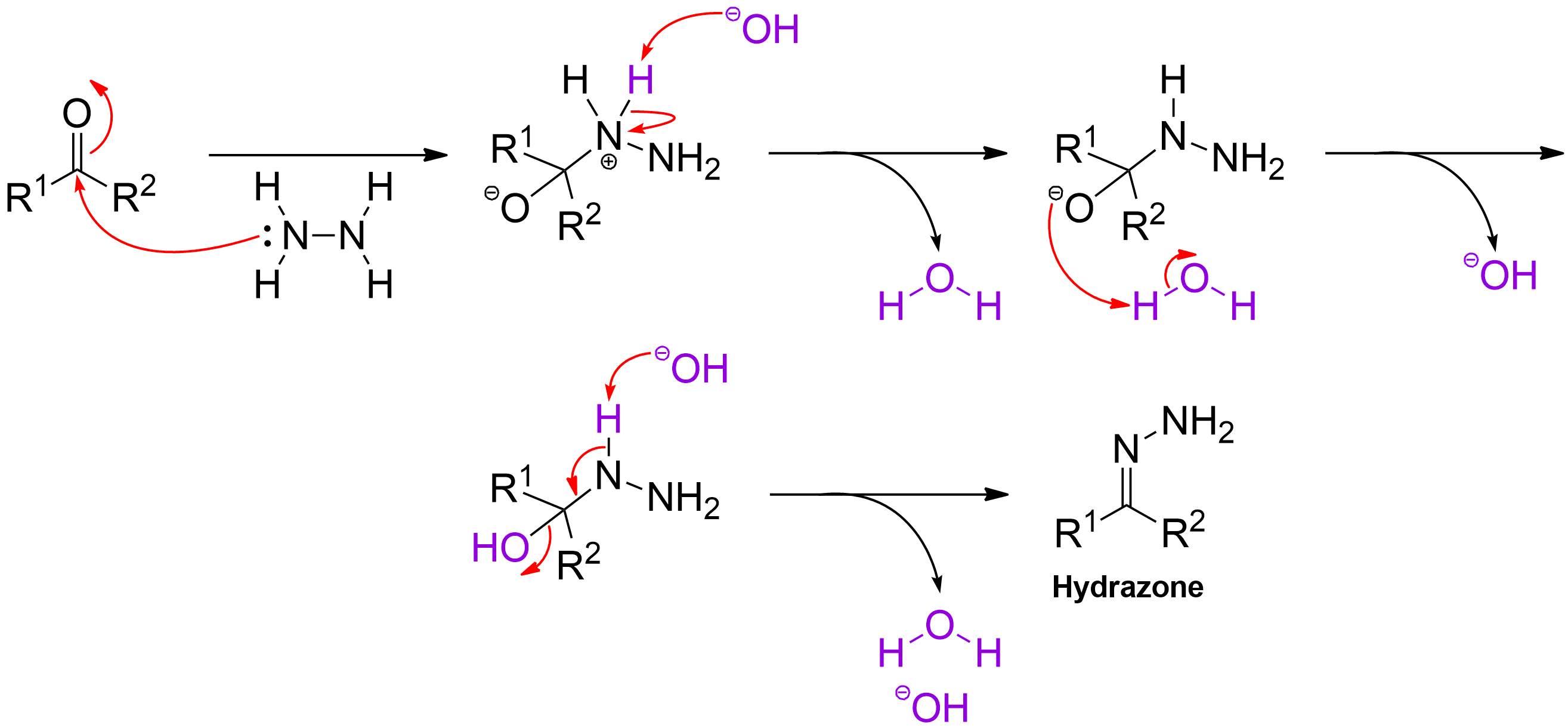
<Note>For the mechanism, we only **selectively reduce the Ketone**. We not do anything to the rest of the molecule. **R<sup>1</sup> and R<sup>2</sup> represents the rest of the molecule.** </Note>
<Steps>
  <Step title="Ketone to Hydrazone Conversion">
    <img className="block dark:hidden mt-0" src="https://mintcdn.com/reactionrepo-bd9a1c17/jrXUYHUApPdH4-EL/reactions/wolff-kishner-reduction-images/reactionpart1light.png?fit=max&auto=format&n=jrXUYHUApPdH4-EL&q=85&s=6358d41b3281be14bf806157d3aa148c" alt="Hero Light" width="2629" height="1220" data-path="reactions/wolff-kishner-reduction-images/reactionpart1light.png" />

    <img className="hidden dark:block mt-0" src="https://mintcdn.com/reactionrepo-bd9a1c17/jrXUYHUApPdH4-EL/reactions/wolff-kishner-reduction-images/reactionpart1dark.png?fit=max&auto=format&n=jrXUYHUApPdH4-EL&q=85&s=52c40626bc3d3b2eea9b4f7e3e99f2ac" alt="Hero Dark" width="2629" height="1220" data-path="reactions/wolff-kishner-reduction-images/reactionpart1dark.png" />

    ```mermaid theme={null}
    flowchart LR
    A[**Nucleophilic Attack**] --> B[**Proton Transfer**]
    B --> C[**Water Elimination**]
    C --> D[**Hydrazone Formation**]
    ```

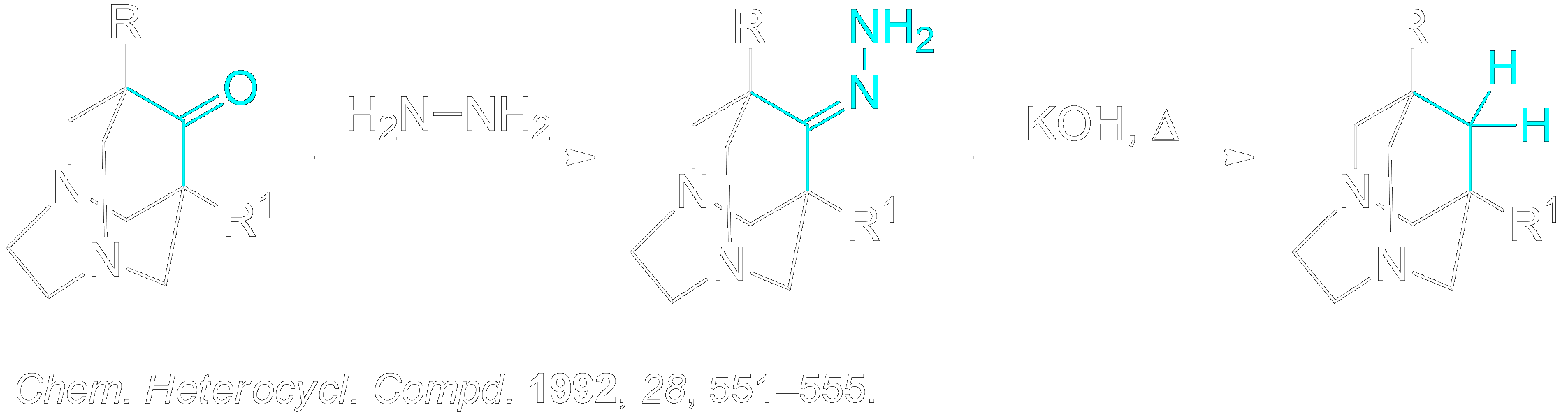
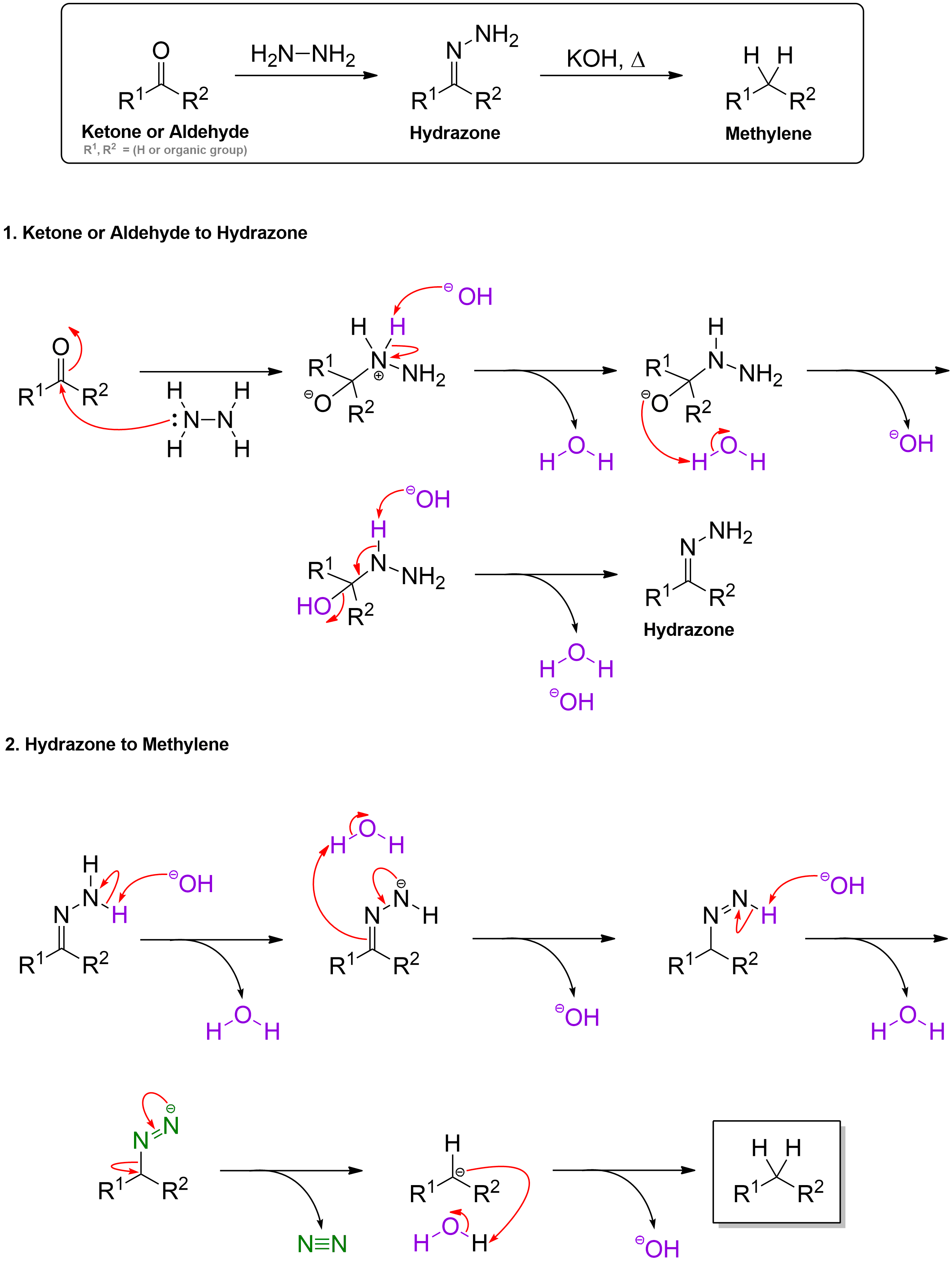
    1. Hydrazine's terminal nitrogen attacks the carbonyl carbon, forming a tetrahedral intermediate.

    2. A proton shifts from the N–H⁺ to the alkoxide, yielding a neutral alcohol.

    3. Base deprotonates the hydroxyl group, facilitating loss of water and forming the C=N double bond.

    4. Hydrazone is formed. (C=NNH₂).
    <Accordion title="How far have we progressed through the scheme?">
      <img className="block dark:hidden" src="https://mintcdn.com/reactionrepo-bd9a1c17/jrXUYHUApPdH4-EL/reactions/wolff-kishner-reduction-images/guessstep1light.png?fit=max&auto=format&n=jrXUYHUApPdH4-EL&q=85&s=6dc2982eba14e9d35355b5d888ff17e4" alt="Hero Light" width="2316" height="486" data-path="reactions/wolff-kishner-reduction-images/guessstep1light.png" />

      <img className="hidden dark:block" src="https://mintcdn.com/reactionrepo-bd9a1c17/jrXUYHUApPdH4-EL/reactions/wolff-kishner-reduction-images/guessstep1dark.png?fit=max&auto=format&n=jrXUYHUApPdH4-EL&q=85&s=927f88ae97b51af1ef1c497199a3d451" alt="Hero Dark" width="2318" height="490" data-path="reactions/wolff-kishner-reduction-images/guessstep1dark.png" />

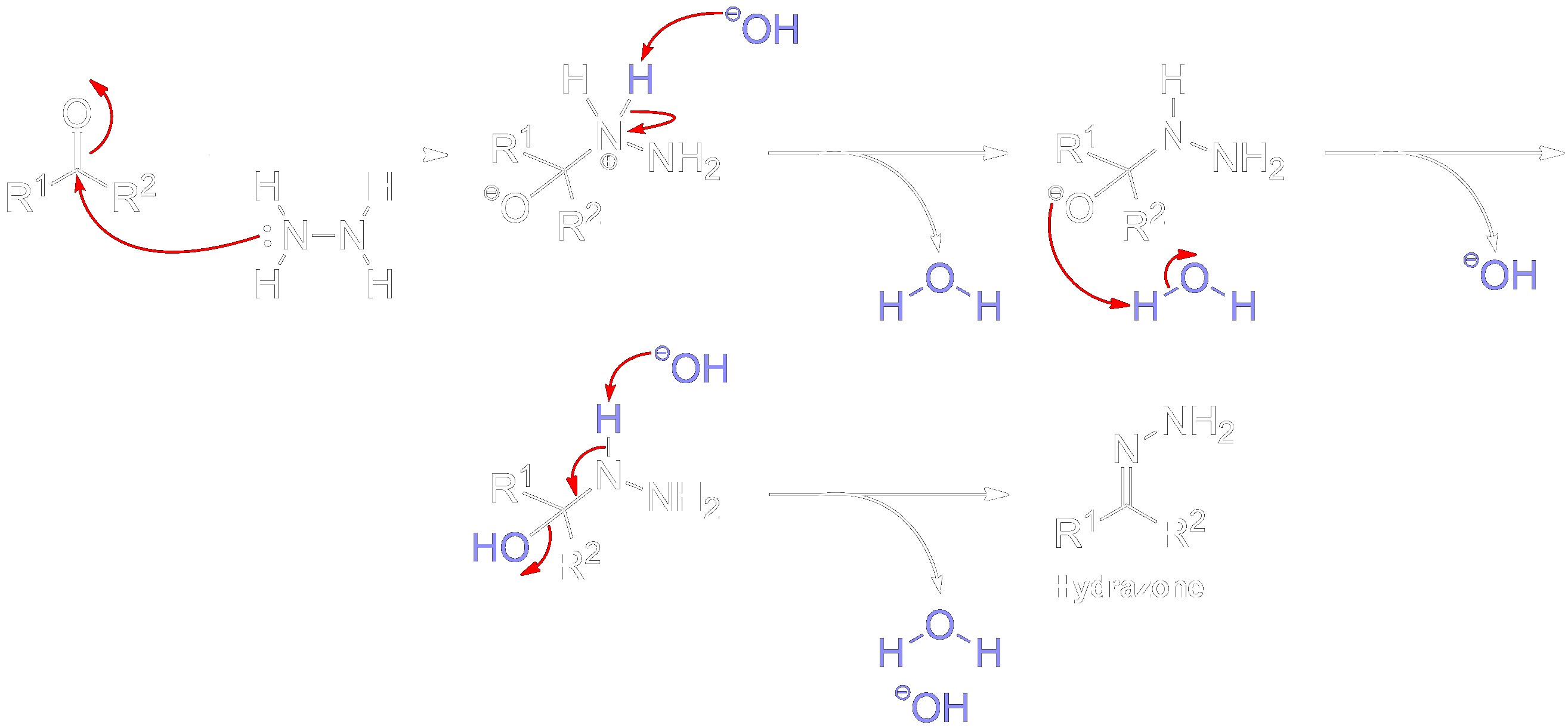
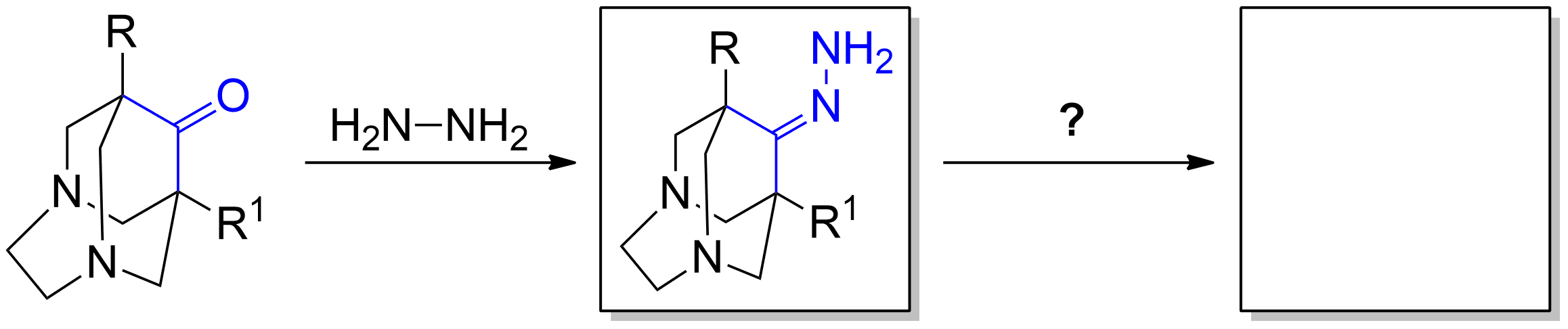
      We are now half-way through with the mechanism and scheme.
    </Accordion>
  </Step>

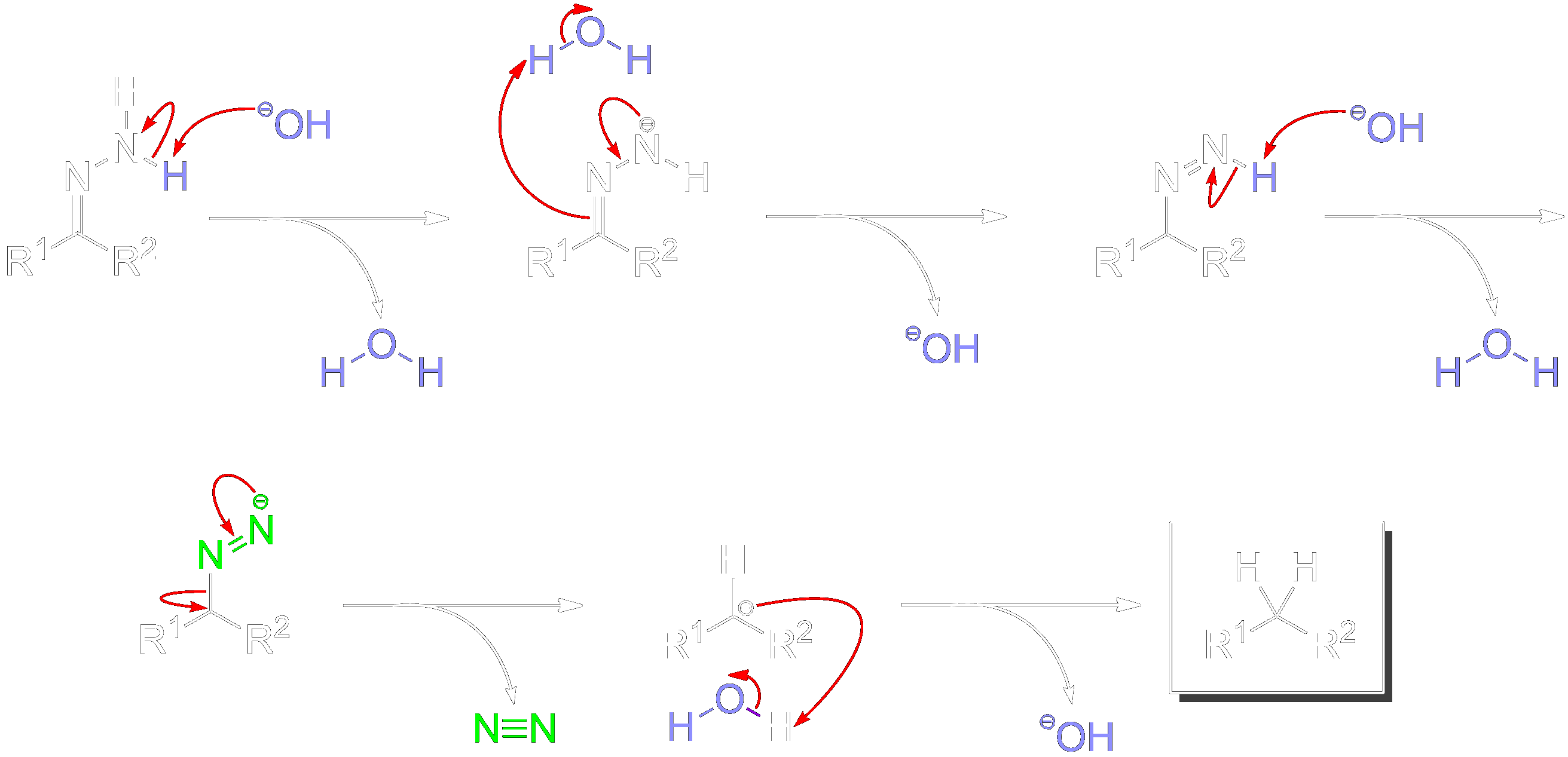
  <Step title="Hydrazone to Methylene Product">
    <img className="block dark:hidden" src="https://mintcdn.com/reactionrepo-bd9a1c17/jrXUYHUApPdH4-EL/reactions/wolff-kishner-reduction-images/reactionpart2light.png?fit=max&auto=format&n=jrXUYHUApPdH4-EL&q=85&s=e9324f4f3c8f8d8657bf760791c82bcd" alt="Hero Light" width="2623" height="1267" data-path="reactions/wolff-kishner-reduction-images/reactionpart2light.png" />

    <img className="hidden dark:block" src="https://mintcdn.com/reactionrepo-bd9a1c17/jrXUYHUApPdH4-EL/reactions/wolff-kishner-reduction-images/reactionpart2dark.png?fit=max&auto=format&n=jrXUYHUApPdH4-EL&q=85&s=2e51cd37a08c28180f8d23ff4f48096d" alt="Hero Dark" width="2623" height="1267" data-path="reactions/wolff-kishner-reduction-images/reactionpart2dark.png" />

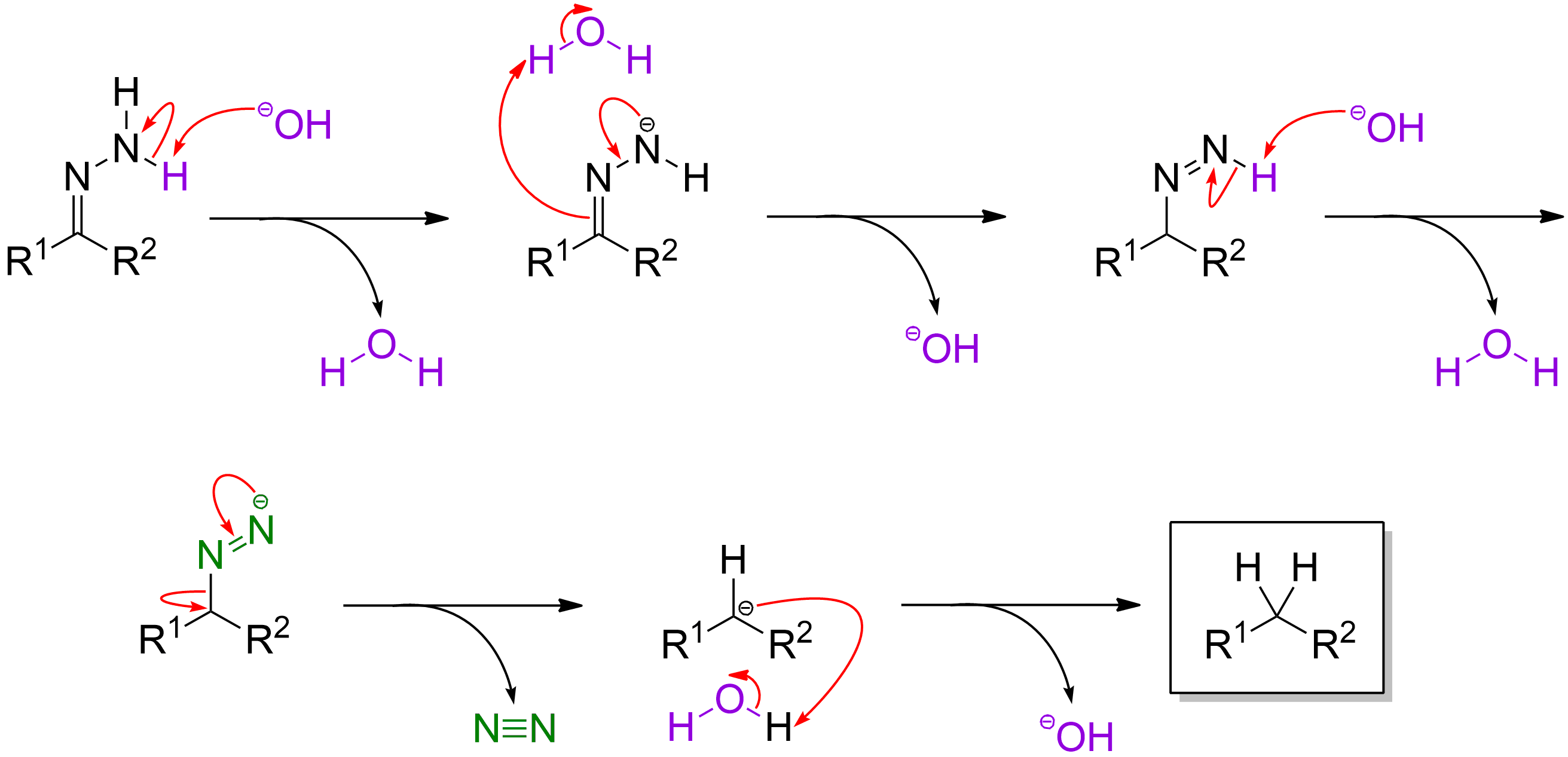
    The Hydrazone is deprotonated by hydroxide and reprotonated by water. Eventually, this leads to removal of a N<sup>2</sup> group. Lastly, a final protonation by water yields the Methylene (alkane) product.
    <Accordion title="How far have we progressed through the scheme?">
      <a href="" target="_blank" rel="noopener noreferrer">
        <img noZoom className="block dark:hidden" src="https://mintcdn.com/reactionrepo-bd9a1c17/jrXUYHUApPdH4-EL/reactions/wolff-kishner-reduction-images/guessstep2light.png?fit=max&auto=format&n=jrXUYHUApPdH4-EL&q=85&s=528540164c383b21fe3cffc351b0dbac" alt="Hero Light" width="2316" height="486" data-path="reactions/wolff-kishner-reduction-images/guessstep2light.png" />

        <img noZoom className="hidden dark:block" src="https://mintcdn.com/reactionrepo-bd9a1c17/jrXUYHUApPdH4-EL/reactions/wolff-kishner-reduction-images/guessstep2dark.png?fit=max&auto=format&n=jrXUYHUApPdH4-EL&q=85&s=33622adb7f8ed4bf6571311385b75574" alt="Hero Dark" width="2316" height="486" data-path="reactions/wolff-kishner-reduction-images/guessstep2dark.png" />
      </a>

      We are now fully completed with the mechanism and the scheme is completed.
    </Accordion>
  </Step>
</Steps>

## Summary

The reaction entry summary. Find the general scheme and full summarized mechanisms here.

### General Scheme

This section briefly summarizes what can and cannot undergo reactions.

<img className="block dark:hidden mt-0" src="https://mintcdn.com/reactionrepo-bd9a1c17/jrXUYHUApPdH4-EL/reactions/wolff-kishner-reduction-images/sidebysideoverviewlight.png?fit=max&auto=format&n=jrXUYHUApPdH4-EL&q=85&s=e44a86c1caea3d877babfc8a3992935e" alt="Hero Light" width="2719" height="364" data-path="reactions/wolff-kishner-reduction-images/sidebysideoverviewlight.png" />

<img className="hidden dark:block mt-0" src="https://mintcdn.com/reactionrepo-bd9a1c17/jrXUYHUApPdH4-EL/reactions/wolff-kishner-reduction-images/sidebysideoverview.png?fit=max&auto=format&n=jrXUYHUApPdH4-EL&q=85&s=c9b87217f4b335e980784243531fd2a5" alt="Hero Dark" width="2719" height="364" data-path="reactions/wolff-kishner-reduction-images/sidebysideoverview.png" />

* Wolff-Kishner uses Hydrazine (H₂N–NH₂), a strong base (KOH or KOtBu), and heat
* Carbonyls are converted into a methylene (–CH₂) group (alkane)
* All reactions, follow a general scheme:
<img className="block dark:hidden mt-0" src="https://mintcdn.com/reactionrepo-bd9a1c17/jrXUYHUApPdH4-EL/reactions/wolff-kishner-reduction-images/schemever2light.png?fit=max&auto=format&n=jrXUYHUApPdH4-EL&q=85&s=72e3ef652ba57de98ff58f90e59a1f55" alt="Hero Light" width="2272" height="469" data-path="reactions/wolff-kishner-reduction-images/schemever2light.png" />

<img className="hidden dark:block mt-0" src="https://mintcdn.com/reactionrepo-bd9a1c17/jrXUYHUApPdH4-EL/reactions/wolff-kishner-reduction-images/schemever2dark.png?fit=max&auto=format&n=jrXUYHUApPdH4-EL&q=85&s=839097f771f4cec6fa5c713f5128b13a" alt="Hero Dark" width="2272" height="469" data-path="reactions/wolff-kishner-reduction-images/schemever2dark.png" />

```mermaid theme={null}
flowchart LR
A[**Ketone or Aldehyde**] --> B[**Hydrazone Formation**]
B --> C[**Reduction to Methylene**]
```

### General Mechanism

This section briefly summarizes steps to find the product and perform the mechanisms.

**Quick steps to finding the product for any carbonyl**

1. Identify the reagents.
2. Identify the target carbonyl to be reduced.
3. Selectively convert the carbonyl, keep the rest of molecule the same.
4. Always remember the general scheme.
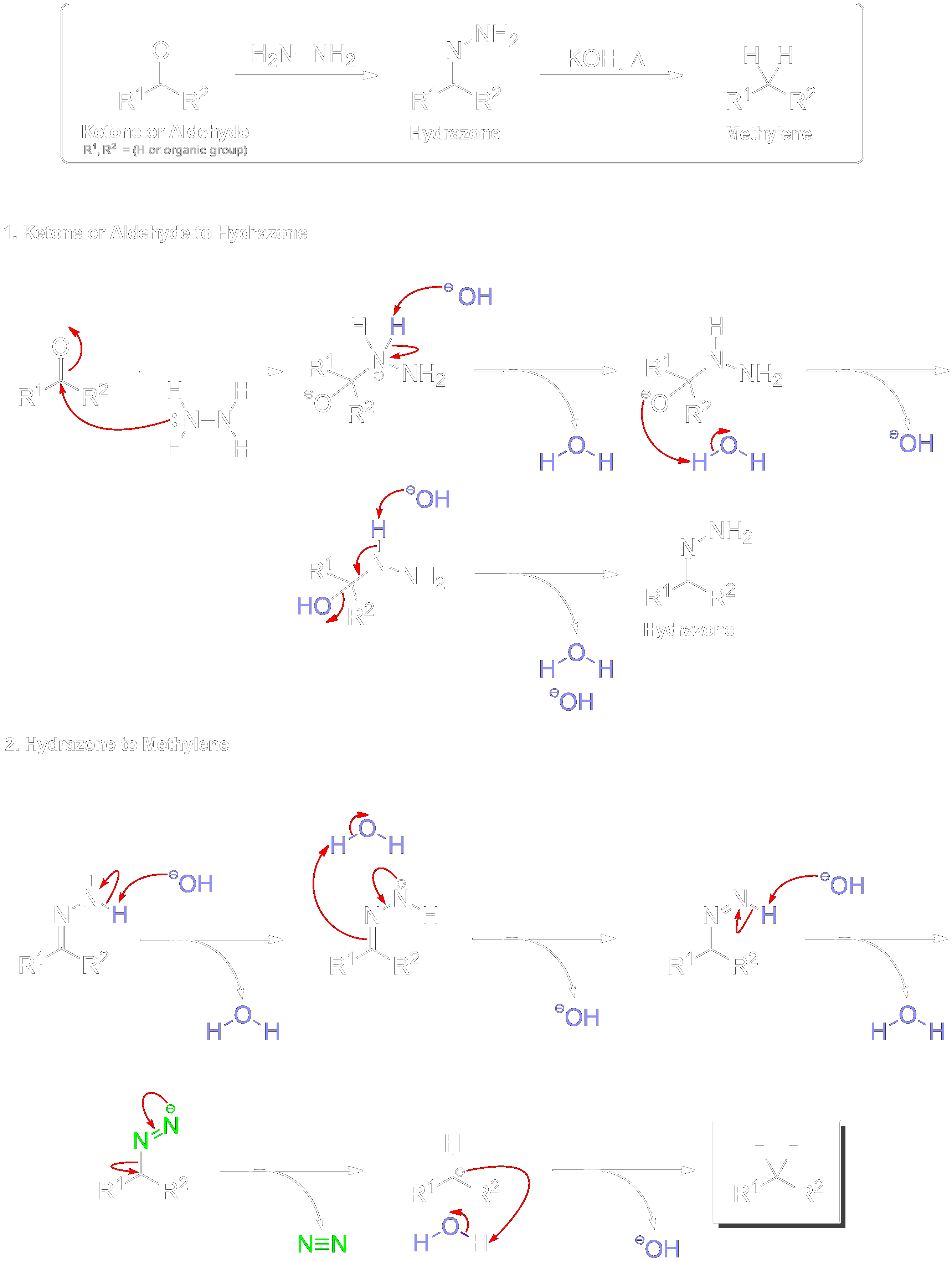
<Accordion title="Full Ketone/Aldehyde to Methylene (Alkane) Mechanism">
  <img className="block dark:hidden mt-2" src="https://mintcdn.com/reactionrepo-bd9a1c17/jrXUYHUApPdH4-EL/reactions/wolff-kishner-reduction-images/reactionfulllight.png?fit=max&auto=format&n=jrXUYHUApPdH4-EL&q=85&s=d73ffe9640ec08fb974dc33e53b867a1" alt="Hero Light" title="" width="2671" height="3538" data-path="reactions/wolff-kishner-reduction-images/reactionfulllight.png" />

  <img className="hidden dark:block mt-2" src="https://mintcdn.com/reactionrepo-bd9a1c17/jrXUYHUApPdH4-EL/reactions/wolff-kishner-reduction-images/reactionfulldark.png?fit=max&auto=format&n=jrXUYHUApPdH4-EL&q=85&s=6ee121832cb5dc0f9de43d05cf19bab9" alt="Hero Dark" title="" width="2671" height="3538" data-path="reactions/wolff-kishner-reduction-images/reactionfulldark.png" />
</Accordion>

<Tip>
  Always remember to repeatedly practice your mechanisms and getting your reagents correct. Take advantage of our materials and/or keep practicing on a whiteboard or paper until you get it right every single time.
</Tip>

## References

<p id="fn1" className="text-xs mt-4">
  \[1] Kishner, N. <em>Wolff–Kishner reduction; Huang–Minlon modification.</em> <em>J. Russ. Phys. Chem. Soc.</em> <strong>1911</strong>, <em>43</em>, 582–595.
  <a href="#fnref1" className="ml-2 text-blue-600 dark:text-blue-400">↩</a>
</p>

<p id="fn2" className="text-xs mt-4">
  \[2] Wolff, L. <em>Chemischen Institut der Universität Jena: Methode zum Ersatz des Sauerstoffatoms der Ketone und Aldehyde durch Wasserstoff. \[Erste Abhandlung]</em>. <em>Justus Liebigs Ann. Chem.</em> <strong>1912</strong>, <em>394</em>, 86–108. [https://doi.org/10.1002/jlac.19123940107](https://doi.org/10.1002/jlac.19123940107)
  <a href="#fnref2" className="ml-2 text-blue-600 dark:text-blue-400">↩</a>
</p>

<p id="fn3" className="text-xs mt-4">
  \[3] Clayden, J.; Greeves, N.; Warren, S. <em>Organic Chemistry</em>, 2nd ed.; Oxford University Press: Oxford, <strong>2012</strong>.
  <a href="#fnref3" className="ml-2 text-blue-600 dark:text-blue-400">↩</a>
</p>

<p id="fn4" className="text-xs mt-4">
  \[4] Verma, D. K.; Dewangan, Y.; Verma, C. Reactions of Aldehydes and Ketones. In <em>Handbook of Organic Name Reactions</em>; Verma, D. K., Dewangan, Y., Verma, C., Eds.; Elsevier: <strong>2023</strong>; pp 155–241.
  <a href="#fnref4" className="ml-2 text-blue-600 dark:text-blue-400">↩</a>
</p>

<a href="https://doi.org/10.1007/BF00475255" target="_blank" rel="noopener noreferrer">
  <img noZoom className="block dark:hidden mt-4" src="https://mintcdn.com/reactionrepo-bd9a1c17/jrXUYHUApPdH4-EL/reactions/wolff-kishner-reduction-images/citationsquaredlight.png?fit=max&auto=format&n=jrXUYHUApPdH4-EL&q=85&s=352ab466518f3a51119ebe582542d6d7" alt="Hero Light" width="2530" height="1967" data-path="reactions/wolff-kishner-reduction-images/citationsquaredlight.png" />

  <img noZoom className="hidden dark:block mt-4" src="https://mintcdn.com/reactionrepo-bd9a1c17/jrXUYHUApPdH4-EL/reactions/wolff-kishner-reduction-images/citationsquareddark.png?fit=max&auto=format&n=jrXUYHUApPdH4-EL&q=85&s=6875c11602b3015c085ebfea0d9b4330" alt="Hero Dark" width="2530" height="1967" data-path="reactions/wolff-kishner-reduction-images/citationsquareddark.png" />
</a>

<p id="fn5" className="text-xs mt-4">
  \[5] Kuznetsov, A. I.; Vladimirova, I. A.; Serova, T. M.; Moskovkin, A. S. <em>Heteroadamantanes and Their Derivatives. 17. Wolff–Kishner Reduction of 3,6-Diazahomoadamantan-9-ones.</em> <em>Chem. Heterocycl. Compd.</em> <strong>1992</strong>, <em>28</em>, 551–555. [https://doi.org/10.1007/BF00475255](https://doi.org/10.1007/BF00475255)
  <a href="#fnref5" className="ml-2 text-blue-600 dark:text-blue-400">↩</a>
</p>